It’s mid-December. The water off New Jersey reads 42°F. You drove forty-five minutes and you are not going home dry. But your 4/3mm suit — the wetsuit thickness designation means 4mm of neoprene through the core and 3mm through the arms and legs — left you shivering through the back half of last session. You’ve been looking at 5mm and 5/4mm suits, but the name brands like Patagonia Yulex or Matuse hover around $500–$700, and that’s a hard ask when you’re not sure the upgrade will actually solve the problem. This guide is for exactly that moment. We’ll walk through what the numbers mean, where budget suits hold up, where they fall short, and which specific products earn a closer look for Atlantic winter conditions — all grounded in what verified owners and long-run reviewers report.
What the Numbers Actually Mean — and Why They Matter in Atlantic Water
A wetsuit’s thickness rating tells you how much neoprene stands between your skin and the ocean. A 5mm uniform suit uses 5mm throughout the entire garment — chest, back, arms, legs. A 5/4mm zoned suit uses 5mm through the core panels (where warmth matters most) and 4mm through the limbs (where flex matters most for paddling). A 5/4/3mm suit goes further, dropping to 3mm at the arms.
For Atlantic surfing, that distinction is real. According to Surfline’s water temperature atlas for the Atlantic coast, water off the mid-Atlantic and Northeast drops below 45°F from late December through February, and stays under 50°F into March. At those temperatures, the core-warmth priority of a 5/4mm zoned suit makes practical sense — you lose the least warmth where you can’t afford to and gain paddle mobility where your performance depends on it.
A uniform 5mm trades that flex for pure insulation. It is the right call when water is coldest and you’re surfing shorter sessions or you just run cold. It is the wrong call if restricted arm movement ruins your pop-up.
By the numbers — Atlantic water temps and suggested minimum suit thickness:
| Month | Mid-Atlantic °F | NE/Maine °F | Suggested minimum |
|---|---|---|---|
| Dec–Jan | 42–48°F | 38–44°F | 5mm or 5/4mm + hood |
| Feb–Mar | 40–46°F | 36–42°F | 5mm + hood + boots/gloves |
| Apr | 48–54°F | 44–50°F | 4/3mm or 5/4mm |
Sources: Surfline Water Temperature Atlas; Wavelength Surf Magazine Wetsuit Buyers Guide 2024.
Where Budget 5mm Suits Actually Deliver
The honest case for a budget 5mm comes down to one question: what are you giving up versus a $600 premium suit, and does that gap matter for how you surf?
Across aggregated owner reviews, the Owntop 5mm superstretch suit earns a recurring pattern of positive feedback that is unusual for a suit at its price point. Owners consistently describe the neoprene as genuinely supple relative to price, and more than one long-tenured surfer has drawn a direct comparison to Scubapro products that cost roughly three times as much. That is a strong signal. It does not mean the suit is identical to a Scubapro; it means the warmth-to-dollar ratio clears a bar that budget suits often miss.
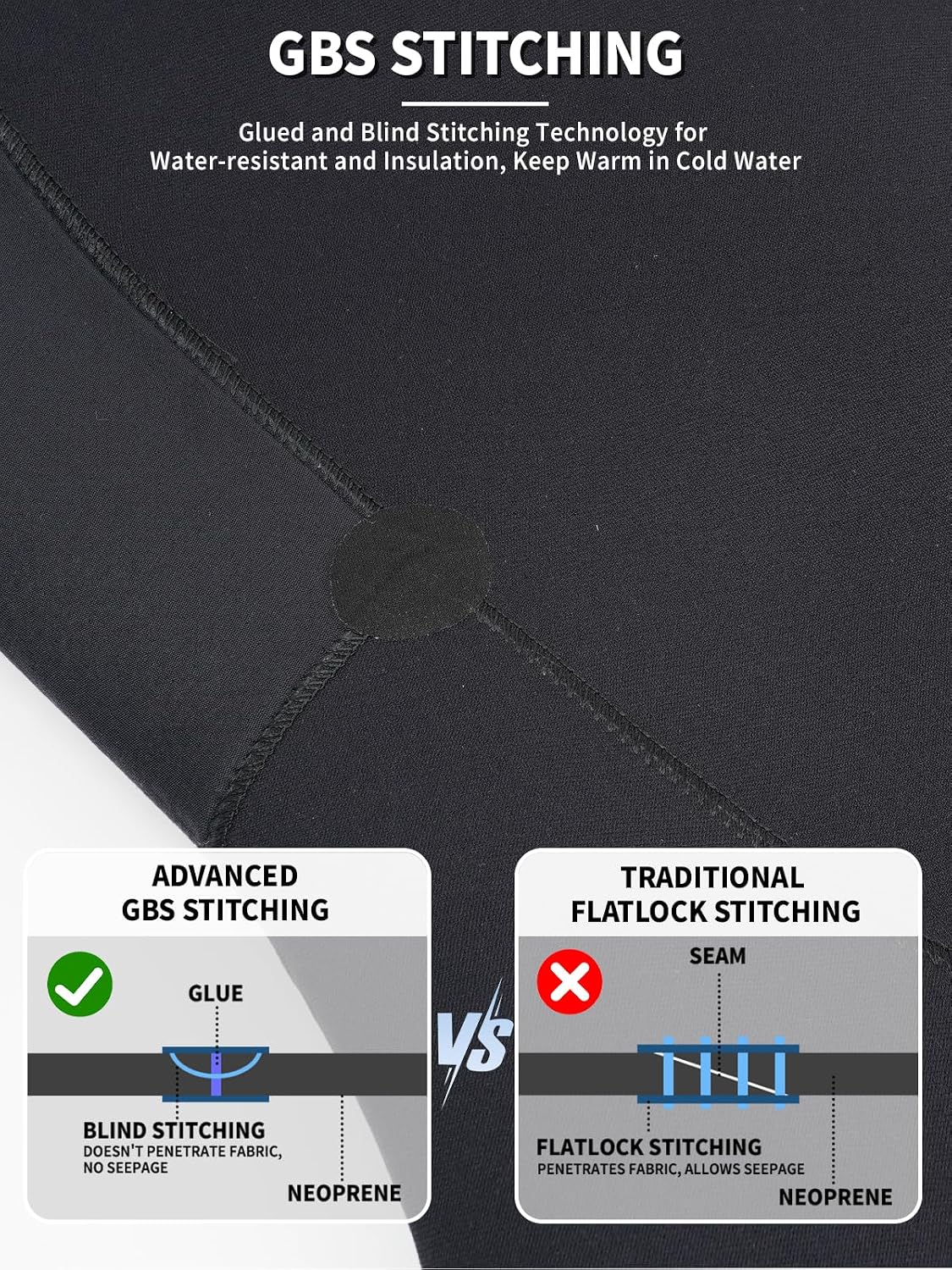
The Owntop uses GBS seams — glued-and-blind-stitched construction — which matters. GBS seams are bonded and then stitched in a way that doesn’t pierce all the way through the neoprene. That prevents water from wicking through the seam line itself. Per CleanLine Surf’s cold water wetsuit FAQ, GBS is the minimum construction standard worth considering for sustained cold-water surfing. Flatlock stitching, which you’ll find on cheaper spring suits and warm-water suits, punches through both layers and allows cold water in at every seam crossing. For December Atlantic sessions, that’s a meaningful difference in how fast you cool down.
One reviewer report is particularly useful for calibrating warmth expectations: a reviewer’s daughter remained comfortable during scuba diving in 68°F water in the Owntop 5mm. Writers at Wavelength Surf Magazine and CleanLine Surf consistently note that 68°F represents something like the warmth floor of a 5mm suit in low-exertion conditions — it’s where you stop needing it rather than where you start. Surfing generates far more heat than scuba diving, so in practice you should expect the suit to carry you through colder water during an active session. Present this as one reviewer’s real experience, not a guaranteed threshold for your conditions.
Fit, Sizing, and the Neck Tightness Question
Here is the most consistent fit issue across all cold-water suit reviews, budget or premium: the neck feels uncomfortably tight. This comes up in Owntop reviews, in feedback on Hevto suits, and in forum threads tracked by The Inertia’s cold-water coverage. First-time wearers frequently flag it as a defect or a sizing error.
It is not. It is by design.
The neck seal is the primary barrier against water flushing — the phenomenon where a wave impact drives cold water down the collar and flushes the warm water your body has already heated inside the suit. A loose neck defeats the entire warmth system. Boardcave’s wetsuit thickness guide specifically notes that neck fit is one of the most misread comfort issues in cold-water suits; what feels constrictive on land typically relaxes somewhat in the water and during movement, and the trade-off is a dry, warm torso for the duration of your session. If the neck genuinely cuts off circulation or causes pain after ten minutes in the water — not just mild tightness on land — that is worth addressing through sizing. But mild pressure on dry land is normal and intentional.
Owntop sizing runs notably close to body in the upper torso. One owner review from a muscular-build surfer at 5’6” and 145 lbs reported that size M cut off hand circulation — a sign of sleeve tension working its way down to the wrist — while size L worked correctly. That is a significant fit delta, and it is the most practically useful sizing data point in the entire Owntop review corpus. If you are muscular through the shoulders and arms, size up from the brand’s chart. If you are on the slimmer end of a size band, the chart may work as stated. When in doubt, size up.
The 5/4mm Budget Option and the Entry Question
The Hevto 4/3mm sits in a different temperature range — it’s the right suit for water in the low-to-mid 50s rather than the 40s — but its owner reviews surface one detail that transfers upward to any budget suit decision: ease of entry is consistently praised. For early-morning winter sessions when you’re parking on a cold beach and trying to get in the water before the wind picks up, a suit that goes on without a 10-minute wrestling match matters more than it sounds. Hevto’s back-zip design and cut get specific credit for this.
If you’re surfing Atlantic water in the 50–58°F range (spring and fall in much of the mid-Atlantic), the Hevto 4/3mm is a legitimate option. If you’re targeting December through February in New Jersey, New York, or north of Cape Cod, you need the 5mm.
Cold-Water Safety: The Leash Factor
One underserved angle in cold-water gear discussions is board retrieval speed. In 42°F water, a swim to your board after a wipeout is not just annoying — it is a real cold-water immersion risk. The coiled SUP leash (stand-up paddleboard leash, designed with a 360-degree swivel to prevent tangling) appears in cold-water gear reviews not because SUP and surfing are the same activity, but because owners specifically call out two features: the swivel prevents the leash from wrapping around your legs during a wipeout, and the key pocket gives you a secure place to store your car key on the beach. In winter conditions where fumbling for a key with cold hands is a genuine problem, that pocket is not a trivial convenience. Cold-water safety starts with not swimming.
Decision Framework: If X, Then Y
You’ve read the specs. Here’s how to use them.
If you surf Atlantic water December through February, run cold, or surf sessions over two hours: A 5mm uniform suit is your floor. Add a hood, 5mm boots, and 3mm gloves. The Owntop 5mm with GBS seams covers the warmth requirement at a price point that leaves budget for accessories.
If you’re muscular through the shoulders: Size up from the Owntop chart, full stop. One size up eliminated the circulation issue that a correctly-sized reviewer experienced.
If you want more paddle freedom and surf mostly October–November or March–April: A 5/4mm zoned suit is the better call — thinner limbs, same core warmth. The cost difference between a budget 5mm and a budget 5/4mm is usually minimal; the flex difference in the water is real.
If you’re comparing budget suits to premium ($$$) options: The gap is in seam durability over seasons, neoprene rebound (how well it recovers its shape and flex after repeated compression), and chest-zip or zipless entry systems. For occasional winter surfers or surfers building toward a premium suit in the next 12 months, a budget GBS-seam 5mm is a defensible bridge purchase. For surfers doing 2–3 sessions per week through a full Atlantic winter, the premium suit’s durability math may close the price gap faster than you’d expect.
Frequently Asked Questions
Is a 5mm wetsuit enough for Atlantic surfing in December and January, or do I need a 6mm? For most Atlantic conditions in that window, a 5mm paired with a hood, boots, and gloves is sufficient. Surfline’s temperature data puts mid-Atlantic water at 42–48°F in that period. A 6mm provides a margin of warmth but significantly reduces flex — most experienced cold-water surfers find 5mm with accessories outperforms a 6mm without them.
Why is the neck so tight on budget 5mm wetsuits — is it defective? It is intentional. The neck seal prevents water flushing — cold water being driven under the collar by wave impact. Per Boardcave’s wetsuit thickness guide, this is standard design across all cold-water suits, budget or premium. Mild tightness on land is normal.
Should I size up in the Owntop 5mm compared to the brand’s size chart? If you are muscular through the shoulders or upper arms, yes — owner reviews include a specific report of a size M cutting off hand circulation in a 5’6”, 145 lb muscular-build surfer while a size L fit correctly. When in doubt, size up.
What is the difference between a 5mm uniform wetsuit and a 5/4/3mm zoned wetsuit for surfing? A uniform 5mm uses the same thickness throughout. A zoned suit uses thicker panels through the core and thinner panels through the limbs. Zoned suits offer more paddle mobility; uniform suits offer slightly more total insulation. For the coldest Atlantic months, either works — the accessories (hood, gloves, boots) matter more than that distinction.
Do budget 5mm wetsuits use GBS seams and does it matter for Atlantic cold water? The Owntop 5mm uses GBS (glued-and-blind-stitched) seams. It matters: GBS prevents water from wicking through seam lines, which is the primary cold-water seam failure mode. Flatlock-stitched suits — common at lower price points — allow water ingress at every seam crossing. Per CleanLine Surf’s cold water wetsuit FAQ, GBS is the minimum standard worth considering for sustained cold-water surfing.
How long does a budget 5mm wetsuit last with weekly winter surfing? Owner reviews and Wavelength Surf Magazine’s buyers guide both point to one to two full seasons as a realistic expectation for budget suits under regular use. Seam integrity and neoprene rebound degrade faster than in premium suits. Rinsing in fresh water after every session and drying inside-out significantly extends life. A premium suit ($$$) in the Patagonia Yulex or Matuse category is built for three to five seasons of hard use — the math on cost-per-session favors premium if you’re surfing consistently.