You’ve got a quiver worth real money sitting in your garage. Maybe it’s leaning against a wall. Maybe it’s stacked on a towel. Maybe one of them already has a pressure ding where it kissed the concrete.
The gear that lives outside the water — board stands, day bags, balance trainers, traction pads — is the category most surfers underinvest in until something goes wrong. A warped longboard. A fin box cracked from a fall. A traction pad that peeled off mid-session. These aren’t freak accidents. They’re what happens when shore-side storage and transport get treated as afterthoughts.
This guide is built for intermediate surfers who already know their dimensions (length, width, volume in liters, tail shape — more on those as they come up) and are now ready to close the gaps in their setup. We’ll cover what to buy at each budget tier, name the tradeoffs, and give you a clear decision rule at each step.
| EDITOR'S PICKCreatures of Leisure Shortboard… | Mid-tierCurve *NEW* Surfboard Bag DAY S… | Budget pickCreatures of Leisure Icon Short… | |
|---|---|---|---|
| Fits board length | 5'8" | 5'6"–7'2" | — |
| Width | — | 21" | — |
| Color | Black/Silver | — | — |
| Gear type | Day bag | Day bag | Traction pad |
| Price | $160.00 | $51.50 | $47.00 |
| See on Amazon → | See on Amazon → | See on Amazon → |
Board Storage: What Your Quiver Actually Needs on Dry Land
Surfboards warp. Fins scratch floors. Dings compound. The enemy on dry land isn’t waves — it’s gravity, UV light, and heat.
The case for a real board stand
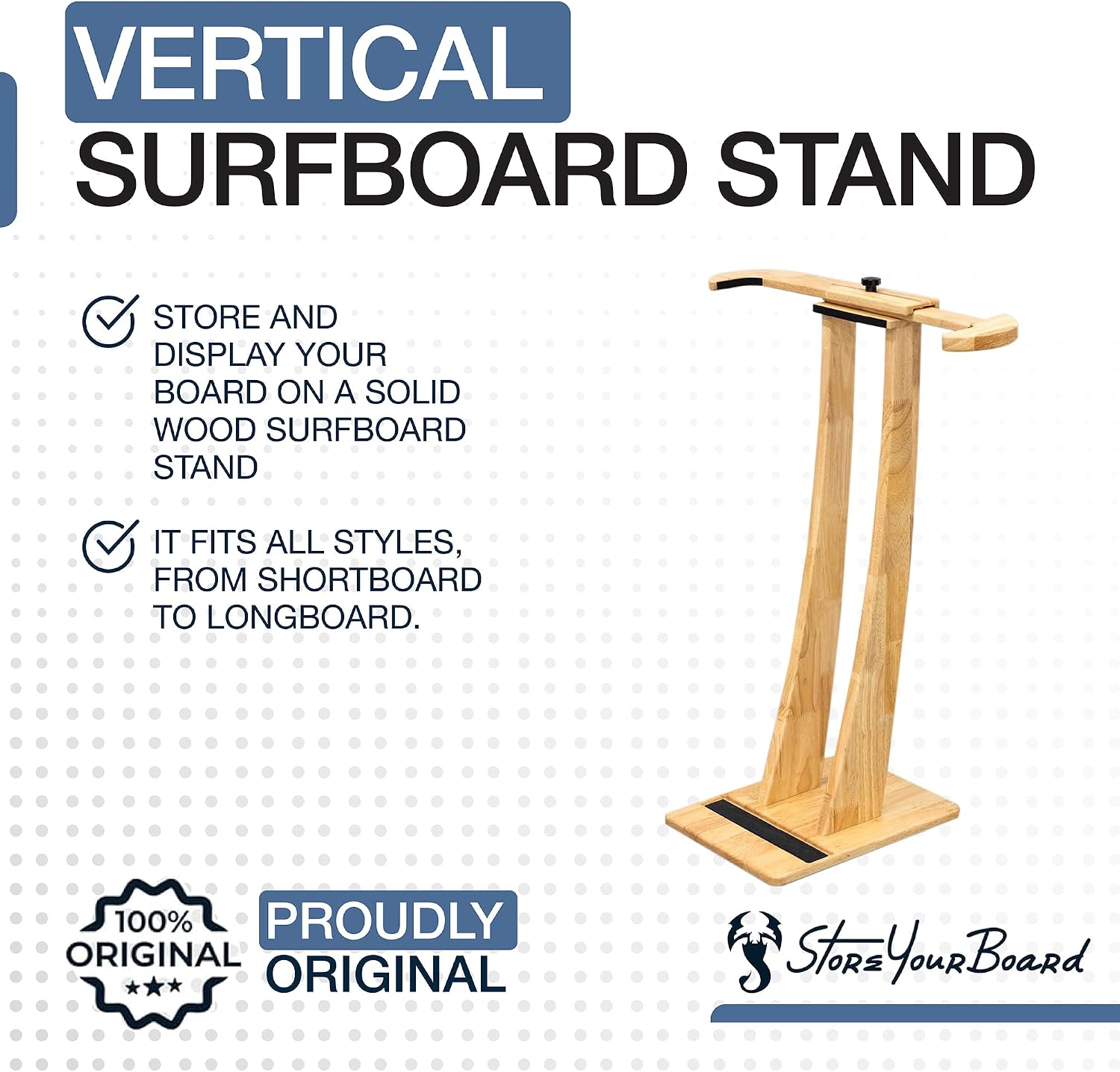
A freestanding board stand — the kind that holds a board vertically or at a slight lean, off the floor — solves two problems at once: it protects the rails and tail from contact damage, and it lets you actually see what you have. That second part matters more than people admit. A board you can see is a board you’ll grab.
The StoreYourBoard SurfStand has developed an outsized reputation in exactly this niche. Reviewers across aggregated buyer feedback keep returning to the same three words: “easy to assemble,” “real wood,” and “very sturdy.” The consistent theme is over-delivery — buyers expect a wobbly specialty accessory and get something that feels furniture-grade. That’s an over-delivery story worth taking seriously, especially if you’ve been skeptical of boutique surf accessories.
By the numbers — StoreYourBoard SurfStand:
- Assembly time reported by owners: ~2 minutes
- Boards supported: one vertically, or one at a display lean
- Material: solid wood with foam-padded contact points
- Price tier: $ (under $60 in most market windows)
Does it fit both shortboards and longboards? Yes — the stand’s contact geometry accommodates boards from around 5’6” shortboards (roughly 27–33 liters of volume, which is a measure of how much float a board has) up through 9’6”+ longboards. The limiting factor is floor space, not the stand’s clamp width. If you’re storing multiple boards, you’ll want a wall-mounted rack system for volume storage and a SurfStand as a display piece for your daily driver.
Wall racks for multi-board quivers
If you’re running three or more boards — common for Atlantic surfers chasing everything from beach break slop to clean point conditions — a horizontal wall rack is the efficient answer. Look for foam-padded arms, adequate spacing (minimum 6 inches between boards to prevent fin-on-rail contact), and weight ratings that account for your heaviest boards. A 9’0” longboard can run 7–9 lbs dry. A performance shortboard sits at 5–6 lbs. Wall ratings degrade over time with repeated load cycling; buy with margin.
Stab Magazine’s storage guide (2024) notes that heat and sustained pressure are the two most common causes of board warping in home storage — which means avoiding garage walls with afternoon sun exposure and never stacking boards flat with weight on top.
Day Bags: Protecting Your Board on the Drive and the Beach Walk
A day bag — a padded sleeve for a single board, not the hard-sided case used for air travel — is the most-used piece of protection gear most surfers own and the most commonly undersized.
The Curve Supermodel day bag: order by your board length, not the bag’s label
The Curve Supermodel has a documented quirk that reviewers consistently flag as a positive: it runs meaningfully longer than its labeled size. A bag listed at 6’0” regularly fits boards closer to 6’4”. This is not a defect — it’s a fit buffer that gives you room for nose and tail guards. But it means you should order based on your actual board length, not the bag’s stated size. If your shortboard is 6’2” (a typical performance shortboard — think narrow nose, pulled-in swallow or round tail, around 30–36 liters depending on your volume target), order the 6’0” Curve and it will fit correctly. Cleanline Surf’s board bag sizing guide (2025) notes this same sizing behavior for the Curve range and recommends measuring from tip to tail before ordering any Curve product.
Price tier: $ to $$ depending on length. The Curve sits in the budget-to-mid range and performs above its price point on foil bubble insulation.
The Creatures of Leisure Shortboard Day Use bag: the sleeper pick
If you’ve been treating day bags as a commodity, the Creatures of Leisure Shortboard Day Use bag is the product that changes that framing. Across aggregated reviews, it carries a perfect 5-star rating — a rare signal in a category where complaints about zipper failure and foam compression are common. One buyer explicitly called it “the best board bag in my experience” and cited build quality as the differentiator. That’s not marketing language — that’s someone who owns multiple bags and made a comparison.
The Creatures of Leisure bag runs at a higher price point than the Curve. The tradeoff is simple: if you’re transporting a board worth $700–$1,100 (a performance shortboard from Channel Islands or JS Industries, for example), the cost-per-use math strongly favors the better bag. Protecting a $900 board with a $30 sleeve is poor risk management. The Creatures bag is our pick for surfers with boards in the mid-to-premium tier.
Day bag vs. travel coffin case: when each makes sense
A day bag is a padded fabric sleeve. A travel coffin (or travel coffin case) is a rigid or semi-rigid multi-board case designed for airline transport — it typically holds two to four boards with fins removed, padded between layers of foam.
Wavelength Surf Magazine’s 2024 feature on Atlantic trip planning draws the line clearly: a day bag for anything you’re driving to; a coffin case for any trip involving a plane. Day bags offer zero protection from the compression forces of airline baggage handling. If you’re flying to the Azores, Ireland, or Morocco — all within Atlantic surfing range — a coffin case isn’t optional. Day bags are for parking lots and beach walks.
Dry-Land Training: What Actually Works, and What to Tell Skeptics
Dry-land training for surfing has a credibility problem. Wax-on, wax-off pop-up drills on a foam mat are one thing. But tools that actually simulate the unstable rotational feel of a surfboard underfoot are another category entirely.
The RipSurf: more useful than it looks, especially if you already skate
The RipSurf is a caster board — two platforms connected by a flexible spine, designed to be ridden with a pumping hip motion that mimics the rail-to-rail loading of surfing. The skepticism is understandable: it looks like a toy.
But reviewer patterns across aggregated feedback reveal a nuance worth surfacing. One reviewer with a skateboarding background noted the RipSurf was easier to ride than a Ripstik — a similar caster board — because of its wider stance and more predictable torsion response. The Inertia’s 2023 piece on dry-land surf training makes the same underlying point: surfers who already have developed proprioception (the body’s sense of its own position and balance) will get more out of tools like this than complete beginners, because they have existing movement patterns to refine rather than starting from zero.
The practical framing: if you’re an intermediate surfer with 6–24 months of consistent water time, you already have board feel. The RipSurf gives you a way to drill the pumping hip extension that generates rail-to-rail speed on a wave — without needing a wave. That’s not a toy. That’s a conditioning tool.
Price tier: $ (under $80 in current market conditions). For surfers who are skeptical, the low entry cost removes the risk of the decision.
Traction Pads: The Shore-Side Prep That Determines In-Water Performance
A traction pad — the textured grip pad stuck to the tail of your board where your back foot lands — is the one piece of shore-side gear that directly determines in-water performance. Get the installation wrong, and the wave will find out for you.
The Billabong Contour foamie has generated a teachable moment in buyer reviews: multiple owners flagged traction pad delamination during surf sessions, often within weeks of purchase. Surfer Magazine’s 2022 piece on traction pad failures identifies the two most common causes: surface contamination at installation (wax residue, sunscreen oils, or moisture) and insufficient cure time before water exposure.
How to prevent a traction pad from coming off:
- Sand the tail area lightly with 60-grit sandpaper before installation — even on a new board
- Wipe down with isopropyl alcohol (70% or higher) and let it dry fully — 10 to 15 minutes minimum
- Apply the pad in one confident placement — repositioning breaks the adhesive bond
- Press firmly across the entire pad surface, especially edges
- Wait at least 24 hours before surf exposure; 48 hours if your garage runs cold (adhesive cures slower in low temperatures)
This process applies whether you’re padding a learner foam board or a custom Pyzel Ghost with a pulled-in pin tail.
Frequently Asked Questions
Does the StoreYourBoard SurfStand fit both shortboards and longboards? Yes. Owners report it accommodates boards from compact shortboards up through nose-riders and traditional longboards. The stand’s padded arms adjust to board width, and the base footprint is small enough for most garages.
Does the Curve Supermodel day bag really run longer than labeled? Consistently, yes. Reviewers and Cleanline Surf’s sizing guide both confirm this. Order based on your actual board length and expect the bag to fit boards two to four inches longer than its labeled size. This is a feature, not a defect — it creates a safe margin at nose and tail.
Is the RipSurf actually useful for surf training or just a toy? It’s a legitimate training tool for surfers who already have water time. If you have 6+ months of surfing experience, you’ll recognize and refine the pumping motion it demands. Complete beginners will likely find it frustrating without existing board-feel reference points.
How do I prevent a traction pad from coming off in the water? Surface prep is everything: sand lightly, clean with isopropyl alcohol, press firmly in one placement, and wait 24–48 hours before your next session. Skipping any of these steps significantly increases delamination risk.
What is the difference between a day bag and a travel coffin case for Atlantic trips? A day bag is a padded sleeve for car transport and beach-to-parking-lot protection. A travel coffin case is a hard-sided or rigid multi-board container for airline travel. If you’re flying anywhere — including Atlantic surf destinations like the Azores, Ireland, or the Canaries — you need a coffin case. A day bag will not protect your board from airline baggage handling.
Is the Creatures of Leisure Shortboard Day Use bag worth the price over a budget day bag? For boards valued at $700 and above, yes — clearly. The cost-per-use math favors the better bag by a wide margin when the asset being protected is a high-performance shortboard. The Creatures of Leisure bag has the review track record to justify the premium. The Curve Supermodel is the right call for learner boards and budget quivers.
The decision rule:
If your board is worth less than $400, the Curve Supermodel day bag and a SurfStand for display covers your shore-side setup. If your board clears $700, step up to the Creatures of Leisure day bag, invest in proper traction pad installation, and treat the RipSurf as a serious off-season conditioning tool — not an impulse purchase. In both cases, the shore-side gear is a small investment relative to the board it protects. The surfers who skip it are the ones with the pressure dings.