You’re standing at the register — metaphorically — about to spend $120 on a set of FCS II Reactor Neo Carbon fins (fins are the removable blades that plug into slots on the underside of your surfboard and control how it turns, holds, and releases through a wave). Your gut says that’s a lot for something you’ll probably ding on a rock eventually. Your buddy says he’s been riding a $25 set of fiberglass fins from an online retailer for six months and can’t tell the difference. One of you is right. This article figures out which one.
We’ve gone through aggregated owner review data — hundreds of sessions worth of reported experience — on three budget fin brands: Ho Stevie, BPS, and Honeycomb Fiberglass. We compare them directly to FCS II and Futures branded sets in the $120–$200 range. By the end, you’ll have a clear decision rule: when budget fins are the smart call, when they’ll cost you more than they save, and which specific fit risks to watch for before you order.
| EDITOR'S PICK[Ho Stevie! Quad (4) Surfboard F…](https://www.amazon.com/dp/B08275WBJP?tag=greenflower20-20) | Mid-tier[Honeycomb Fiberglass Performanc…](https://www.amazon.com/dp/B0C3BZP2MD?tag=greenflower20-20) | Budget pick[Ho Stevie! FRP Thruster (3) Sur…](https://www.amazon.com/dp/B01BPJ0TB4?tag=greenflower20-20) | |
|---|---|---|---|
| Fin count | 4 | 3 | 3 |
| Material | HexCore | Fiberglass | FRP |
| Case included | ✓ | — | ✓ |
| Wax comb incl. | ✓ | — | ✓ |
| Fin key incl. | ✓ | — | ✓ |
| Base type | Single Tab | Futures Single Tab | Single Tab |
| Price | $64.97 | $42.34 | $24.97 |
| See on Amazon → | See on Amazon → | See on Amazon → |
The Fin System Question You Must Answer First
Before any brand comparison, one non-negotiable: fin system compatibility.
There are two dominant fin box systems in use today:
- FCS II — a two-tab click-in system requiring no screws. Most boards made after 2013 from Channel Islands, JS Industries, and Pyzel use this system.
- Futures — a single-tab, single-screw system. Common on Lost surfboards, many Firewire builds, and a significant portion of the broader market.
These systems are not interchangeable. A Futures fin will not fit an FCS II box, and vice versa. Every brand reviewed below — Ho Stevie, BPS, and Honeycomb — offers fins in both systems, but you must confirm your box type before purchasing. If your board predates 2013 or is a custom shape, you may have the original FCS plug system, which uses two individual plugs and requires a screw. That is a third format entirely.
Check the slot on your board. FCS II looks like a rectangular keyhole. Futures is a long single channel with a screw hole at the front. Get this right before anything else.
Head-to-Head: Three Budget Brands Compared
Ho Stevie FRP Thruster Set
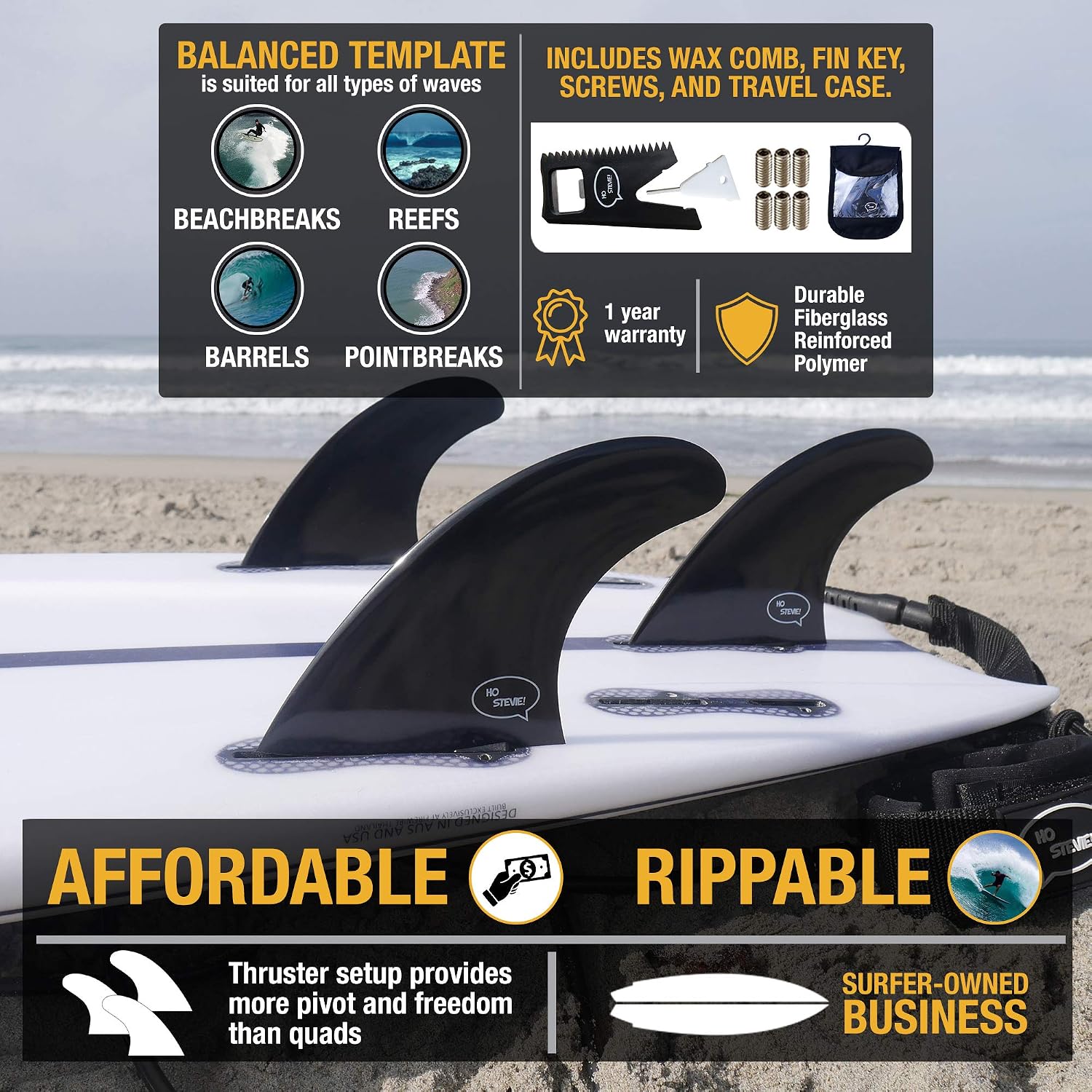
Ho Stevie is the most-cited budget fin brand in aggregated owner review data, and their fiberglass-reinforced polymer (FRP) thruster set is the flagship product. FRP means the fin is built from woven glass fibers set in a resin matrix — the same core material used in mid-range branded fins, without the premium layup refinements that justify higher prices.
What owners consistently report: Performance claims from Ho Stevie buyers are unusually credible because several reviewers came in with high reference points. In one documented case, a surfer who lost a set of premium Futures fins bought Ho Stevie as a stopgap for a repaired shortboard. Their report was that the performance difference was real but smaller than the price gap would suggest — particularly in everyday beach break conditions below head-high. Another reviewer cross-referenced Ho Stevie sizing against FCS G3000 and G5 templates, noting close dimensional alignment. Template dimensions — base width, depth, and rake angle — drive most of a fin’s real-world feel, so that alignment matters more than brand name alone.
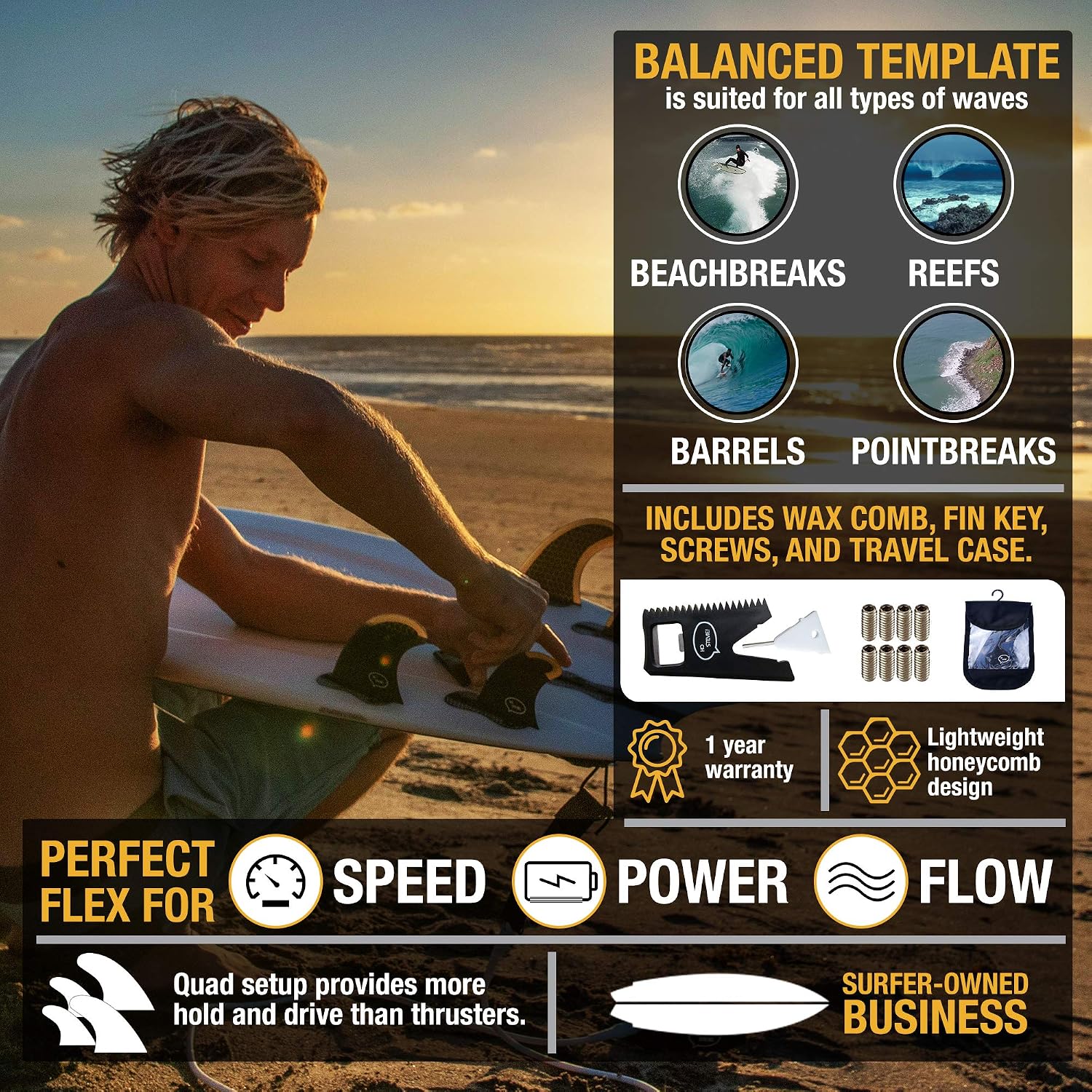
The quad fit caveat — don’t skip this: If you’re buying the Ho Stevie quad set rather than the thruster, there is a documented fit issue to know about. Multiple reviewers report having to sand the rear fin bases to fit FCS II rear slots, which run slightly tighter than front slots. One reviewer described removing several millimeters from the base tab to achieve a clean fit. Sanding is safe if done carefully — use 120-grit sandpaper, work in small passes, and test-fit frequently. The risk is removing too much material and creating a loose fit that causes fin rattle. This is a known friction cost, not a rare defect you’ll likely escape. Factor in the prep time if you’re sourcing fins for a surf school quiver where downtime matters.
Compatibility: Available in FCS II and Futures. Thruster sets seat cleanly in the large majority of owner reports. Quad rear fins in FCS II boxes are where modification is most commonly needed.
Ho
$24.97
In stock on Amazon
Check price on AmazonBPS Fins: The Customer Service Differentiator
BPS (Best Performance Surfboards) produces budget fiberglass fins that occupy roughly the same performance bracket as Ho Stevie. The fins themselves don’t generate dramatically different performance reporting. What makes BPS stand out is the ownership experience.
In the review record, BPS has generated documented cases of the brand owner personally following up with customers by email on the day fins arrived, confirming satisfaction. For a sub-$30 fin set, that level of responsiveness is genuinely uncommon. Wavelength Surf Magazine, in their budget gear coverage, has noted that budget surf brands frequently earn loyalty not on product alone but on responsiveness — and BPS fits that pattern precisely.
Who this matters for most: Surf school operators and coaches buying in volume. If you’re sourcing eight to ten sets at a time for a learner quiver, you want a brand with a visible customer contact layer when a defective tab or missing fin shows up in a shipment. BPS’s responsiveness record makes them a lower-risk bulk purchase than brands that offer no accessible support.
Compatibility: Available in FCS II and Futures. Owner reports do not flag the same rear-slot fit issues documented with Ho Stevie quads. Thruster sets appear to seat cleanly across board types.
Ho
$24.97
In stock on Amazon
Check price on AmazonHoneycomb Fiberglass Fins: The Durability Argument
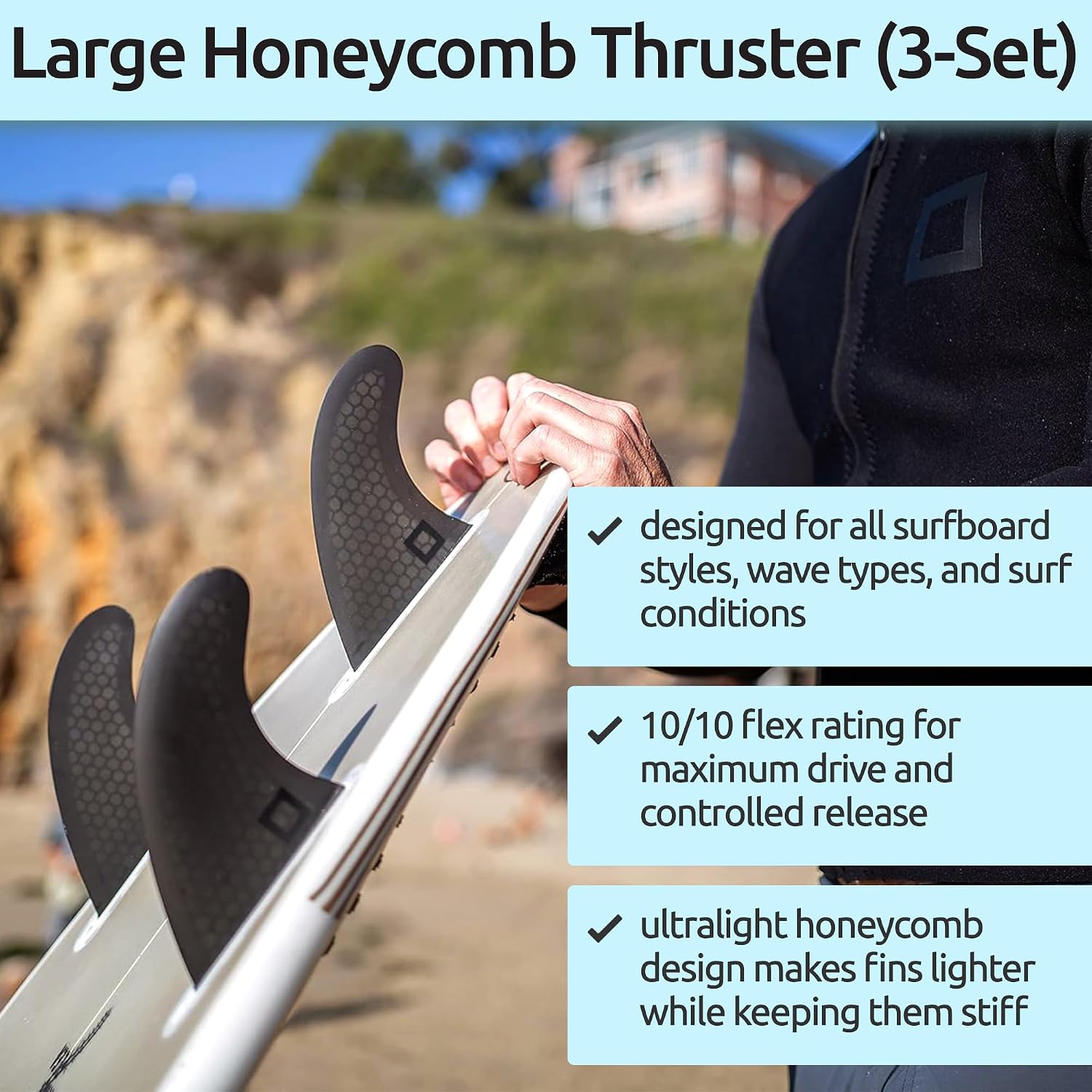
Honeycomb fins approach the budget category from a different angle. Owners consistently highlight two things: fin wall thickness that owners compare favorably to higher-priced competitors, and durability through sustained hard use.
Thickness matters because it affects stiffness distribution through the blade. A fin that is too thin flexes unpredictably under load — particularly in faster, steeper waves. The Inertia, in their editorial coverage of fin construction titled “The Real Difference Between Cheap and Expensive Surfboard Fins,” noted that budget polymer fins often reduce thickness to cut weight and cost, producing the “washy” feel experienced surfers associate with cheap fins. Honeycomb’s reviewers specifically call out that the fin walls feel comparable to mid-range branded sets — an uncommon claim at this price point.
The travel consumable strategy: One notable pattern in Honeycomb’s review data involves pre-trip bulk buying. A documented buyer purchased five to six sets before a multi-week international trip. The logic was explicit: rather than traveling with a $200 fin set and managing the anxiety of losing it to reef, rocks, or airline baggage, the buyer committed to treating fins as consumables for the trip. At $28–$35 per set, six sets costs less than one premium set. This is a legitimate risk-management decision, not a compromise — particularly for destinations with heavy reef exposure or unreliable logistics.
Compatibility: Available in FCS II and Futures. No consistent fit modification reports from owners across either box type.
Ho
$24.97
In stock on Amazon
Check price on AmazonThe Premium Tier: When $120–$200 Earns Its Price
FCS II Reactor Neo Carbon and Futures Branded Sets
Premium branded fins from FCS II and Futures occupy a different performance bracket, and the gap is real — it just isn’t always relevant to the conditions you’re actually surfing.
Carbon construction in fins like the FCS II Reactor Neo Carbon delivers a stiffer, more responsive flex pattern than fiberglass. Boardcave, in their editorial guide “Fin Flex Ratings and What They Mean for Your Surfing,” explains that carbon layup quality controls how precisely load transfers through the blade under a committed bottom turn or cutback — and that inconsistency in carbon layup is where budget carbon fins typically fall short. Premium branded sets have validated, consistent layups. That consistency translates to predictable hold and snap response in critical sections.
Who benefits most: Surfers on performance shortboards pushing into overhead surf, competition surfers, and anyone surfing heavy reef where fin hold has safety implications. Surfer Magazine, in their fin buyer’s guide “How Fins Shape Your Wave: A Buyer’s Guide to Templates and Flex,” consistently notes that stiff carbon fins reward surfers who can load them deliberately — meaning you need the technique to feel the difference. If you’re still building precision, you may not unlock what a $150 carbon set offers.
Fit note: Both FCS II and Futures branded sets are engineered for their respective box systems and seat without modification.
Ho
$64.97
In stock on Amazon
Check price on AmazonWhat ‘Moderate Flex’ Actually Means in Atlantic Beach Break
Most budget fiberglass fins are marketed as “moderate flex.” Here is what that means in practice for the wave conditions most Atlantic surfers are actually riding.
Flex in a fin describes how much the blade bends under load when you drive off a bottom turn or compress through a cutback. High flex loads and releases energy — it feels lively but can feel loose at speed. Stiff fins deliver immediate, direct response and hold a line in powerful surf. Moderate flex sits between: it forgives imprecise footwork (useful for intermediate surfers still dialing in timing) but does not deliver the snap response of a carbon fin under a precise, committed turn.
Surfer Magazine’s fin buyer coverage has consistently noted that high-flex fins perform best in weaker, slower waves where surfers need help generating speed, while stiff carbon fins reward deliberate loading. For Atlantic beach break — typically punchy, fast-breaking, and inconsistent — moderate flex is a reasonable match at the intermediate level. If you’re surfing Outer Banks beach break or mid-Atlantic shore pound, a moderate-flex budget fin will not hold you back the way it might in overhead reef surf.
Honeycomb
$42.34
In stock on Amazon
Check price on AmazonAt-a-Glance Comparison
| Brand | Material | Price Tier | Fit Notes | Best Use Case |
|---|---|---|---|---|
| Ho Stevie FRP Thruster | Fiberglass | ~$25–30 | Clean thruster fit; quad rears may need sanding | Everyday beach break, backup set |
| BPS Thruster | Fiberglass | ~$20–28 | Clean fit reported | Volume buyers, school quivers |
| Honeycomb Fiberglass | Fiberglass | ~$28–35 | Clean fit reported | Travel, reef exposure, consumable use |
| FCS II Reactor Neo Carbon | Carbon fiber | $120–$200 | Plug-and-play FCS II | Performance shortboard, competition |
| Futures branded sets | Various | $60–$180 | Futures-specific | Mid to high-performance boards |
A Note on Budget Carbon Fins
One budget carbon fin set — the UPSURF carbon thruster — appears in the same search results as the brands above. Carbon construction theoretically offers stiffer, more responsive flex than fiberglass. However, as Boardcave’s fin buyer guides note, carbon layup quality varies enormously at the budget end, and without sufficient owner data to validate performance claims, budget carbon fins represent an unknown quantity. As of mid-2026, UPSURF has too thin a review record to establish a reliable pattern. Skip it until the data deepens.
Frequently Asked Questions
Do budget fiberglass fins actually perform comparably to FCS or Futures branded fins in real surf? For most recreational and intermediate surfers in everyday conditions, the performance gap is real but smaller than the price gap. Owners who came in with premium Futures sets report a noticeable but not disqualifying difference in snappy response and hold in critical sections. In small-to-medium beach break, the gap shrinks further. At elite performance levels — competition surfing, heavy reef, powerful overhead surf — branded fins earn their price.
Will Ho Stevie fins fit my FCS II or Futures boxes without modification? Ho Stevie thruster sets fit FCS II and Futures boxes without modification in the large majority of owner reports. The documented exception is the quad rear fins in FCS II boxes — those may require sanding the base tab for a clean fit. Confirm your fin system before buying.
Is it worth buying multiple sets of cheap fins instead of one premium set? For travel to reef-heavy or logistically unpredictable destinations, yes — the math is legitimate. Five sets of $30 fins covers the same dollar spend as one premium set, with no anxiety about loss or damage. For your home quiver where fins stay in your board between sessions, one well-chosen mid-range set is probably more practical.
What does moderate flex mean in practice for Atlantic beach break? Moderate flex means the fin blade bends under loading, absorbs imprecise inputs, and releases energy progressively. In Atlantic beach break — punchy, fast, variable — it matches the demands of intermediate surfing well. It will not hold you back at that level.
Do I need to sand budget fins to fit my boxes, and is that safe? Only Ho Stevie quad rear fins show a documented pattern of needing sanding. The process is safe if done carefully — 120-grit sandpaper, small passes, frequent test-fits. The risk is removing too much material and creating a loose, rattling fit. It is manageable, but factor in the time if you are buying for a school quiver.
The Decision Rule
If you are an intermediate surfer riding beach break regularly and losing fins to rocks, reef, or airline baggage: buy budget fiberglass, buy in multiples, and don’t look back. Ho Stevie for trusted fit data across a large owner sample, BPS if you value brand responsiveness and purchase in volume, Honeycomb if durability and travel logistics are your primary concern.
If you are on a performance shortboard pushing into overhead surf, competing, or surfing reef where fin hold is a safety factor: the $120–$200 set earns its price. FCS II Reactor Neo Carbon or a comparable Futures set delivers the stiffness, precision, and consistency that budget fiberglass fins do not fully replicate.
Confirm your fin system. Pick the bracket that fits your conditions. Get in the water.