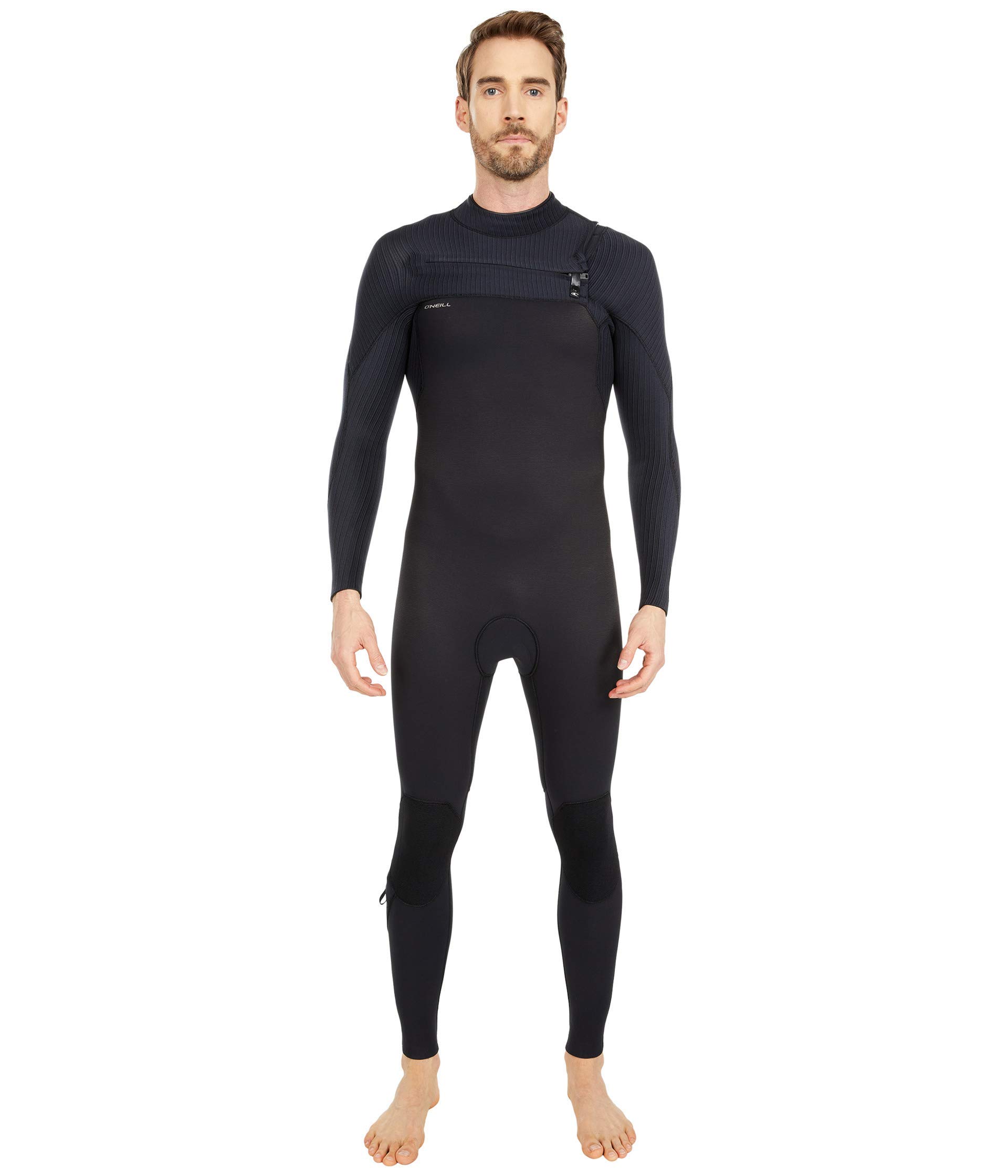
You’re standing in a cold car park somewhere on the mid-Atlantic coast — New Jersey, Delaware, the Outer Banks — and the water temperature app says 57°F. Your current wetsuit is a 4/3 back-zip that’s been reliable but stiff. Your paddling suffers for it. You’ve heard that a chest-zip suit — one where the entry zipper runs horizontally across your chest rather than down your spine — flushes less cold water and moves more freely. But you’re not sure if the upgrade is real or just marketing language.
That’s the exact decision this article is built to answer. A wetsuit’s thickness (written as mm, e.g., “3/2” means 3mm of neoprene over your core and 2mm over your limbs) determines warmth. The zip system determines how much cold water flushes through the suit when a wave hits you, and how freely your shoulders rotate when you paddle. Both matter enormously on Atlantic breaks, where water sits in the low-to-mid 50s°F through winter and climbs only to the low 60s°F by late spring in many regions. We’ve compiled published specs, aggregated owner reviews, and data from cold-water users to give you a clear comparison of two O’Neill Hyperfreak models — and to tell you exactly when each one is the right call.
| EDITOR'S PICKO'Neill Hyperfreak 4/3 mm Chest… | Mid-tierO'NEILL Hyperfreak 3/2+mm Chest… | Budget pickO'Neill Men's Reactor-2 3:2mm B… | |
|---|---|---|---|
| Thickness | 4/3 mm | 3/2+ mm | 3:2 mm |
| Zip | Chest | Chest | Back |
| Size | Large | XLS | Large |
| Gender | — | Men's | Men's |
| Price | $419.95 | $399.95 | $154.95 |
| See on Amazon → | See on Amazon → | See on Amazon → |
What the Chest-Zip Design Actually Does (and Why It Matters for Atlantic Surf)
A back-zip wetsuit has a long zipper running from the base of your neck to the middle of your back. It’s easy to get into, but that zipper creates a gap. Every duck dive — when you push your board under an oncoming wave — forces cold water in through that opening. On a beach break with high-frequency wave sets, you’re flushing that gap repeatedly. The result is a suit that’s never as warm as its thickness rating suggests.
A chest-zip suit has no zipper on your spine. Instead, a short zipper crosses your chest, hidden under a neoprene flap. To get in, you pull the suit over your body from the bottom up and fold down a latex-sealed neck entry. When it’s closed, the seal across your chest and neck is close to waterproof. Per Surfer Magazine’s chest-zip vs back-zip comparison feature, riders consistently report noticeably less water flushing in chest-zip designs — particularly important in the powerful, punchy surf common to Atlantic beach breaks and reef setups.
There’s a second benefit: shoulder mobility. A back zipper physically restricts how far your shoulder blade can rotate during paddling. Remove that zipper from the equation and you recover range of motion. Owners of the Hyperfreak across review aggregates on Cleanline Surf cite arm mobility as the single most consistent reason they switched — and the single biggest reason they stayed.
The tradeoff is time. Chest-zip suits take longer to put on and take off, especially solo. We’ll address that in the FAQ below.
O’Neill Hyperfreak 3/2+: The Performance Case for Shoulder-Season Atlantic Surfing
The spec baseline:
| Spec | Detail |
|---|---|
| Thickness | 3mm chest/core, 2mm limbs (+ thermal lining panels) |
| Zip type | Chest zip, latex neck seal |
| Water temp range | 60–68°F (manufacturer-rated) |
| Price tier | $$$ |
| Eco material | Hyperfreak neoprene (petroleum-based, but closed-cell ultra-stretch compound) |
The 3/2+ designation means there’s an additional thermal lining layer over the core panels beyond what a standard 3/2 offers — O’Neill builds the ”+” in warmth without adding raw neoprene thickness that would compromise flex. Wavelength Surf Magazine’s 2025 buyer’s guide flags this construction approach as one of the more effective ways manufacturers are adding warmth without sacrificing the suit’s stretch ratio.
The honest warmth question for Atlantic surfing: The manufacturer rates this suit for 60–68°F water. That puts the Atlantic coast in marginal territory from October through May in most regions — and firmly cold in New England, where water can sit in the low 50s°F through June. If your Atlantic sessions run in the 55–60°F window, is the 3/2+ enough?
Owner data from review aggregates tells a nuanced story. A reviewer documented on Cleanline Surf describes using the Hyperfreak specifically in 45–55°F cave water — an unusual environment, but one that gives precise temperature data with no wave-generated body heat to inflate results. This person, an Indiana cave explorer who wears the suit for extended cold-water immersion, praises its flexibility above its warmth, which is the exact opposite of what you’d expect from someone operating below the manufacturer’s rated range. What this tells us: the Hyperfreak 3/2+ performs as an elite flexibility suit first, with warmth that’s respectable but not class-leading at the cold edge. For Atlantic surfers regularly seeing 55–60°F water, this suit is viable with strong paddling output — but if you run cold, or you’re logging long sessions with extended sits between sets, you’ll want to read the 4/3 section closely.
Sizing note: Owners at Cleanline Surf and across other retail review sources consistently flag the Hyperfreak as running small. A lean reviewer at 160 lbs, 5’9”, ordered a Large on the 4/3 and reports a perfect fit — someone that build would typically expect a Medium in looser garments. Size up at least one size from your normal clothing size. O’Neill’s own fit chart tends to be optimistic; trust the owner reports.
O’Neill Hyperfreak 4/3: The Cold-Atlantic Workhorse
The spec baseline:
| Spec | Detail |
|---|---|
| Thickness | 4mm chest/core, 3mm limbs |
| Zip type | Chest zip, latex neck seal |
| Water temp range | 52–61°F (manufacturer-rated) |
| Price tier | $$$ |
| Eco material | Hyperfreak neoprene compound |
The 4/3 is where most committed Atlantic surfers from New Jersey northward spend the majority of their season — roughly October through late April depending on latitude. The extra millimeter of core neoprene makes a meaningful difference in sustained warmth without the bulk of a traditional 5/4.
What the 40-year O’Neill user tells you: A reviewer with four decades of O’Neill experience, noted in aggregated sources at Cleanline Surf, endorses this suit directly — a short review, but notable for its source. When someone who has tracked a brand’s quality arc across that time span calls the product out positively, it carries weight. O’Neill’s Hyperfreak line represents their current performance pinnacle, and experienced surfers who remember earlier O’Neill technology note the flex improvement as generational.
The flexibility comparison against competitors: Reviewers who switched to the Hyperfreak from Patagonia’s Yulex suits — a legitimate high-end comparison point, given the Yulex’s reputation for premium eco-construction — report switching after perceived quality decline in the Patagonia product, and specifically cite arm mobility as the Hyperfreak’s winning attribute. Per The Inertia’s eco-wetsuit materials overview, Patagonia’s Yulex (natural rubber neoprene alternative) offers strong warmth and sustainability credentials, but owners in aggregated reviews increasingly flag that flex performance in the Hyperfreak’s neoprene compound outperforms it in the shoulder area. If paddling endurance and shoulder fatigue are pain points for you, the Hyperfreak 4/3’s flex advantage is real and documented by owners, not just spec-sheet language.
Sizing in the 4/3: The same size-up guidance applies. The 4/3 runs small. The 160 lbs / 5’9” owner example above was specifically on this model — Large was correct. If you’re on the heavier or broader-chested end, Boardcave’s wetsuit fit guide recommends prioritizing chest and shoulder measurement over height when selecting O’Neill suits, because the Hyperfreak is cut athletic.
O’Neill Epic 4/3: The Value Benchmark (and Why It Matters for Comparison)
The Hyperfreak doesn’t exist in a vacuum. O’Neill’s own Epic 4/3 — a back-zip suit in a lower price tier ($$) — is the most common comparison point, and it’s worth naming directly.
Owner data from the Epic is genuinely impressive on warmth. One owner at 6’0”, 230 lbs, ordered an XXL and reports that 50–55°F water felt like he “couldn’t even tell he was in the water.” Another Epic owner documents using the suit from 65°F down to the mid-50s without additional layering. These are strong warmth numbers for the price tier.
The tradeoff is flex. Across aggregated reviews, the pattern is clear: the Epic warms better per dollar, the Hyperfreak moves better per session. Per Boardcave’s thickness and temperature guide, a back-zip 4/3 at this quality level will keep most surfers warm through the mid-Atlantic winter — but it will tax your shoulder endurance on long paddle sessions or overhead surf. The chest-zip Hyperfreak costs more and requires more effort to put on, but repays that investment in sessions where you’re paddling hard.
If X, then Y decision rule:
- If you surf 2–3× per week on Atlantic beach breaks with water temps consistently at or above 55°F, and paddling endurance is a limiting factor → Hyperfreak 3/2+ or 4/3, size up one.
- If you surf 1–2× per week, prioritize warmth over flex, and are working within a tighter budget → Epic 4/3, size up one.
- If you’re below 55°F regularly and logging 2+ hour sessions → Hyperfreak 4/3 minimum; consider a hood.
Frequently Asked Questions
Is the O’Neill Hyperfreak noticeably more flexible than the Epic for paddling?
Yes, measurably so. The Hyperfreak uses a different neoprene compound with a higher stretch ratio across the shoulder panels, and the chest-zip entry removes the spine zipper that physically constrains shoulder blade rotation. Owners in aggregated reviews consistently describe the difference as “night and day” specifically on paddle-out. If you surf punchy beach break that requires repeated duck-diving and hard paddling, this gap is meaningful.
Does a chest-zip wetsuit keep out more water than a back-zip in Atlantic surf?
Yes. The chest-zip seal — when properly fitted — eliminates the primary flushing point of a back-zip: the long spine zipper. Surfer Magazine’s comparison feature notes this is especially relevant in surf with frequent duck-diving. The neck seal on the Hyperfreak is latex, which creates a near-waterproof closure. You will feel less cold-water flushing, which translates to longer comfortable sessions in borderline temperatures.
Is the Hyperfreak 3/2 warm enough for Atlantic water in the 55–60°F range?
Marginally, depending on your body and output. The unusual cold-water data point from a cave diver using the suit in 45–55°F conditions suggests the suit can perform below its manufacturer rating when the wearer is active. But that same reviewer praises flex over warmth — meaning you’re relying on paddling output to generate body heat. For sustained 55–60°F sessions without high output, the 4/3 is the safer choice.
How hard is a chest-zip wetsuit to put on and take off solo at a beach car park?
Harder than a back-zip, especially at first. A Hyperfreak owner in aggregated Cleanline Surf reviews specifically calls it “a bit complicated to put on at the very beginning.” The learning curve is real. After 4–6 sessions, most owners report it becomes routine. Tip: put the suit on from the bottom up, use a plastic bag over your feet to slide the legs on, and fold the chest flap open fully before pulling the neck seal down. In a cold wind, budget an extra 3–4 minutes until it’s second nature.
Should I size up in the Hyperfreak the same way I would in the Epic?
Yes, and possibly more aggressively. Both suits run small, but the Hyperfreak’s athletic cut makes the chest and shoulder fit more critical. The 160 lbs / 5’9” owner example — ordering a Large — is the clearest real-world data point available. If you’re between sizes, go up. A Hyperfreak that’s too tight across the shoulders will negate the flex advantage you paid for.
The Bottom Line
Atlantic water punishes the wrong wetsuit choice immediately. The O’Neill Hyperfreak 4/3 is the strongest case for a chest-zip performance suit in the mid-Atlantic to New England corridor — owners with decades of brand experience endorse it, and the flex advantage over back-zip alternatives is documented and consistent. The 3/2+ is the right tool for shoulder-season sessions where water is reliably above 57–58°F and you’re surfing actively enough to generate heat. Size up in both. Budget the extra minutes at the car park. The seal and the shoulder mobility are worth it.