You’re standing on the sand at Hatteras or Folly Beach. The sets are chest-high and punchy. You strap on your leash — the cord that connects your ankle to your surfboard so it doesn’t rocket into the lineup every time you wipe out — without thinking twice. But that leash is quietly making decisions for you: how much drag you feel in the water, whether your SUP paddle catches on the cord every third stroke, and whether your board comes back to you cleanly or wraps around your legs on a hold-down. A surf leash is a tether, typically 6 to 12 feet long, that attaches via a velcro cuff at your ankle to a plug on the tail of your board. They come in two cord styles — straight (conventional) and coiled (compressed like a phone cord, used mostly for SUP and longboard) — and the choice matters more than most buyers expect.
This guide breaks down the real tradeoffs between Abahub and Billabong leashes, when to go coiled versus straight, and how to match cord length and thickness to what Atlantic waves actually demand.
| EDITOR'S PICKBillabong x Surfboard Leash – A… | Mid-tierAbahub Premium Surfboard Leash | Budget pickCoiled SUP Leash Premium Paddle… | |
|---|---|---|---|
| Length | 8 ft | 6 ft (option range) | — |
| Cord type | PU cord | Straight | Coiled |
| Strap size | — | 5.5 mm | — |
| Swivel | Double | — | — |
| Discipline | Shortboard/Longboard | Shortboard/Longboard | SUP/Paddleboard |
| Price | $32.00 | $11.19 | $7.09 |
| See on Amazon → | See on Amazon → | See on Amazon → |
Why Leash Design Actually Matters in Atlantic Conditions
Atlantic beach break is not forgiving. From the Outer Banks to the Jersey Shore to Montauk, the waves are often fast, hollow, and shore-dumping — meaning wipeouts happen close to shore and boards travel fast toward other surfers and toward you. A leash that’s the wrong length or too thin for your board’s volume creates real safety risk, not just inconvenience.
Surfline’s leash sizing and safety guide notes that the most common beginner mistake is using a leash shorter than the board itself. The rule of thumb: your leash should match or slightly exceed your board’s length. A 9-foot longboard on a 7-foot leash creates slack that snaps the board back at speed — which is how teeth get chipped and heads get cut.
Cord thickness is the other underappreciated variable. Thicker cords in the 6mm–7mm range are rated for larger boards and heavier surfers because they absorb more force on a wipeout without snapping or stretching past recovery. Thinner cords in the 5mm–5.5mm range are tuned for performance shortboards where drag reduction actually registers in your surfing. The Inertia’s overview piece on surf leash construction confirms that cord diameter directly correlates to break-strength ratings — this isn’t marketing copy, it’s physics.
The swivel count matters too. A single swivel — the rotating joint between the cord and the cuff or rail saver — reduces tangling. Dual swivels, one at each end, reduce it dramatically. On a crowded summer beach break, you’ll feel the difference.
Abahub vs. Billabong: Head-to-Head by Use Case
The two brands share a category but serve different buyer priorities. Abahub competes on feature density and owner-reported utility. Billabong competes on brand trust and retail ubiquity. Below, each is evaluated against three real Atlantic surfing scenarios.
Budget Entry Point: Learner and Foamie Boards in Small Beach Break
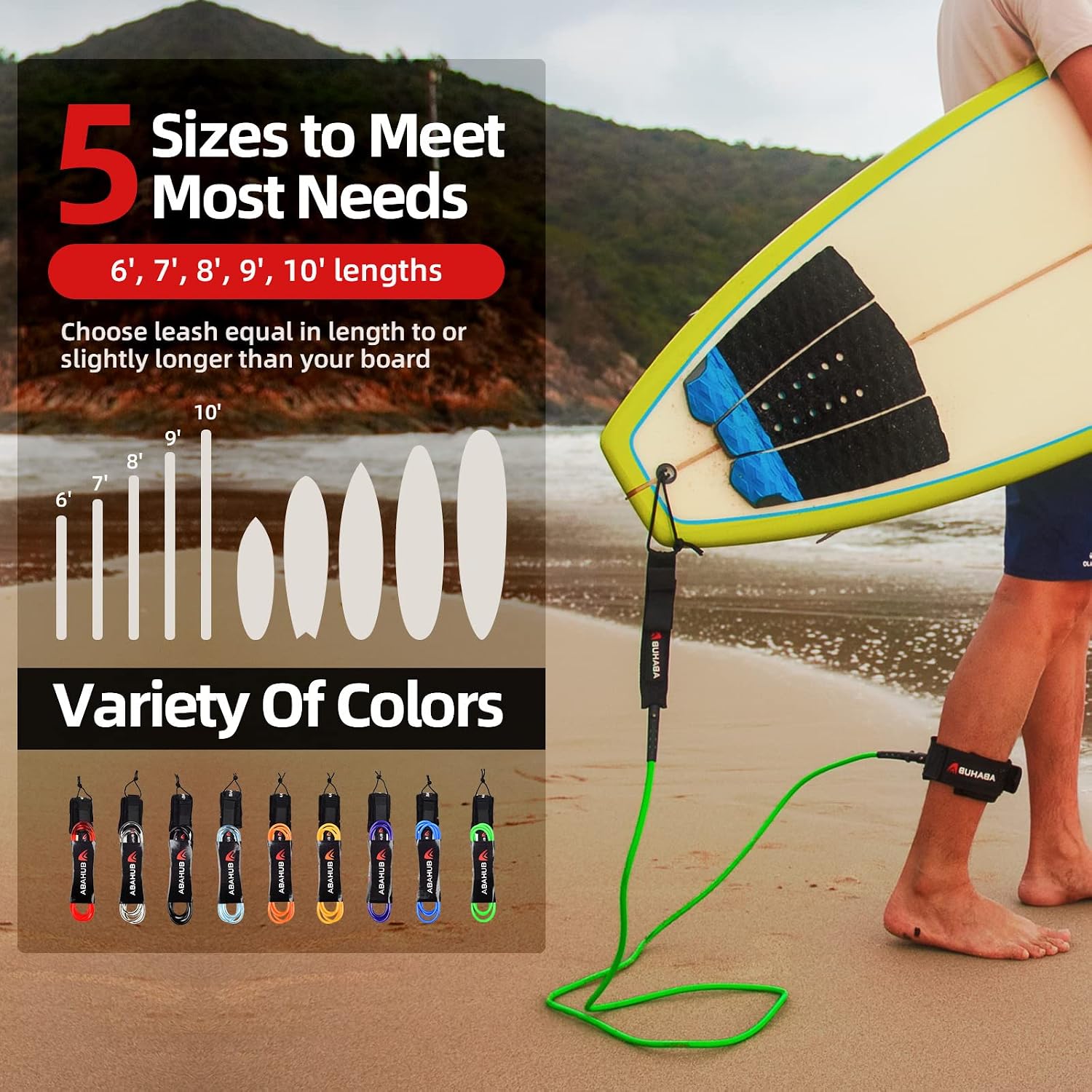
For surfers on foam learners — a Wavestorm, a Catch Surf Odysea, a rental-grade soft-top — the leash requirements are straightforward: match or exceed board length, use 7mm cord to handle the volume and weight of the board, and prioritize a secure ankle cuff that won’t slip during frequent wipeouts.
Abahub’s straight leashes sit firmly in the mid-range price bracket. Owner reviews consistently praise the ankle cuff padding for reducing hot-spot irritation during longer sessions — a real consideration when a learner is spending three hours in the water working on pop-ups. The hidden key pocket in the ankle cuff earns specific attention in owner feedback: buyers report that modern proximity key fobs, including bulkier formats like Tesla key cards, fit securely and stay put through full sessions. For a beginner driving to a surf beach and parking in an exposed lot, that’s a functional differentiator, not a gimmick.
Billabong’s entry-level straight leashes are widely stocked at brick-and-mortar surf shops from Virginia Beach to Narragansett. For a surf school or rental operation replacing leashes mid-season, that availability matters. The tradeoff: Billabong’s owner reviews in this segment tend to be brief and confirmatory — “works well, no issues” — rather than feature-specific. There is no key pocket, no detailed padding discussion. It’s a utility buy backed by decades of brand reliability.
Verdict at this tier: Abahub for the individual buyer who wants feature utility and padding comfort. Billabong for operators who need walk-in retail replacement options without shipping delays.
Coiled
$7.09
In stock on Amazon
Check price on AmazonMid-Tier: Shortboard and Fish in Head-High Atlantic Beach Break
Performance surfing in punchy Atlantic break — the kind of fast, wedging shore-dump you get at Hatteras or the lower Outer Banks — demands a leash that doesn’t telegraph every movement. Here the variables are cord diameter, swivel quality, and cord length relative to board length.
For a 5’10” shortboard or a 5’8” fish, a 6-foot straight leash in 5.5mm cord is the standard configuration. The Inertia’s leash construction overview explains why going thinner than 5.5mm for Atlantic beach break is inadvisable even on a performance board: shore-dump creates short, violent jerks on the leash rather than the longer pulls of open-ocean surf, and undersized cord fatigues faster under repeated impact loading. Thinner cord is a false economy in this environment.
Abahub’s dual 360-degree swivel system is the standout feature at this tier. In a fast, wave-rich session with frequent wipeouts and resets, swivel quality determines how tangled your leash gets over a two-hour session. Owners using Abahub in performance surf contexts consistently note that the cord stays clear and doesn’t require mid-session detangling. Build quality is also reported as exceeding expectations for the price point — one reviewer noted using a 6-foot straight Abahub leash to tether a floating cooler on a river outing, which speaks to material and hardware margins beyond what the surf use case demands.
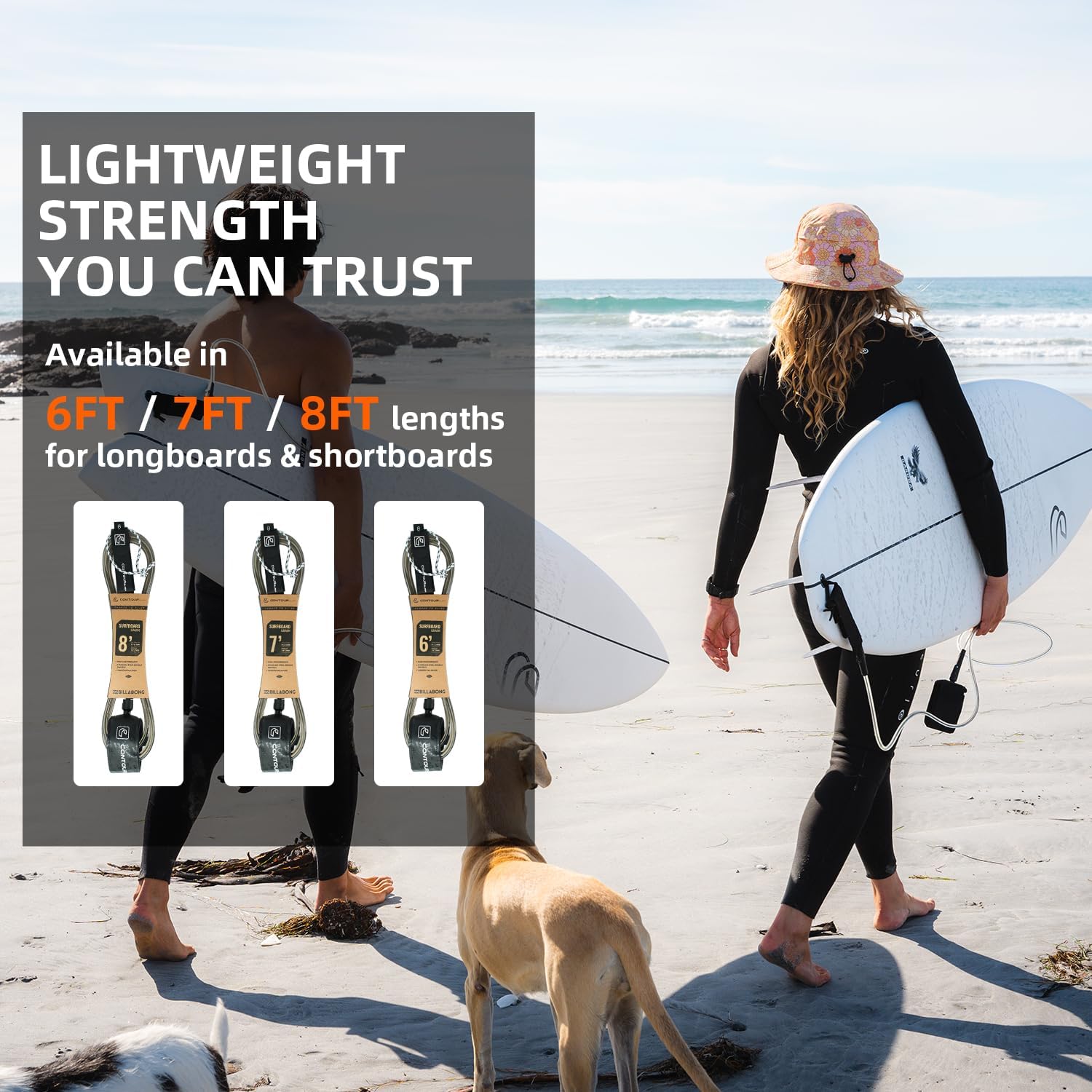
Billabong’s performance straight leashes are well-regarded within the same functional window. Wavelength Surf Magazine’s leash buyer’s guide positions heritage surf brands like Billabong as reliable choices for intermediate and advanced surfers who want proven construction without research overhead. The honest limitation is that independent editorial coverage of specific Billabong leash features is sparse — the brand’s reputation carries the product more than documented feature specifics.
Verdict at this tier: Abahub for the surfer who wants documented swivel performance and padding quality at a competitive price. Billabong for the intermediate surfer already inside the brand’s ecosystem who prefers brand-assured simplicity.
Abahub
$11.19
In stock on Amazon
Check price on AmazonPremium Application: SUP and Longboard Logging Sessions
Stand-up paddleboarding and longboard nose-riding represent the clearest functional case for a coiled leash over a straight one — and the highest stakes for getting the choice wrong.
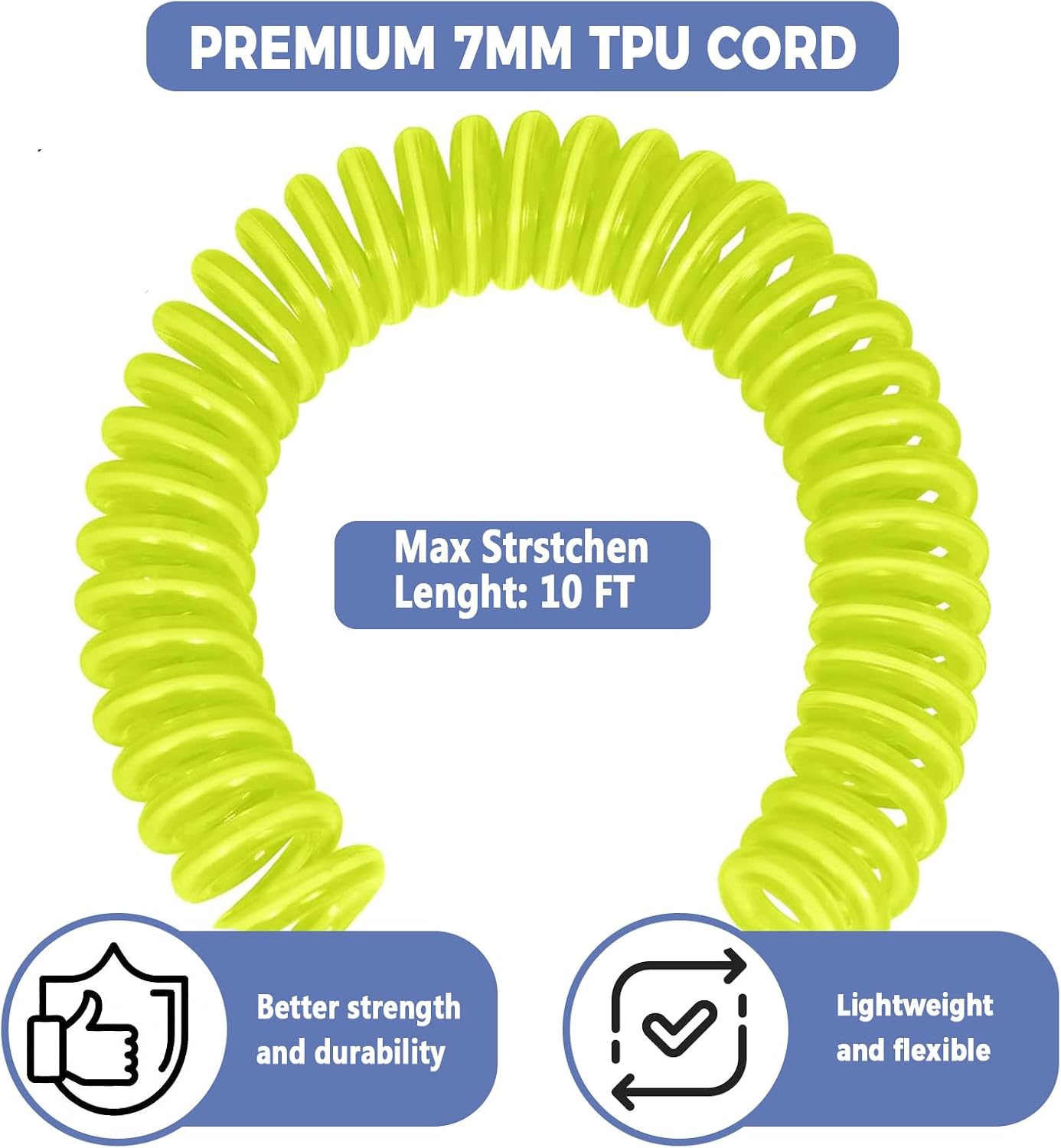
Cleanline Surf’s leash selection guide organized by board type draws the distinction clearly: straight leashes are the default for surfing because the cord lies in the water behind the surfer and doesn’t impede footwork. Coiled leashes are the correct choice for SUP because the coil contracts back toward the ankle rather than dragging flat across the deck or catching on the paddle shaft. This is an engineering distinction, not an aesthetic preference. On a 10-foot SUP in small Atlantic chop, a straight 10-foot leash becomes a trip hazard on the deck and a drag anchor underfoot. The coil solves both problems simultaneously.
Abahub’s coiled SUP leash earns its most specific and detailed owner praise in this segment. Buyers cite the dual 360-degree swivel system as the primary purchase driver — on a large SUP where the paddle is a third element in the tangle equation, swivel quality at both ends of the cord materially reduces fouling. The coiled format keeps the cord elevated and out of the water during paddling, which eliminates the underfoot drag that a straight leash creates during flatwater or small-wave SUP sessions. Color options available in the Abahub SUP lineup also emerge as a purchase driver in aggregated reviews from women buyers — and this isn’t superficial; high-visibility cord colors have a real safety dimension in busy Atlantic waterways.
For longboarders in the 9-foot-plus range, the coiled case is softer but genuine. During nose-riding sessions where foot placement precision is essential, a trailing straight cord underfoot is a nuisance that a coiled format eliminates. In punchy beach break on a 9-footer, a straight leash in a 9–10 foot length is still common and functionally adequate. The coiled format becomes clearly superior when logging in mellower conditions with extended nose-time.
Dedicated SUP leashes — as opposed to coiled surf leashes — often attach at the calf rather than the ankle, keeping the cord even further from the rider’s footing. Surfline’s leash sizing and safety guide recommends the calf-attachment coiled format as the correct specification for SUP in nearly all conditions. Using a standard 6-foot surf leash on a 10-foot SUP creates a cord too short for safe board release and a deck tangle risk that a purpose-built SUP leash eliminates.
Verdict at this tier: Abahub’s dedicated coiled SUP leash is the clear recommendation for stand-up paddleboarding in Atlantic conditions, with dual swivel construction and color options that address both safety and usability. For longboard logging, coiled is preferred; for longboard performance surfing in beach break, a straight leash remains a sound choice from either brand.
Billabong
$32.00
In stock on Amazon
Check price on AmazonCoiled vs. Straight: The Decision Frame
| Format | Best For | Drag Profile | Tangle Risk |
|---|---|---|---|
| Straight | Shortboard, fish, mid-length | Low at rest, some drag in water | Moderate |
| Coiled | SUP, longboard 9ft+, flatwater paddling | Minimal — cord stays elevated | Low |
The decision rule is simple: if your board is under 9 feet, use a straight leash matched to your board length. If your board is 9 feet or longer and you’re paddling or logging rather than ripping, consider coiled. If you’re on a SUP of any size, use a coiled leash with a calf attachment. Don’t undersize cord thickness for your board’s weight class — Surfline’s leash sizing guide recommends 7mm for boards over 7 feet and for surfers over 180 lbs.
Frequently Asked Questions
What leash length should I use for an 8-foot foamie vs. a 5’10” shortboard in Atlantic beach break?
Match the leash to the board length, or go one size up. For an 8-foot foam learner board, use an 8-foot or 9-foot leash. For a 5’10” shortboard, a 6-foot leash is standard. Some shortboard surfers in heavy shore-dump go to 5’6” for tighter response, but 6 feet is the safe default for Atlantic beach break.
Why does cord thickness matter and when do I need 7mm vs. 5.5mm?
Thickness determines break strength and stretch recovery. Per The Inertia’s leash construction overview, thicker cords withstand higher-force wipeouts without snapping or permanently stretching. Use 7mm cord for boards over 7 feet, surfers over 180 lbs, or any overhead-plus surf. Use 5.5mm for performance shortboards in waist-to-head-high conditions where drag reduction matters. Going too thin for your conditions is a snap risk.
Is a coiled leash actually better for SUP and longboard use, or is it just aesthetics?
It’s functional, not aesthetic. A coiled leash contracts back toward your ankle rather than trailing flat across the deck, which eliminates the underfoot tangle risk during paddle strokes or walking the board. Per Cleanline Surf’s leash selection guide, coiled is the correct format for SUP in nearly all conditions.
Does the Abahub key pocket fit a modern car key fob securely underwater?
Based on aggregated owner reports, yes — including Tesla proximity fobs, which are among the bulkier modern key formats. Owners consistently report confidence across full surf sessions. No leash key pocket is rated as waterproof to a specific depth; the expectation is splash and submersion resistance. If your fob is particularly large or expensive, test the closure on dry land before your first session.
Can I use a standard surf leash on a SUP?
You need a dedicated SUP leash, or at minimum a coiled surf leash long enough for your board. SUP leashes often attach at the calf rather than the ankle, keeping the cord further from your footing, and are rated for the higher forces a large SUP generates on a wipeout. Using a standard 6-foot surf leash on a 10-foot SUP creates a cord too short for safe board release and a tangle risk on deck.
The bottom line: For shortboards and mid-lengths in Atlantic beach break, a straight leash matched to board length is the right call — Abahub for feature depth, key-pocket utility, and padding comfort; Billabong for brand-assured simplicity and retail accessibility. For SUP or longboard logging, go coiled. Don’t undersize cord thickness for your board’s weight class. And if you’re running a quiver for a junior program or surf school, Billabong’s wide retail availability makes mid-season replacement frictionless.
Your leash is the last piece of gear between your board and the rocks. Spend twenty minutes choosing it correctly.