You’re shopping for a shorty wetsuit — “shorty” meaning short sleeves and short legs, cut above the knee, as opposed to a full-suit covering arms and legs completely. You’ve landed on a front-zip design, where the zipper runs down the chest rather than across the back, because entry and exit are dramatically easier. Now you’re staring at three price tiers: Seaskin, Hevto, and a stack of unbranded options that all look identical on a product page. This article breaks down what the review record actually shows across those options — fit quirks included — so you can make a call with clear eyes. We’ll cover warmth math for Atlantic water temps, the fit issues that keep coming up for women, durability timelines, and the one use case that will quietly kill a budget suit.
The on-ramp ends here. If you’ve been around neoprene long enough to argue about limestone rubber versus petroleum-based foam, the rest of this goes fast.
Why the Front Zipper Is Winning This Category
Let’s name the actual purchase driver first, because the review record is unambiguous. Across aggregated buyer feedback on Seaskin and Hevto shorties, warmth ranks second or third in what people say they liked. Entry and exit ease ranks first. That’s worth sitting with.
A back-zip shorty — the traditional design — requires you to reach behind your head, find a cord, and wriggle in while the neoprene fights you. In cold air on a beach parking lot, that’s miserable. A front-zip pulls open across your chest, you step in, zip up, done. Wavelength Surf Magazine, in their Wetsuit Buyer’s Guide 2025, notes that front-entry designs have gained significant market share in the shorty category precisely because convenience drives repeat purchase and brand loyalty more than thermal ratings do at this temperature range.
For surf coaches and junior program operators running eight kids through a two-hour session, the time savings on suit-up alone justify the format. For the solo dawn-patroller, it’s just a better morning.
What front-zip designs trade away is some flush resistance — water can track in through the chest zipper under heavy wipeouts or duck-dives. At shorty thickness (2mm to 3/2mm), this is a minor thermal concern, not a dealbreaker. The Inertia, in their guide “How to Choose Your First Wetsuit,” notes that flush resistance matters far more in full-suit configurations in cold water than in shorties used in temperate conditions.
How the Three Tiers Stack Up
The comparison below organizes Seaskin, Hevto, and unbranded no-name options as distinct buying tiers. Each has a defensible use case and a clear failure mode.
Seaskin 3mm Front-Zip Shorty
Seaskin occupies the entry-to-budget tier with a 3mm flatlock construction that performs reliably in saltwater surf sessions between 65°F and 75°F. The zipper pulls smoothly on new units, the neoprene panels have consistent thickness across production runs, and the brand offers actual customer service escalation — which unbranded competitors cannot say.
The fit note you need to hear before ordering: owners consistently report that narrow-waisted women experience lower-back gapping in the Seaskin 3mm. A suit that fits the chest and hips correctly may bridge the waist without contouring inward, creating a gap that lets water pool. This is not a defect; it’s a pattern cut issue. Seaskin’s patterns appear designed for a more rectangular torso than a pronounced hourglass. If you’re narrow-waisted relative to your hip and bust measurements, size consideration alone won’t fix this — the cut itself is the issue.
Verdict: A defensible buy for saltwater surf use if your torso geometry matches the brand’s pattern assumptions.
Hevto
$42.12
In stock on Amazon
Check price on AmazonHevto Front-Zip Shorty (Women’s and Men’s Lines)
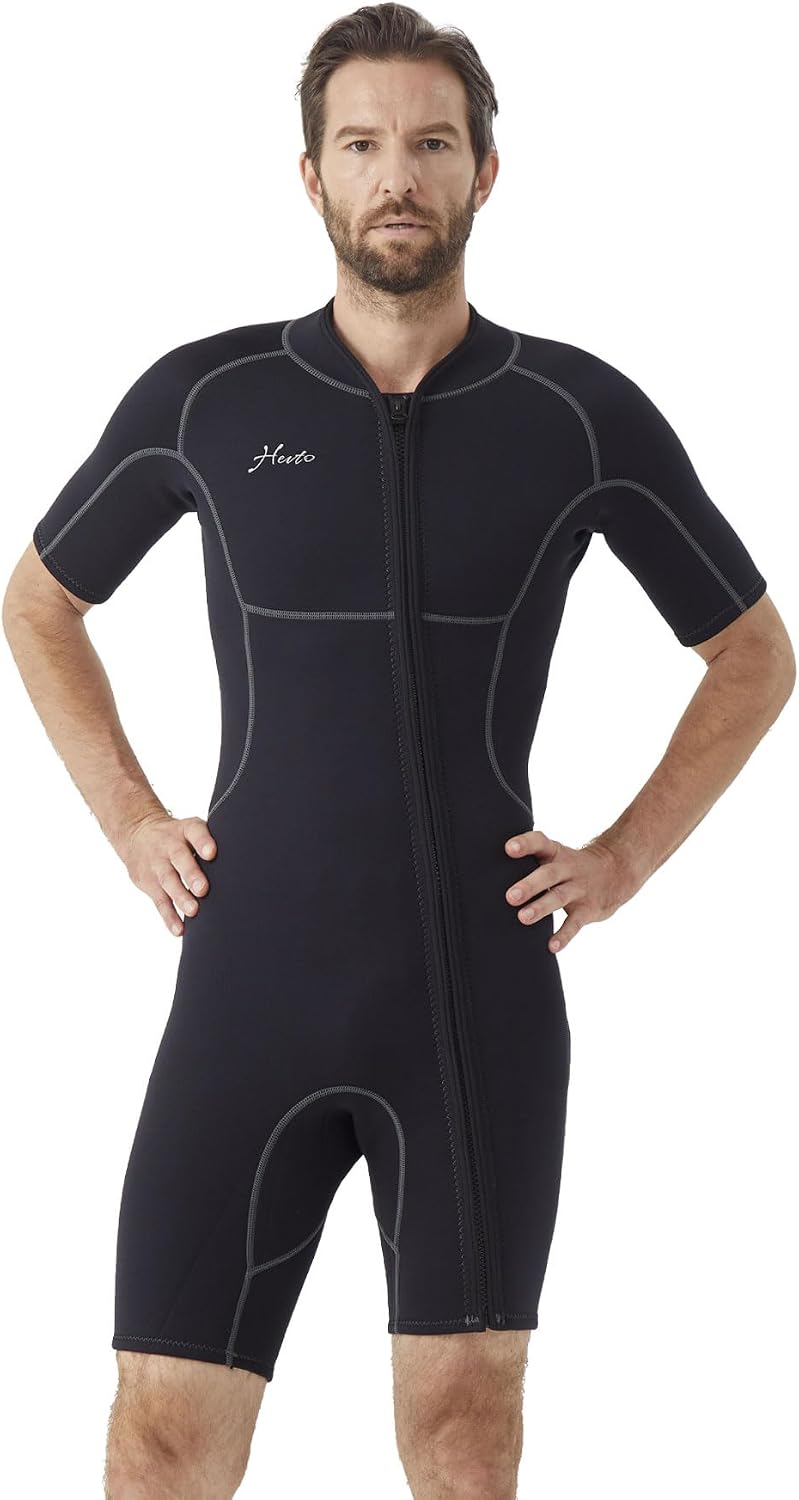
Hevto sits in the same budget tier as Seaskin but offers a women’s-specific line with panel differentiation in the chest and hip blocks. The 3/2mm women’s version — 3mm at the chest, 2mm at the legs — is appropriate for the same 65–75°F Atlantic water range.
The calf situation worth knowing: across multiple reviewers in the Hevto women’s shorty line, the calf panels consistently fit roomier than the thigh and upper leg. This is a brand-wide pattern characteristic, not a one-off complaint. For most surfers it reads as comfortable — no restriction on paddling or duck-diving. For surfers who prioritize a trim fit, or who are doing paddle racing where material bunching affects stroke mechanics, it’s a known limitation. Outside Online, in their Budget Wetsuit Roundup, flagged similar fit asymmetries in several Asian-manufactured budget women’s suits, attributing the issue to pattern grading that scales from a single block without a women’s-specific lower-leg template.
The durability picture for pool use deserves its own callout. A Hevto 2mm men’s shorty used three times per week in a chlorinated pool failed at the zipper mechanism after approximately 10 months — roughly 130 sessions. The zipper pull corroded, the slider seized, and the neoprene around the zipper base began delaminating. This is not a Hevto-specific failure; it’s a chemistry problem that affects all budget suits under chlorine exposure.
Verdict: The stronger choice for narrow-waisted women compared to Seaskin, with the calf-width caveat for trim-fit buyers.
Hevto
$42.12
In stock on Amazon
Check price on AmazonNo-Name Unbranded Front-Zip Shorties
Unbranded front-zip shorties cycle through marketplace listings and share a common problem that neither Seaskin nor Hevto has: inconsistent thickness. A 3mm listing may deliver 2.2mm panels. Neoprene density varies between production runs. You have no recourse if the spec doesn’t match because there’s no brand structure to escalate to.
The seam construction risk is real. Some unbranded suits use raw-edge seams — where neoprene is simply cut without flatlock stitching or gluing. Cleanline Surf, in their Shorty Wetsuit FAQ, explicitly warns against raw-edge seams in any suit intended for active surfing as opposed to casual wade-in use. These seams fail faster under the stretch demands of paddling and duck-diving.
For a surf school operator buying six suits for instructor use, thickness variance and seam inconsistency are operationally painful. For a solo buyer doing one transaction, it’s a gamble. If the price is meaningfully lower than Hevto’s entry point, ask why.
Verdict: Acceptable only for single-season casual use where fit precision and durability are secondary. Not recommended for regular active surf sessions or volume program purchases.
Hevto
$42.12
In stock on Amazon
Check price on AmazonThe Durability Math: Saltwater vs. Chlorine
Here’s the data point that should anchor your buying decision if your use case is anything other than ocean surfing.
Chlorine attacks zinc and brass zipper hardware aggressively, accelerates neoprene offgassing, and degrades the adhesive bonding in flatlock seam tape. Surfer Magazine, in their Neoprene Care and Longevity Guide, is explicit: even wetsuits marketed as “pool safe” experience significantly shortened lifespans under chlorine exposure compared to saltwater use, and budget suits with entry-grade zipper hardware are the most vulnerable category.
If your primary use is pool training, open-water paddle racing, or triathlon: A budget front-zip shorty will last you one to two seasons at most under regular use. That may still be an acceptable cost-per-use calculation — a $60 suit used three times per week for 12 months costs roughly $0.15 per session — but go in with eyes open. Rinse the suit in fresh water immediately after every pool session and apply a neoprene conditioner regularly to slow degradation.
For regular saltwater surf use: The durability picture is considerably better. Owners consistently report 18 to 36 months of usable life from Hevto and Seaskin shorties under two-to-three-times-weekly surf use, with the primary failure modes being zipper stiffening (manageable with beeswax) and panel delamination at high-flex zones — knees and armpits.
One Hevto 3/2mm owner wore the suit through a paddle race conducted in 33°F air with a wind advisory in effect. The suit performed well; the 3/2mm thickness held core temp through the event. This is useful evidence that these suits are not fragile — they’re just not engineered to resist chlorine chemistry at the zipper hardware level.
Seam Types, Sizing, and What the Charts Don’t Tell You
On seams: Flatlock seams — where panels are stitched flat rather than glued and blind-stitched — are appropriate for suits used above roughly 65°F water. They’re flexible, durable under moderate use, and they allow water to pass through the stitching. At shorty thickness and warm-water temperatures, that water passage is a minor issue. Cleanline Surf’s Shorty Wetsuit FAQ confirms flatlock is the correct seam choice for warm-water shorties, with blind-stitch upgrades adding cost that isn’t thermally justified in this temperature range.
On sizing: The consensus across Seaskin and Hevto owner reviews is to go true to size on height and weight, but to cross-reference chest and waist measurements in each brand’s own size chart rather than relying on your usual apparel size. Both brands run slightly generous in the torso relative to European wetsuit sizing from brands like Rip Curl and O’Neill. If you’re between sizes in Hevto, size down. If you’re narrow-waisted, be aware of the Seaskin gapping issue and consider whether the brand’s size chart addresses it — or whether a different cut is the right move entirely.
For junior development programs: Order one size in each dimension before committing to a volume buy. Fit variance across a class of mixed-body athletes in budget suits is real, and a suit that’s technically the right size but cut wrong is a distraction in the water. Wavelength Surf Magazine’s Wetsuit Buyer’s Guide 2025 recommends in-person sizing trials before any program-level purchase, a step that’s easy to skip and consistently regretted at scale.
Frequently Asked Questions
How warm is a 3mm shorty in 67°F Atlantic water? A 3mm shorty is appropriate for water temps in the 65–72°F range for most surfers during active paddling. At 67°F you’ll feel the cold on your exposed forearms and calves within 20–30 minutes, but your core stays comfortable. Add a 1mm hood or rash guard underneath if you run cold. Wavelength Surf Magazine’s Wetsuit Buyer’s Guide 2025 pegs the 3mm shorty category at 65–75°F for moderate activity levels.
What causes lower-back gapping in shorty wetsuits for women? It’s a pattern cut issue. Most budget shorty patterns are graded from a single block that assumes a relatively uniform torso width. Women with pronounced waist-to-hip ratios have a waist diameter significantly narrower than the pattern accounts for, so the neoprene bridges the gap rather than contouring inward. The fix is a suit with a women’s-specific panel cut at the waist — not just a women’s colorway on a unisex pattern.
How long will a budget front-zip shorty last with regular saltwater use? Owners consistently report 18 to 36 months under two-to-three-times-weekly ocean use, with proper rinsing in fresh water after each session and storage out of direct UV. Zipper maintenance with beeswax or a zipper lubricant extends the most common failure point significantly.
Can I use a surf shorty in a chlorinated pool? You can, but expect meaningfully shorter suit life. Chlorine corrodes zipper hardware and degrades neoprene adhesive bonds faster than saltwater. Rinse immediately after every pool session and apply neoprene conditioner regularly. If pool use is your primary application, treat the suit’s usable life as one season and plan accordingly.
Should I size up or go true to size in Seaskin and Hevto shorties? Go true to size using each brand’s own chest and weight chart — not your apparel size. Hevto runs slightly generous in the torso; if you’re between sizes, size down. Seaskin is consistent with its own chart but has the waist-cut issue for narrow-waisted women described above. Always measure before ordering and compare against the published size grid, not against other wetsuit brands you’ve worn.
The Decision Rule
If you surf Atlantic saltwater two-to-three times per week in 65–75°F conditions and want an easy on/off suit that won’t break your gear budget: Hevto or Seaskin are defensible buys at the budget tier. Know the fit quirks going in, size from the brand’s own chart, and maintain the zipper.
If you’re a narrow-waisted woman: lean toward Hevto’s women’s cut over Seaskin’s 3mm, or step up to a mid-tier brand with a women’s-specific panel construction at the waist.
If your primary use is pool or chlorinated open-water racing: budget for annual replacement, or step up to a suit with higher-grade zipper hardware and chlorine-resistant neoprene treatment.
If you’re running a surf school or junior program and buying in volume: buy one unit in each size before committing to a quiver purchase. Fit variance across budget suits is real, and a wrong-cut suit is a wet, cold, unhappy student.