You just snapped a fin on a shallow sandbar section. Your backup set is a pair of beat-up FCS II G5s you wouldn’t trust on a solid day. Replacing them with another branded set — FCS II Reactor Neo Carbon, for example — means $150 to $200 out of pocket before you’re back in the water. Then someone in your local lineup mentions they’ve been running $35 fins from Amazon and can barely tell the difference. That claim deserves scrutiny, not dismissal.
Fins are the removable blades that plug into the underside of your surfboard and control how it turns, holds in a wave, and releases when you want looseness. Most modern boards use one of two plug systems: FCS II (click-in, no screws needed) or Futures (single screw, longer box). Budget fin brands have historically made poorly fitting, floppy fins that chattered at speed. That reputation is now outdated for at least three brands — Ho Stevie FRP, BPS Fiberglass, and Honeycomb — and the aggregated buyer feedback across thousands of reviews tells a more nuanced story than “cheap fins are bad.” Here’s what that story actually says, where each brand earns its praise, and where each one still has rough edges.
| EDITOR'S PICKHo Stevie! Quad (4) Surfboard F… | Mid-tierHoneycomb Fiberglass Performanc… | Budget pickHo Stevie! FRP Thruster (3) Sur… | |
|---|---|---|---|
| Fin count | 4 (Quad) | 3 (or 2 or 4) | 3 (Thruster) |
| Foil material | HexCore | Fiberglass | FRP |
| Travel case | ✓ | — | ✓ |
| Fin key | ✓ | — | ✓ |
| Screws | ✓ | — | ✓ |
| Wax comb | ✓ | — | ✓ |
| Price | $64.97 | $42.34 | $24.97 |
| See on Amazon → | See on Amazon → | See on Amazon → |
The Material Reality: FRP Nylon vs. Fiberglass vs. Honeycomb Core
Before comparing brands, you need a baseline on materials, because the marketing language around budget fins obscures more than it reveals.
FRP (Fiberglass-Reinforced Plastic / nylon) is the entry-level construction. The fin is molded from nylon with short glass fibers mixed in. It is stiff enough to function, inexpensive to manufacture, and very durable against dings. The tradeoff is flex pattern: FRP fins tend to flex in a uniform, less-responsive way compared to layered fiberglass. For most surfers in average Atlantic beach-break conditions — waist- to head-high, punchy, fast — the difference is subtle. According to Wavelength Surf Magazine’s fin flex and material guide, the flex differential between nylon-glass and woven fiberglass becomes more perceptible above head-high surf with powerful, fast down-the-line sections.
Woven fiberglass layup (what BPS markets and what most mid-tier fins use) produces a more directional flex. The tip bends while the base stays stiff, which is closer to the feel of branded performance fins at $80–$120. Boardcave’s fin template and foil explainer notes that tip flex drives that “release then rebound” sensation on a snappy turn — the kind of pop you feel off the tail.
Honeycomb core construction sandwiches a lightweight internal lattice between fiberglass skins. The result is a fin that is lighter than solid fiberglass at comparable stiffness. Lighter fins reduce swing weight, which in theory makes the board feel more responsive through direction changes. Whether average surfers consistently feel this difference is genuinely debated, but experienced surfers who weigh fins in hand describe the weight reduction as real.
Material comparison at a glance:
| Brand / Set | Construction | Approx. Price (2026) | FCS II | Futures |
|---|---|---|---|---|
| Ho Stevie FRP Thruster | FRP nylon-glass | ~$30–$38 | ✓ | ✓ |
| BPS Fiberglass Thruster | Woven fiberglass | ~$35–$45 | ✓ | ✓ |
| Honeycomb HexCore Quad | Honeycomb / fiberglass | ~$40–$50 | ✓ | ✓ (see note) |
Head-to-Head: Three Brands in Detail
Ho Stevie FRP: The Volume Play That Actually Delivers
Ho
$24.97
In stock on Amazon
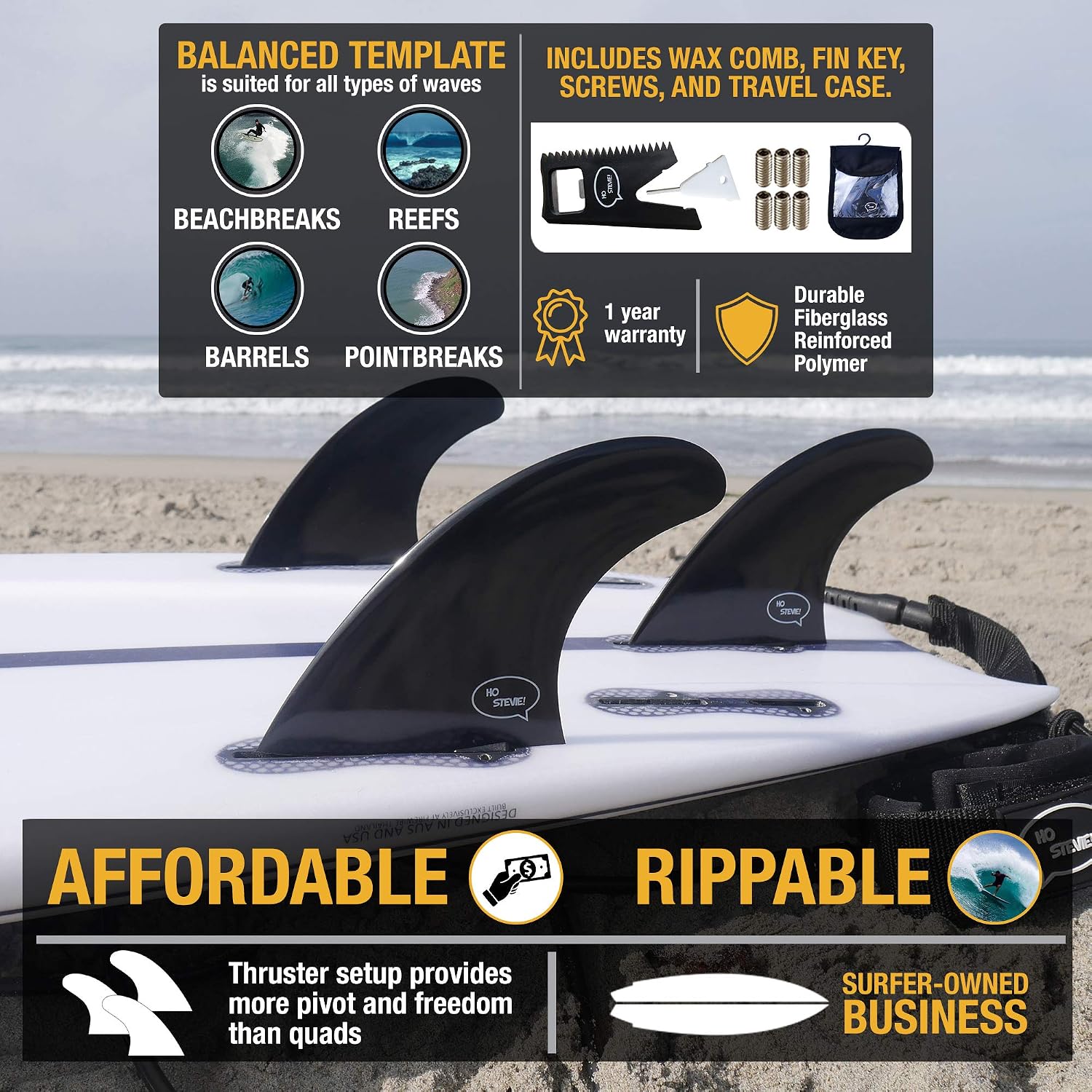
Check price on AmazonHo Stevie built its reputation on teaching content and value gear targeted at beginners. The FRP thruster set punches well above that reputation. Across aggregated buyer reviews, the pattern is consistent: experienced surfers — including at least one surfboard shaper with a Futures account — describe these fins as competitive with sets costing $60 to $100 more.
The most useful benchmark in buyer feedback is a direct size comparison to the FCS II G5 template. Reviewers describe the Ho Stevie medium thruster as closely matching G5 dimensions in base length and height. The G5 is a high-volume, upright template designed for powerful, down-the-line surfing — not a niche fin. If Ho Stevie is tracking alongside it dimensionally, the template geometry is doing real work.
Fit in FCS II boxes: Owners consistently report clean drop-in fit with FCS II plug systems without modification. No sanding, no forcing. This matters because an ill-fitting fin introduces micro-movement in the box that kills feel.
Fit in Futures boxes: Also reported as clean for the thruster set, though Futures’ longer box requires a different tab geometry — and Ho Stevie versions sold for Futures boxes are specifically engineered for that system. Confirm you are ordering the correct version for your box type before purchasing.
The honest tradeoff: In powerful, fast surf — overhead-plus with real push — owners in more demanding reviews note the FRP flex pattern lacks the snappy rebound of woven fiberglass. On mushy or average beach-break days, that difference largely disappears. For Atlantic surfers who spend 80% of their sessions in waist- to shoulder-high beach break, the FRP construction is more than adequate. Stab Magazine’s budget fin materials overview makes a similar observation: FRP fins close the gap on woven fiberglass in smaller, weaker surf where peak load on the fin is lower.
Ho
$24.97
In stock on Amazon
Check price on AmazonBPS Fiberglass: Stronger Material, Exceptional Support
Honeycomb
$42.34
In stock on Amazon
Check price on AmazonBPS (sold primarily through Amazon) positions itself one tier above the FRP category by using woven fiberglass construction. The performance feedback reflects that difference. Owners who have surfed both BPS and Ho Stevie FRP in back-to-back sessions describe BPS as noticeably livelier off the top, with more tip flex and better rebound on snap turns.
The story that keeps surfacing in BPS reviews — and it is worth taking seriously — is the customer service. Multiple buyers describe the BPS owner contacting them the same day their order was delivered, proactively asking about the experience. One reviewer called it unprecedented across their history of online purchases. A follow-up concern was resolved within 24 hours. For a product category where fit inconsistency can make or break a session, direct founder-level support is a genuine differentiator. It also signals that the brand is treating quality control as a reputation issue, not just a return-rate metric.
The side-bite angle: BPS side-bite fins (sold as part of a 2+1 or five-fin setup) earn specific praise from hybrid and mid-length riders. The flat inner foil and thin profile are described by owners as producing excellent pivot on wider-tailed boards — exactly the kind of easy release that makes a hybrid fun in small, soft beach-break surf. For Atlantic surfers running a mid-length or step-up fish in summer conditions, this is directly relevant.
Boardcave’s fin template and foil explainer confirms that flat inner foils on side bites reduce drag and increase pivot responsiveness, which aligns with what BPS owners describe in practice.
Compatibility note: BPS thruster and quad sets are available in both FCS II and Futures tab configurations. As with all budget fins, verify your box system before ordering — FCS II and Futures are not interchangeable.
Honeycomb
$42.34
In stock on Amazon
Check price on AmazonHoneycomb HexCore Quads: Real Advantages, Real Inconsistency
Honeycomb
$42.34
In stock on Amazon
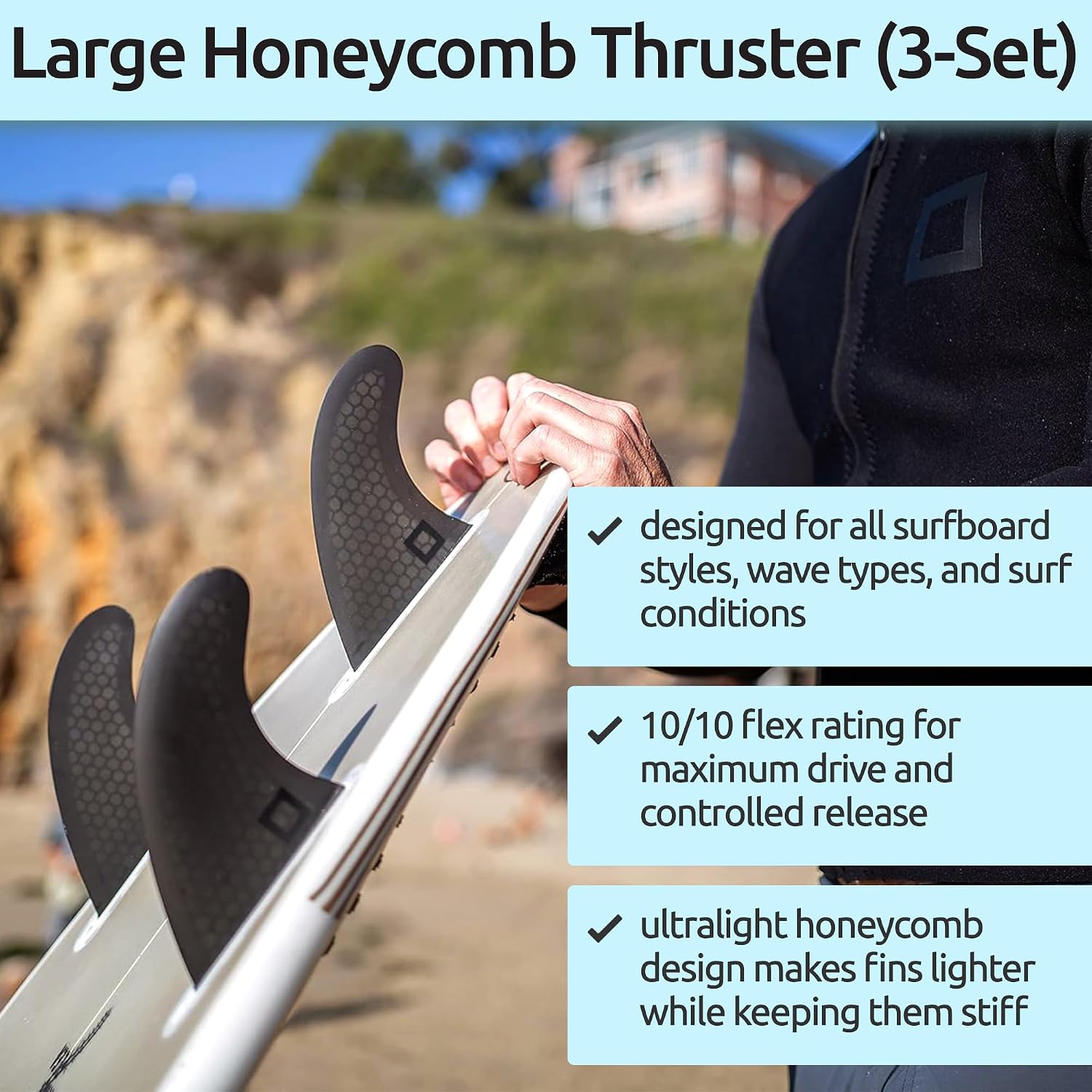
Check price on AmazonThe Honeycomb HexCore quad set is the most technically ambitious product in this comparison. The dual FCS II and Futures compatibility claim — meaning the same fin physically fits both box types — is the headline feature, and reviewers who have used it in both systems confirm it works. That is a genuine advantage for surfers who own boards with different fin systems, or coaches managing a quiver across multiple board brands.
The weight advantage is also real. Owners who handle the HexCore fins describe them as noticeably lighter than comparable fiberglass sets. Surfer Magazine’s fin buyer’s guide notes that swing-weight reduction is most perceptible in quad configurations, where four fins move with the board through each maneuver rather than three. Lighter quads translate to a snappier, more pivoty feel in smaller surf — exactly the condition where quad setups excel on Atlantic beach breaks.
The quality-control issue you need to know: Lot-to-lot consistency is a problem. Some buyers report perfect drop-in fit across both FCS II and Futures boxes. Others — specifically with rear quad fins in Futures boxes — found they needed light sanding before the tabs seated cleanly. This is not a universal failure, but it is frequent enough to flag. If you are buying these for a competition quiver or a surf school’s rental boards, build in time to check fit before you need them in the water.
A few minutes with 220-grit sandpaper on the tab edges resolves the fit issue in most reported cases. But these are not a guaranteed plug-and-surf experience the way a premium branded set is. You are accepting some assembly variance in exchange for the price point.
Stab Magazine’s budget fin materials overview singles out honeycomb core fins in small, peaky beach-break as consistently outperforming expectations for intermediate surfers who previously ran FCS II Performer quads — a finding that aligns with the HexCore’s owner feedback pattern.
Honeycomb
$42.34
In stock on Amazon
Check price on AmazonWhen Budget Fins Make Sense — and When They Don’t
The decision rule is straightforward once you map your conditions against the material limitations above.
Run budget fins if: You are surfing beach break in waist- to head-high conditions more than 80% of the time. You break or lose fins regularly on shallow sandbars or in crowded lineups. You are a coach or school operator equipping learner or intermediate boards where premium fin cost does not scale. You are experimenting with a new fin template or quad versus thruster configuration before committing to a $120–$200 set.
Spend $120-plus on fins if: You are surfing overhead-plus powerful reef or point break where flex pattern translates directly to hold and release on critical sections. You are competing. You need guaranteed, zero-modification fit every session. You are running a high-performance shortboard shape — a Pyzel Ghost or JS Monsta, for example — where the board’s built-in performance ceiling is high enough that fins become a meaningful variable.
Boardcave’s fin template and foil explainer makes the volume connection explicit: fins matter more as board volume decreases. On a beginner or mid-volume board, fin choice is a smaller performance lever. On a 26-liter performance shortboard, it is a larger one. Wavelength Surf Magazine’s fin flex and material guide reinforces this from the conditions side, noting that the performance gap between material tiers is most visible when surf power is high enough to load the fin fully through a turn.
Frequently Asked Questions
Do Ho Stevie FRP fins actually fit FCS II boxes without modification? Owners consistently report clean drop-in fit in FCS II boxes with no sanding or modification required. This appears to be reliable across the production run.
What is the real performance difference between FRP nylon fins and fiberglass fins for average surfers? In waist- to head-high beach break, most surfers cannot reliably detect the difference in a blind test. The gap widens in more powerful surf above head-high, where woven fiberglass returns more energy through the turn. If that is your typical condition, the upgrade to BPS fiberglass is worth the additional $10–$15.
Do I need to sand Honeycomb or Ho Stevie fins to fit my Futures boxes? For Ho Stevie: owners report clean fit without sanding. For Honeycomb HexCore rear quad fins in Futures boxes: sometimes. Lot-to-lot inconsistency means you may need light sanding on the tab edges. Check fit before your session.
Are BPS side-bite fins suitable for a longboard 2+1 setup in Atlantic small waves? Yes — the flat foil and thin profile owners describe produces good pivot well-matched to a 2+1 longboard setup in small, soft conditions. The side-bite size should match your center fin diameter; BPS offers sizing guidance in their product listings.
How do budget quad fins compare to budget thruster sets in terms of fitting reliability? Budget thruster sets show fewer fit complaints across all three brands. Quad sets — particularly rear fins, which use a different tab geometry in some systems — show more variability. The Honeycomb HexCore is the most discussed example. If fit reliability matters most, a budget thruster set is the safer starting point.
When does it actually make sense to spend $120-plus on fins instead of using these budget options? When you are surfing powerful overhead reef or point break regularly, competing, or running a sub-28-liter shortboard where the board’s performance ceiling is high enough that fins become a meaningful variable. For everything else — especially Atlantic beach break in average conditions — the case for $120-plus fins is harder to make.