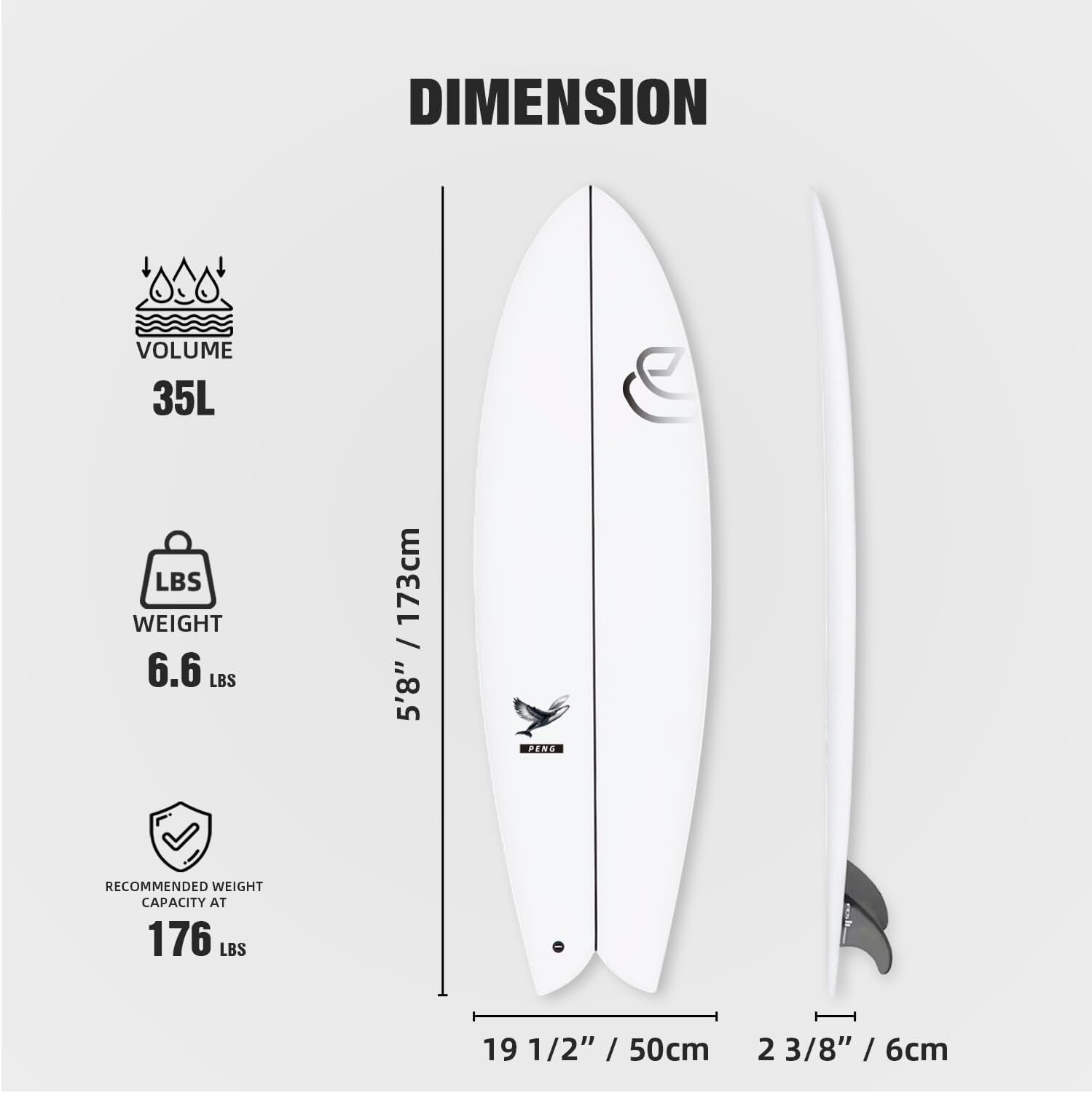
You’ve been riding a foam soft-top — a board with a soft, forgiving deck and lots of built-in buoyancy — for six months to a year. You’re catching unbroken waves on your own, you’ve landed a few turns, and every time you paddle out you feel slightly embarrassed next to the boards the intermediate crew is riding. That feeling is actually useful data: it usually means you’re ready to move on.
But “moving on” is where a lot of surfers make an expensive mistake. They buy a board that’s too short, too narrow, and too low in volume (volume is the total amount of foam inside a board, measured in liters — it determines how well the board floats you and how easy it is to paddle). Drop volume too fast and you’ll spend more time flailing than surfing. Keep too much and you’ll plateau. This guide is about finding that middle ground — with real numbers, named boards, and a clear decision rule at the end.
| EDITOR'S PICKnanazero Wood Skin Surfboard Mi… | Mid-tierRock-It 6' Albert Performance F… | Budget pick[Rock-It DA Wizard Performance S…](https://www.amazon.com/dp/B0DDQMQ4VR?tag=greenflower20-20) | |
|---|---|---|---|
| Volume | 40L | — | 39L |
| Length | 6'4'' | 6' | 4'10'' |
| Material | Wood Skin | Foam | Foam |
| Fin System | — | — | 2+1 |
| Target Rider | — | Kids & Adults | — |
| Price | $856.00 | $299.98 | $274.99 |
| See on Amazon → | See on Amazon → | See on Amazon → |
Why Volume Math Is the Only Number That Really Matters
Every surfboard dimension — length, width, thickness — feeds into one master figure: volume in liters. Think of it as the board’s carrying capacity. The more volume, the easier it paddles and the more stable it feels underfoot. The less volume, the more responsive and snappy it is — but only if you have the technique to activate it.
Boardcave’s volume calculator (a widely referenced tool among shapers and retailers) uses a simple starting formula for intermediate surfers: multiply your body weight in kilograms by a ratio between 0.35 and 0.42. At the higher end of that range, the board paddles easily and forgives weight shifts. At the lower end, you’re doing more work but getting more feedback from the wave.
A quick reference by body weight:
| Body weight | Conservative volume (0.42×) | Progressive volume (0.35×) |
|---|---|---|
| 65 kg (143 lb) | ~27 L | ~23 L |
| 75 kg (165 lb) | ~31.5 L | ~26 L |
| 85 kg (187 lb) | ~35.7 L | ~29.5 L |
Stab Magazine’s “How Much Volume Do You Actually Need?” feature makes the point clearly: most first-time shortboard buyers drop 30–40% of their foam-board volume in one jump and then wonder why surfing suddenly feels impossible. The smarter move is a 20–25% reduction from your soft-top’s volume, not more.
If your Wavestorm or Catch Surf Odysea is around 65–70 liters (most are, for an average adult), you’re targeting roughly 28–35 liters for your first performance board, depending on your weight and current ability level.
Reading the Spec Sheet: Length, Width, Tail Shape, and Construction
Volume is the headline number, but the other dimensions tell you where that volume lives in the board — and that changes how it surfs entirely.
Length is the easy one. Most intermediate performance boards sit between 6’0” and 6’6” for average-weight adults. Going shorter gets you into steeper drops faster; going longer gives you more paddle power in weaker beach break. The Inertia’s guide to buying your first shortboard specifically recommends that intermediate surfers err toward the longer end of their comfort zone on the first purchase — you can always go shorter next time, and you won’t regret extra paddle power on a slow New England summer day.
Width matters as much as length. A board that is 20–21 inches wide will feel stable underfoot for a surfer still building rail-to-rail balance (rail means the side edge of the board). A board under 19.5 inches requires precise weight distribution to stay flat — that’s a skill most intermediate surfers are still developing.
Tail shape changes how the board releases in a turn. A squash tail (squared-off with rounded corners) is the most forgiving all-rounder — it holds in the pocket of a wave and still lets you pivot. A swallow tail (cut into a shallow V at the tip) loosens up the back foot and suits faster, hollower beach break. A round tail holds a longer arc and works well on point breaks and reef where the wave wraps predictably. For your first performance board, squash is the safe starting point.
Construction is where the epoxy vs. polyester (PU) question comes in. Traditional polyester boards use a foam blank wrapped in fiberglass and soaked in polyester resin — they’re heavier, flex more, and feel lively but dent easily. Epoxy boards use a different resin (epoxy, sometimes over an EPS foam core — EPS stands for expanded polystyrene, the same material in a coffee cup) that is stiffer, lighter, and more buoyant volume-for-volume. Wavelength Surf Magazine’s overview of EPS/epoxy construction notes that the extra buoyancy means EPS boards paddle better than their volume suggests on paper — useful information if you’re right on the edge of two volume targets.
Firewire’s Timbertek construction takes this further: a timber veneer skin over an EPS core that reviewers consistently describe as lively without the dead stiffness some all-epoxy boards carry. It sits at the higher end of the construction spectrum, typically $900–$1,200 depending on model. $$$ — but operators who’ve run them in surf school quivers report noticeably lower ding rates than standard PU boards.
Three Boards Worth Comparing at This Stage
These aren’t the only options, but they’re the ones that come up most in intermediate-surfer conversations for good reason.
Channel Islands Dumpster Diver ($$, ~$750–$900) A mid-length-ish shortboard that runs wider than a standard shortboard template. Typical specs in a 6’2” are around 30–32 liters, 20.75 inches wide, squash tail. Surfline’s intermediate buyer coverage repeatedly positions this model as a “training wheels shortboard” — which sounds patronizing but isn’t. The extra width catches waves early while the rocker (the curve from nose to tail — flatter = faster paddling; more curved = easier turning in steep waves) keeps it responsive once you’re up. FCS II fin system. Worth noting: FCS II uses a tool-free click-in mechanism; Futures requires a screw and key. Neither is better — but they’re not interchangeable, so confirm before buying fins separately.
JS Industries Forget Me Not 2 ($$, ~$700–$850) JS Industries’ answer to the same problem. Runs slightly narrower than the Dumpster Diver — around 20.25 inches in a 6’2” — which makes it a better choice if you’re on the lighter end of the weight range and don’t need as much width to stay on plane. Stab’s volume coverage notes JS positions this model explicitly at surfers transitioning from higher-volume boards, and owners consistently report it surfs above its volume number because of its low entry rocker. Available in Futures. If you’re already riding Futures fins on a mid-length, staying in that ecosystem saves you $50–$80.
Lost Puddle Jumper ($$, ~$680–$820) Shorter, wider, flatter rocker than a conventional shortboard. A 5’10” Puddle Jumper often carries 30+ liters in a package that fits in smaller surf better than a 6’2”. Squash tail standard. Cleanline Surf’s staff guidance consistently recommends this shape for intermediate surfers on mushy Atlantic beach break — the flat rocker generates speed where the wave isn’t providing it, which describes most of the Northeast from May through August. Available FCS II or Futures depending on retailer build.
Fin System Compatibility: Don’t Skip This
This gets skipped constantly and it costs people money. FCS II and Futures are the two dominant fin systems. They are completely incompatible — a Futures fin will not fit an FCS II box, full stop.
When you buy your first performance board, ask the shop which system it runs. Then buy fins in that system. FCS II Reactor Neo Carbon fins ($120–$160 the set) are a popular intermediate step-up — stiffer than glass-flex, lighter than full carbon, and the click-in installation means you can swap them between boards if you add to your quiver. Futures fins require a screw and fin key, which is a minor hassle but creates a slightly firmer connection that some surfers prefer in bigger surf.
For most intermediate surfers on 1–4 foot beach break, the fin system matters less than just having fins that are sized correctly for your weight. Fin manufacturers publish weight range charts — use them. A fin built for 130–160 lb will feel stiff and skatey underfoot if you’re 190 lb.
Beach Break vs. Point vs. Reef — Conditions Shape the Call
Surfline’s condition-specific guidance is worth internalizing early: the right board for Outer Banks beach break is not the same board as the right board for a New England point break, even at the same volume.
Mushy, slow beach break (most of the Mid-Atlantic, summer): flat rocker, wide outline, squash tail. Volume on the higher end of your range. The Puddle Jumper template was built for this.
Punchy, hollow beach break (Outer Banks fall, Jersey Shore post-storm): slightly more rocker, can go a touch narrower. A standard shortboard template starts making sense here once your technique is solid.
Point or reef (New England granite points, Caribbean reef sessions): round tail or rounded pin, more rocker to handle the steeper sections, length over shortness. The Channel Islands template shines here.
The Decision Rule
Here’s where this all lands. If you’re reading spec sheets and feeling lost, use this framework:
- If you weigh under 160 lb and surf 3+ days a week: Target 26–29 liters. The JS Forget Me Not 2 or Lost Puddle Jumper in a 5’10”–6’0” range is your bracket.
- If you weigh 160–185 lb or surf less consistently: Target 29–33 liters. The Channel Islands Dumpster Diver in a 6’2”–6’4” is the safer bet; you’ll outgrow it into better surfing rather than outgrow it into frustration.
- If you weigh over 185 lb: Don’t go under 33 liters on your first performance board regardless of how impatient you feel. Volume loss is cumulative — you can drop a few liters on the next board once your paddle fitness catches up.
Construction-wise: if your budget is $700–$900, a standard PU shortboard from any of the three brands above is money well spent. If you’re at $900–$1,200 and plan to keep this board for 2+ years, the Firewire Timbertek builds in a comparable template earn the premium through durability alone — and the extra buoyancy from the EPS core gives you a slight buffer if your volume math is borderline.
The foam board got you here. Respect it — and then move on with the numbers to back up the decision.