You’re standing on the sand at 6:45 a.m. in late June. The water is 68°F — warmer than you expected, but there’s a northeast wind cutting across the beach that makes your arms cold the second you peel off your hoodie. Do you grab the full 3/2mm wetsuit sitting in your car? Wear just board shorts and a rashguard? Something in between?
This is the decision point that trips up a lot of surfers on the Atlantic coast every summer. The water is technically “warm,” but Atlantic beach breaks are exposed, wind-chill is real, and two sessions in a day means wet gear with no drying time. This guide breaks down every option — rashguards, 1.5mm neoprene pullovers (thin neoprene tops), and 2mm shorties (short-arm, short-leg wetsuits) — and tells you exactly which one makes sense for your conditions, your session length, and your budget.
| EDITOR'S PICKO'Neill Men's Reactor-2 2mm Bac… | Mid-tierO'Neill Men's Reactor-2 2mm Bac… | Budget pickO'Neill Men’s Basic Skins Long… | |
|---|---|---|---|
| Style | Spring wetsuit | Spring wetsuit | Rashguard |
| Sleeves | Short sleeve | Short sleeve | Long sleeve |
| Thickness | 2mm | 2mm | — |
| Closure | Back zip | Back zip | — |
| Size | XX-Large | X-Large | Large |
| Sun protection | — | — | UPF 50+ |
| Price | $99.99 | $88.95 | $29.96 |
| See on Amazon → | See on Amazon → | See on Amazon → |
The Temperature Framework: What 65–75°F Atlantic Water Actually Means for Your Body
First, a calibration. Surfline’s Atlantic coast water temperature data for 2025–2026 puts the Mid-Atlantic (NJ to NC) in the 65–74°F window from roughly late May through early October, with New England lagging about four to six weeks behind. Florida’s Atlantic side runs warmer, often 78°F+ by midsummer.
Why does this matter for gear? Because your body loses heat in water about 25 times faster than in air at the same temperature. A 68°F day feels like a warm morning in a t-shirt. A 68°F ocean session lasting two hours can leave a lean surfer shivering. The Inertia’s warm-water wetsuit guide notes that most surfers underestimate heat loss in the 65–70°F band, especially when paddling hard into a headwind between sets.
Here’s the quick reference:
| Water Temp | Wind Factor | Recommended Layer |
|---|---|---|
| 72°F+ / calm wind | Low | Long-sleeve rashguard |
| 68–72°F / light wind | Moderate | 1.5mm neoprene top |
| 65–68°F / any wind | High | 2mm shorty or 1.5mm + rashguard layered |
| Below 65°F | N/A | Full 2/2mm or 3/2mm wetsuit |
Rashguards: What They Do (and Don’t Do)
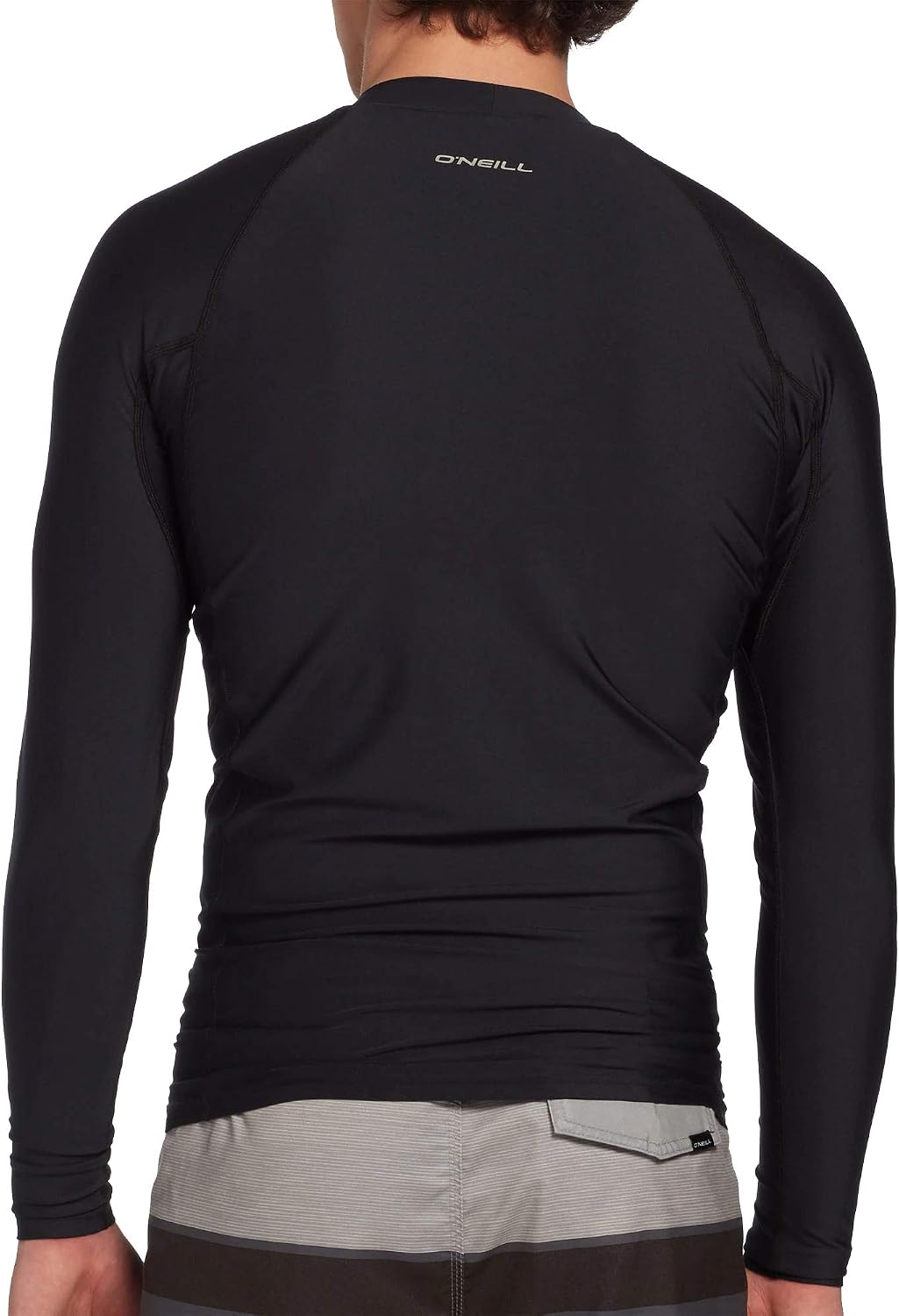
A rashguard is a fitted, quick-drying shirt — usually made from spandex/polyester blends — designed to protect your skin from board wax rash and UV exposure. Most carry a UPF 50+ rating (UPF, or Ultraviolet Protection Factor, is the fabric equivalent of SPF sunscreen — a UPF 50 garment blocks 98% of UV rays).
The O’Neill Basic Skins rashguard is the workhorse of this category and worth anchoring the discussion around. Aggregated buyer reviews reveal something interesting: a meaningful chunk of buyers aren’t surfers at all. Farmers using it for field work, swimmers, paddleboarders — and the consistent report is that the UPF 50+ claim holds up under sustained outdoor use, not just a single beach day. That’s a meaningful data point for anyone doing back-to-back sessions in July.
The sizing reality is consistent across dozens of reviews: go one size up from your normal shirt size. The Skins runs fitted by design, and reviewers who ordered their usual size reported restriction across the shoulders during paddling. This is different from wetsuit sizing, which we’ll address in the FAQ — the logic isn’t the same.
What a rashguard does not do: provide meaningful thermal protection. In 68°F water, a rashguard adds essentially zero insulation. It keeps the sun off your arms and stops wax rash on your chest. That’s it. If warmth is the goal, you need neoprene.
The 1.5mm Neoprene Pullover: The Middle Layer Most Surfers Overlook
A 1.5mm neoprene top (also called a wetsuit top or neo top) is a pullover — no zipper, just a thin neoprene shell that traps a thin layer of water against your skin and lets your body warm it. At 1.5mm thickness, it’s about as thin as neoprene gets before it becomes a rashguard in function.
The O’Neill Reactor-2 1.5mm pullover is the benchmark in this tier. The review that stands out in aggregated buyer feedback is a multi-year repeat buyer who specifically notes returning to it as a “good price” practical layer — not a performance purchase, a reliable utility tool. That pattern — repeat buyers at a consistent price point — is a signal that this product punches at its value, not above it.
The dry-time problem is real and you need to plan for it. One buyer’s note that the 1.5mm pullover “takes all day to dry” is not an edge case — it’s an operational reality for Atlantic surfers doing a dawn patrol session and then heading back out in the afternoon. At 65°F air temperature with moderate wind, a soaked 1.5mm neo top laid flat will not be session-ready by 2 p.m. if you pulled it off at 8 a.m. Your options: own two, use a neoprene hanger in full sun, or pair a dry rashguard for the PM session instead.
Warmth added vs. a rashguard: reviewers consistently describe the 1.5mm as taking the “edge off” cool water, not eliminating it. Wavelength Surf Magazine’s layering guide describes 1–2mm neoprene tops as suitable for 65–70°F water in low-wind conditions, with caveats for exposed beach breaks.
The 2mm Shorty: When the Wind Is the Enemy
A shorty wetsuit (short arms, short legs — typically cut above the knee and at the bicep) in 2mm neoprene is a genuinely different category of product. You’re now in a sealed system — back zipper, sealed seams — versus a pullover that relies entirely on fit for water retention.
The O’Neill Reactor-2 2mm shorty is where the reviewer data gets operationally specific. The standout review comes from a kitesurfer — an important detail. Kitesurfing is done in exactly the same exposed Atlantic beach-break conditions that most readers here are navigating: constant wind exposure, dynamic body movement, repeated water entry. Two features earned consistent praise:
The windproof chest panel. On an exposed Atlantic beach break — think Outer Banks, Island Beach State Park, Cape Cod — wind hitting a wet neoprene surface pulls heat away fast. A windproof panel on the chest doesn’t add insulation; it cuts convective heat loss. For long sessions or between-set paddle-outs, reviewers describe this as noticeably effective.
The Velcro zipper lock. Back-zip shorties have a known failure mode in dynamic sessions: the zipper tab catches water and the suit partially unzips mid-ride. The Velcro lock that secures the pull tab against the back panel directly addresses this. For anyone doing aerial maneuvers, heavy duck-dives, or wipeouts in serious shore-pound, this is not a trivial feature.
The sizing insight that matters most: Reviewers at 5’10” and 157 lbs consistently report that medium-tall sizing solves the inseam tightness problem in shorties. Standard mediums in this weight/height profile pull tight at the crotch during duck-dives, restricting hip rotation. If you’re in that body profile, size to the medium-tall before you size up to a large.
Layering Strategy: Can You Stack a 1.5mm Under a 2mm Shorty?
Yes, and for 65°F Atlantic sessions this is a legitimate approach — but with trade-offs. Outside Online’s wetsuit buying guide notes that layering thin neoprene can create fit issues: a 1.5mm pullover under a 2mm shorty adds effective thickness but can restrict arm movement if the outer layer is fitted. The math: 1.5mm + 2mm = 3.5mm effective coverage on the torso, closer to a full spring suit in warmth terms.
When this layering makes sense: Sub-67°F water, windy beach break, sessions over 90 minutes, surfers who run cold.
When it doesn’t: 70°F+ water where overheating mid-session becomes the problem, or if you don’t have a dry 1.5mm for the outer layer to seal against.
Frequently Asked Questions
Does a rashguard provide any meaningful warmth in 68°F Atlantic water or is it purely for sun and rash protection? Purely sun and rash protection. The thermal contribution of a fabric rashguard in 68°F water is negligible. If you’re cold at 68°F — and many paddlers are, especially lean body types or longer sessions — you need neoprene, not UPF fabric.
Can I layer a 1.5mm wetsuit top under a 2mm shorty for a 65°F Atlantic session? Yes. This gives you roughly 3.5mm of core coverage — adequate for 65°F with wind. Monitor arm mobility; if the shorty’s sleeves bind, size up in the outer layer or try the pullover on top instead.
How does the O’Neill Reactor-2 1.5mm pullover compare to a long-sleeve rashguard for warmth? Considerably warmer — not in the same category. The 1.5mm neoprene traps water and lets your body heat it. A rashguard does not. Wavelength Surf Magazine’s thermal layering guide places 1–2mm neoprene tops at 3–5°F effective water temperature advantage over bare skin or fabric layers.
What does the windproof panel on the Reactor-2 shorty actually do in Atlantic beach-break conditions? It cuts convective heat loss — the chill you feel when wind hits wet neoprene. It doesn’t add insulation the way thicker neoprene does, but on exposed Atlantic breaks reviewers describe it as meaningfully reducing that between-set cold feeling during long sessions.
Should I size up in the O’Neill rashguard the same way I do in wetsuits? The sizing direction is the same (go bigger), but the logic is different. Rashguards size up for shoulder mobility and paddle range. Wetsuits size up to prevent restriction of hip and knee flex. Check both your chest measurement and your shoulder width before ordering the Skins — reviewers who sized by chest alone sometimes got restriction across the upper back.
How long does the 1.5mm pullover take to dry between morning and afternoon sessions? Buyer reports say all day in typical conditions — plan for it. In direct sun with good airflow on a warm day, six to eight hours is realistic. If you’re running a dawn patrol plus an afternoon session, either own two pullovers or treat the PM session as a rashguard day.
The If-Then Decision Rule
If the water is above 72°F and wind is light → long-sleeve rashguard, full stop.
If the water is 68–72°F with any meaningful wind or sessions over 90 minutes → 1.5mm neoprene pullover.
If the water is 65–68°F or you’re on an exposed Atlantic beach break with consistent wind → 2mm shorty, and consider the windproof panel a must-have feature, not a bonus.
If you’re planning dawn patrol plus an afternoon session → own two pieces, or budget for a rashguard as your backup PM layer. The dry-time math doesn’t work otherwise.
The 2mm shorty medium-tall sizing note is the most practically useful piece of intelligence in this entire category. If you’re 5’10” in the 150–165 lb range, try medium-tall before defaulting to a large. It solves the problem that most reviews describe as fit failure in shorties — and it’s the kind of detail that only surfaces when you read the buyer data carefully.