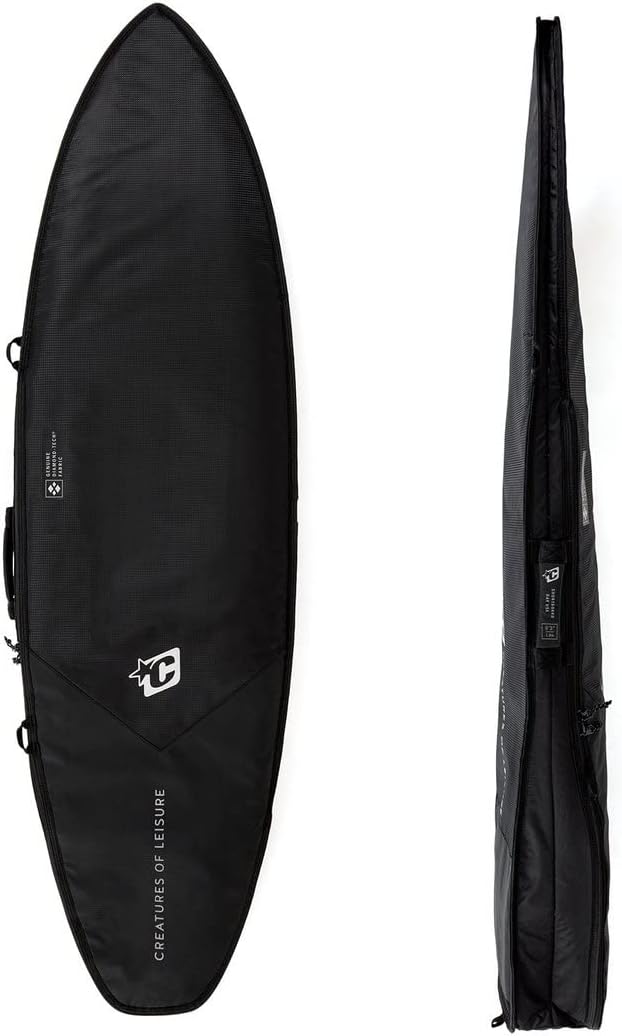
You’re standing at check-in with a shortboard under your arm — that’s a surfboard roughly 5’8” to 6’6” in length, shaped for performance in punchy waves — and the agent looks at it like it’s a problem waiting to happen. You probably already know this feeling. A shortboard is an investment: a quality performance shape from a shaper like Pyzel or JS Industries runs $700 to $1,100 or more, and that’s before fins and leash. A board bag (sometimes called a board sock, day cover, or coffin case depending on how much protection it offers) is the difference between your board arriving session-ready and arriving with a snapped nose or cracked rails. This guide breaks down every category of shortboard bag — what each type actually does, when you need it, and how to spend your money wisely — whether you’re driving to your local beach break or flying into a reef-pass destination in the Azores or Puerto Rico.
Day Covers vs. Travel Bags: The Fundamental Trade-Off
These are two genuinely different products doing two different jobs. Mixing them up is the most expensive mistake a traveling surfer makes.
A day cover (also called a board sock or basic day bag) is a thin, lightweight sleeve — usually 3mm to 5mm of foam padding or less — designed to protect a board from UV damage, wax transfer, and minor dings during a car ride or a short walk. It adds almost nothing in terms of structural protection. Brands like Creatures of Leisure and Dakine make solid day covers in the $40–$80 range. They roll up small, they’re light, and they’re genuinely useful for daily use.
A travel bag (also called a coffin case, double bag, or travel coffin) is built around a completely different problem: surviving baggage handlers, conveyor belts, and the cargo hold of a 737. These bags run 5mm to 10mm of high-density foam throughout, reinforced corner padding, heavy-duty zippers, and external carry handles built to take abuse. A quality travel bag from Creatures of Leisure or Dakine holds one to three boards and typically weighs 3–6 kg (6–13 lbs) empty. Prices range from $150 on the budget end up to $350+ for premium double or triple constructions.
The decision rule is simple: if the board is leaving your hands and entering someone else’s logistics system — a flight, a ferry, a bus cargo hold — you need a travel bag, not a day cover. Everything else is a day-cover situation.
Breaking Down the Travel Bag Categories
Single Bags ($, $$)
A single travel bag holds one board. For an Atlantic surfer who travels with one shortboard and wants to keep weight and bag fees manageable, this is worth serious consideration. Dakine’s Tour series (published specs: 6mm PE foam throughout, padded nose and tail blocks, dual carry handles) targets this segment at around $120–$160. Creatures of Leisure’s Day Use Travel bag sits in the same tier.
Owners consistently report that single bags do the job for short-haul routes — East Coast domestic runs, island hops in the Caribbean, a quick trip to the Canaries — where you’re not checking a bag for long and handlers aren’t moving freight aggressively.
The limitation is obvious: one board. If you crack a fin box or snap a tip mid-trip, you’re done. Surf coaches and competitive juniors who travel for events almost always move up to a double or triple bag for this reason.
Double Bags ($$, $$$)
A double (or “twin”) coffin bag holds two boards stacked with foam dividers between them. This is the most useful format for an intermediate-to-advanced Atlantic traveler. Two boards means one as a backup, or the ability to bring a different shape for different conditions — your go-to shortboard plus a fish or a step-up for larger swells.
Creatures of Leisure’s Icon Double (published specs: 5mm high-density foam, reinforced corner guards, 210D double-coated polyester shell, padded carry straps) and Dakine’s Noserider Double are the two most-cited names across aggregated reviews. Stab Magazine’s 2024 feature on pro packing habits noted that double bags dominate at the WQS and CT level precisely because they balance protection with airline fee efficiency — paying one oversized bag fee for two boards instead of two.
Price point for a quality double: $180–$280 depending on brand and construction year.
Triple/Coffin Bags ($$$)
Triple bags — sometimes called full coffins — are what surf school operators, team managers, and coaches reach for when moving a quiver (a collection of multiple boards for different conditions or athletes). They hold three to five boards, often include internal dividers, and typically run 10mm foam in the nose and tail sections where impact is highest.
These are heavy, expensive, and only make logistical sense when the volume justifies it. Creatures of Leisure’s Icon Triple runs $280–$350 at 2025–2026 retail. Dakine’s DLX Triple is in the same bracket. The cost-per-board math favors these bags when you’re moving three or more boards per trip, but for a single traveler carrying one or two shortboards, the weight penalty (6–8 kg empty) erodes the value fast.
What Actually Matters Inside a Bag Spec Sheet
By the Numbers
| Protection Layer | Day Cover | Single Travel | Double/Triple |
|---|---|---|---|
| Foam thickness | 3–5mm | 5–6mm | 6–10mm corner-padded |
| Nose/tail reinforcement | None | Light padding | Reinforced blocks |
| Empty weight | 0.3–0.8 kg | 1.5–2.5 kg | 3–6 kg |
| Boards carried | 1 | 1 | 2–5 |
Foam Density, Not Just Thickness
Two bags can both claim “5mm padding” and perform completely differently. High-density PE (polyethylene) foam compresses less under load than standard open-cell foam, which means it actually distributes impact instead of just compressing flat. Creatures of Leisure and Dakine both publish foam density specs in their technical documentation; Wavelength Surf Magazine’s 2025 buyer’s guide specifically flagged this as the most under-discussed variable in travel bag comparisons. When you’re comparing bags, look for the foam type listed explicitly — not just the millimeter thickness.
Zipper and Rail Systems
Zipper failure mid-trip is more common than most people plan for. Heavy-gauge coil zippers (YKK is the benchmark specification most quality manufacturers reference) hold up longer than standard nylon zippers. The rail that the zipper runs along matters too — if it’s poorly stitched to the shell, the zipper pulls free under lateral stress. Cleanline Surf’s travel bag FAQ (2025) recommends checking the zipper rail stitching in-store before purchasing, especially on bags at the lower end of the price range.
External Shell Material
The outer fabric is what contacts conveyor belts and cargo floors directly. 420D or 600D nylon-polyester blends are the most commonly published specs in this category; higher denier (the “D” number) means more abrasion resistance. Bags using a double-coated or ripstop weave hold up better on multi-leg itineraries. Bags marketed primarily on price tend to use lighter-denier materials that look fine on day one but develop abrasion holes and zipper stress by trip three.
Strap Systems
For a one-board traveler, padded backpack straps matter a lot — you’re carrying the bag from curbside check-in to the gate and back. For operators moving triple bags full of boards, wheeled systems or cart straps become more important than shoulder padding. Both Creatures of Leisure and Dakine offer padded backpack-style strap systems on their single and double bags; the Icon Triple from Creatures of Leisure includes compression straps designed to keep boards from shifting internally rather than backpack straps.
Airline Fees, Board Length, and the Sizing Problem
Airlines charge oversized baggage fees for surfboards, and the fee structure has tightened in 2025–2026. Most major carriers (American, Delta, United on domestic routes; TAP, Iberia, Ryanair for Azores/Canary routes) treat surfboards as a separate oversized sports equipment category, not a standard checked bag. Per The Inertia’s 2024 flight-packing guide, fees range from $50 to $100 per leg on domestic routes and $75 to $150+ per leg on international routes depending on carrier.
This has two practical implications:
-
Size your bag to your actual board — don’t over-buy length. A bag listed as “6’6 to 7’0” on a 5’10” shortboard adds dead weight and blank space that lets boards shift internally. Most quality manufacturers recommend 4–6 inches of clearance beyond your board length for nose/tail padding to seat properly, but no more.
-
Weigh your packed bag before you leave. Fins wrapped in boardshorts, wetsuits stuffed around the boards, leashes, and wax all add up. A double bag packed with two shortboards, two wetsuits, and hardware regularly hits 15–20 kg — well above the typical 23 kg (50 lb) oversized allowance on budget carriers.
Decision Framework: Which Bag for Which Situation
Here’s how to run the decision:
If you’re driving to the beach or loading a car for a road trip: A quality day cover ($40–$80) is all you need. Creatures of Leisure and Dakine both make reliable options. Don’t spend travel-bag money on a day-cover use case.
If you’re flying once or twice a year with one board, domestic routes: A single travel bag in the $120–$180 range is the right level. Dakine’s Tour or Creatures of Leisure’s base single are the two names that come up most consistently in aggregated reviews for this use case.
If you’re flying internationally, traveling multiple times per year, or taking two boards: Spend the $200–$280 for a quality double bag. The Icon Double from Creatures of Leisure or Dakine’s Noserider Double are the top-cited options at 2025–2026 pricing. Foam density and zipper quality are the variables that justify paying toward the top of that bracket.
If you’re a coach, a school operator, or managing a junior competitive program: A triple/coffin bag is the only format that makes economic and logistical sense when moving three or more boards. Budget $280–$350 and treat the bag as a capital purchase with a 3–5 year replacement cycle.
If the board is irreplaceable — a custom high-performance shape over $900 — always use a bag rated for at least 6mm corner-padded foam, regardless of trip length. The $200 you spend on the bag is cheap insurance against a ding repair bill that can run $80–$150 per crack, or the cost of reshaping a damaged nose entirely.
One more thing: pack your fins separately, inside padded fin cases or wrapped in a wetsuit, never installed in the board during transport. This is the single most common source of box-cracking damage on flights, and it costs nothing to prevent.