Picture this: the swell went flat two weeks ago. Your legs remember the feeling of pumping through a section, but your muscle memory is already fading at the edges. A friend sends you a video about surf skating — basically riding a skateboard engineered to mimic the hip-driven, rail-to-rail motion of surfing — and suddenly you’re down a rabbit hole at midnight comparing the Flow surf skate cruiser against the Razor RipSurf.
Both products promise to keep your surfing sharp when you’re nowhere near water. But they work differently, feel different underfoot, and suit very different riders. One is a full-length skateboard with a special front truck that allows deep, carving turns. The other is a compact caster board — a two-wheeled platform where the front and back sections twist independently — that forces you to generate momentum through body rotation alone. If you’re a surfer with six to twenty-four months of active gear-buying experience, you already know that “surf skate” is a broad label. This guide cuts through it.
| EDITOR'S PICKFlow Surf Skates Cruiser - 29"x… | Budget pickRazor RipStik RipSurf Caster Bo… | |
|---|---|---|
| Deck Length | 29" | — |
| Deck Width | 10" | — |
| Deck Material | 7-ply maple | — |
| Weight Limit | 275 lbs | — |
| Wheel Type | Carving | Caster |
| Assembly | Pre-assembled | — |
| Price | $124.95 | $84.99 |
| See on Amazon → | See on Amazon → |
How Surf Skates Work — And Why the Mechanism Matters
A standard skateboard steers by tilting the board left or right, which pivots both trucks slightly. A surf skate changes the front truck entirely. On a surf-skate setup, the front truck can swing forward and pivot through a much wider arc — sometimes 30 to 45 degrees — which lets you initiate turns the same way you initiate them on a wave: by driving your front shoulder, dropping your weight into your heels or toes, and following through with your hips.
The Flow surf skate cruiser uses this kind of enhanced front-truck system. Riders who come to the product through surf-specific content report that the carving sensation is legitimately close to the rail-to-rail feel of surfing a longer, more forgiving board. One long-consideration buyer — who watched the product for over a year before finally purchasing during a sale event at a price point near $73 — described the experience as immediately intuitive if you arrive with surf experience already in your body. That price-sensitivity detail matters, and we’ll return to it.
The Razor RipSurf operates on a completely different principle. It has a single front wheel and a single rear wheel, each mounted on a separate platform that can rotate independently. You generate all forward momentum by shifting your weight rhythmically side to side — no pushing off the ground required. That body-rotation demand is exactly what makes it a training tool. You cannot cheat it. Every inch of forward progress comes from your core and hips working in sync.
Head-to-Head Comparison: Flow Cruiser vs. Razor RipSurf
The two boards share a marketing category but solve different problems. The comparison below breaks them into three tiers of decision-making: who gets the budget pick, who gets the mid-tier recommendation, and who should consider a premium surf-skate investment.
H3: The Budget-Accessible Option for Group Training and Junior Surfers
The Razor RipSurf is the natural starting point for coaches running junior programs or parents buying a first surf-training tool. Its lower price point, combined with its documented success with riders in the 10–14 age range, makes it accessible for buying multiple units. The caster-board mechanism — one front wheel, one rear wheel, each on an independently rotating platform — forces hip rotation from the very first session. There is no way to push with your foot and coast. The body does all the work, which is exactly what young surfers need to internalize before bad habits form on the water.
The RipSurf does run slower than comparable caster boards, as riders who’ve tested multiple styles consistently report. For junior training purposes, that is arguably a feature rather than a flaw — the emphasis stays on pattern quality rather than speed. The compact platform can feel cramped for larger adult bodies, but for the 10–14 demographic, the geometry works well.
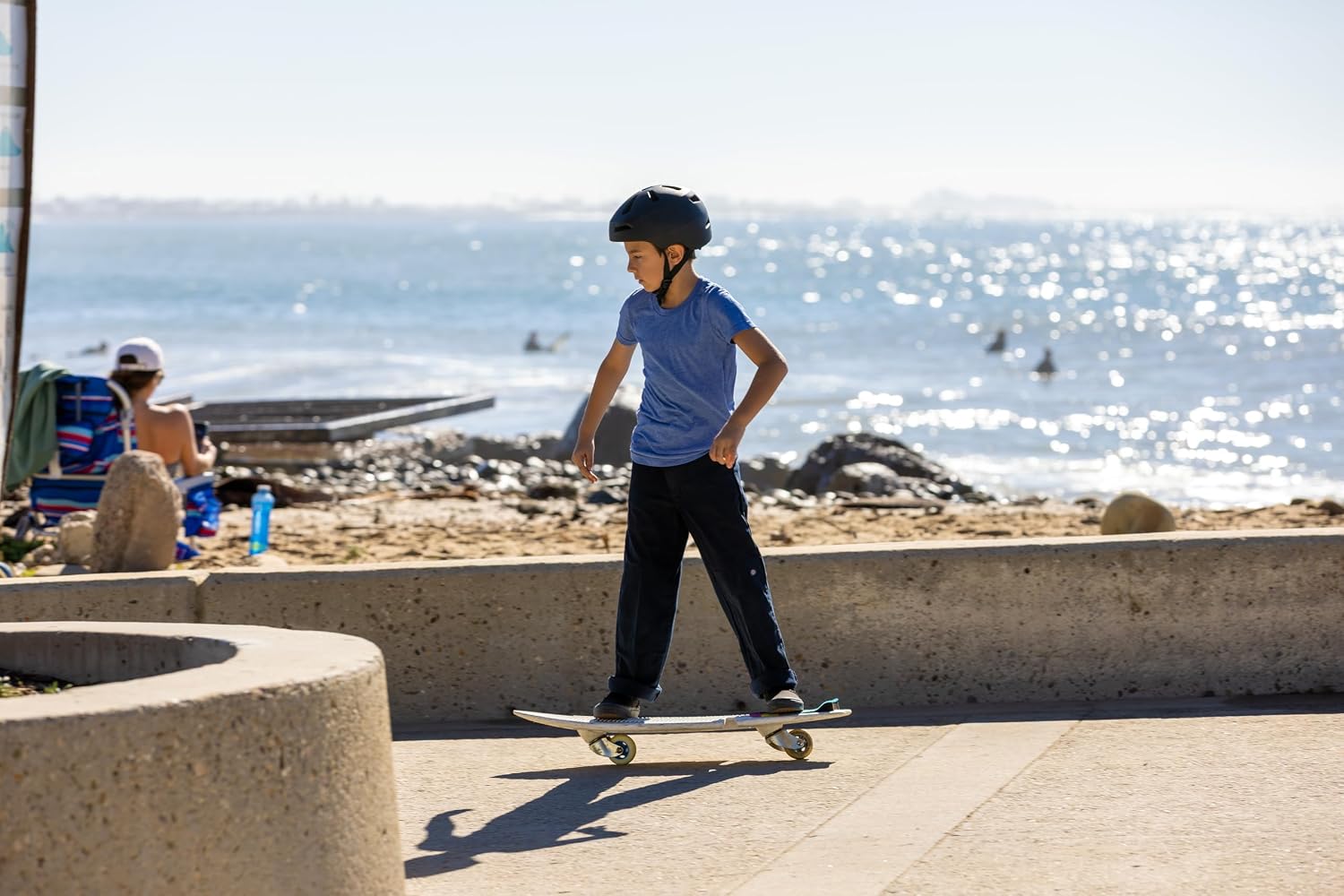
Razor
$84.99
In stock on Amazon
Check price on AmazonH3: The Mid-Tier Pick for Adult Intermediate Surfers Who Want Real Carve Feedback
The Flow surf skate cruiser sits at the mid-tier of this comparison and is the right call for adult intermediate surfers who want to rehearse actual carving mechanics. The enhanced-pivot front truck replicates the range of motion you use on a wave — front-foot pressure, heel-to-toe transitions, hip follow-through. Riders with surf experience typically find the motion intuitive within one to two sessions, because the movement vocabulary is already in their bodies.
One important caveat surfaces repeatedly in owner feedback: fit matters. The truck is calibrated for specific weight ranges and stance widths, and a board that performs beautifully for a 150-pound rider with a medium stance will feel noticeably different for a 200-pound rider with a wide stance. Before committing, verify the manufacturer’s current weight limit and stance guidance against your own dimensions. This is not a dealbreaker — it is a verification step.
The Flow cruiser has appeared at significant discounts, with that ~$73 sale price representing a meaningful drop from standard retail. If you’re price-sensitive, a price alert is worth setting. The gap between full retail and sale price is wide enough that patient buyers are regularly rewarded.
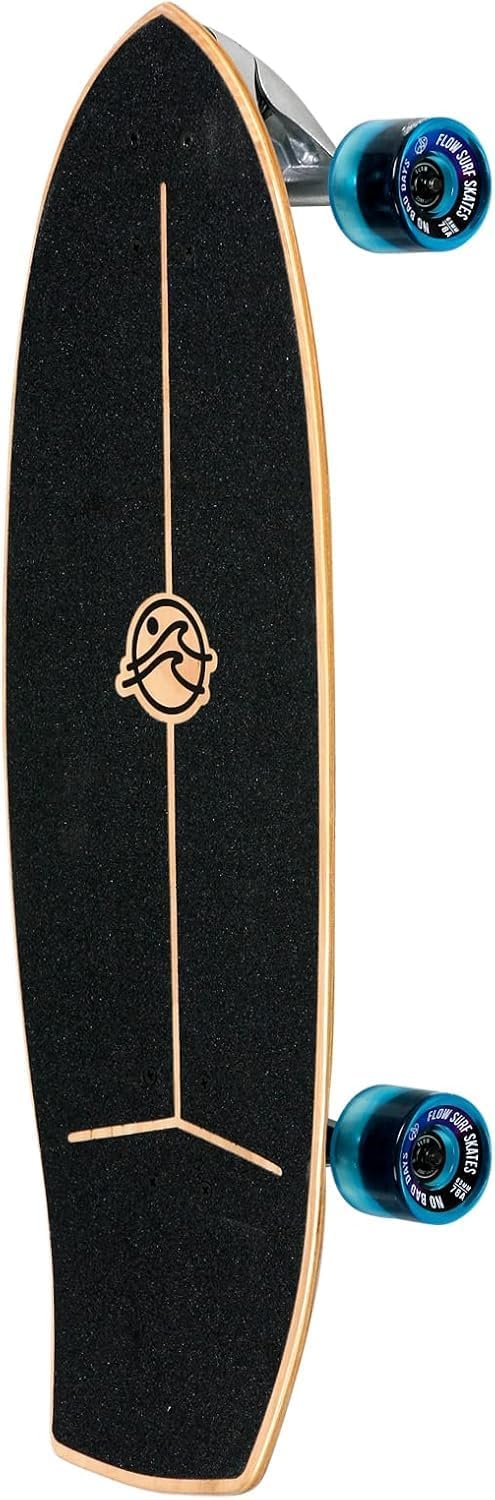
Flow
$124.95
In stock on Amazon
Check price on AmazonH3: Premium Surf-Skate Investment for Progression-Focused Riders
Surfers who have moved past the “will this actually help?” question and want the highest-fidelity dry-land training experience should look beyond the RipSurf’s limitations and toward a full surf-skate truck setup on a quality deck. The Flow cruiser represents the upper boundary of this comparison, but the broader premium surf-skate category — boards from established skateboard brands with purpose-built surf-truck geometry — offers even more nuanced carve feedback for riders who are genuinely trying to compress their progression timeline.
As The Inertia’s ongoing dry-land training editorial coverage notes, motor-pattern rehearsal is the legitimate benefit of surf skating: you are encoding the muscle-activation sequence that produces a carved turn, so that sequence becomes automatic in the water. The more accurately the board replicates the movement, the more directly that encoding transfers. Premium surf-skate setups justify their price by tightening that replication gap.
Outside Online’s overview of land-based surf training tools consistently surfaces one finding: session quality is almost entirely determined by the quality of the movement replication, not the price of the board. But for riders who are logging serious water time and want their land sessions to be equally serious, the investment in a higher-fidelity truck setup pays off over a full season.
Flow
$124.95
In stock on Amazon
Check price on AmazonRough Pavement, Smooth Pavement, and Real-World Use
This question appears in owner feedback for both products. The honest answer is the same for nearly every surf skate or caster board: rough pavement degrades the experience significantly and, for caster-type boards like the RipSurf, can make riding functionally impossible.
Both products are optimized for smooth, sealed surfaces — fresh asphalt, concrete bike paths, smooth parking garage decks, or gymnasium floors. Cracked sidewalks, chip-seal driveways, and rough aggregate parking lots are not training environments. They are hazards.
Outside Online’s land-based surf training overview makes the point plainly: the most consistent feedback from surfers using dry-land boards is that session quality is almost entirely determined by surface quality. Find your smooth spot first. Then decide which board to bring to it.
Does This Actually Improve Your Surfing?
The honest editorial position, supported by The Inertia’s ongoing coverage of dry-land training and Surfer Magazine’s features on progression tools for intermediate riders, is: yes, within specific limits.
Surf skating develops motor patterns — the sequence of muscle activations that produces a carved turn or a pump through a flat section. Wavelength Surf Magazine’s surf skate and cross-training guide notes that rehearsing movement patterns on land reduces cognitive load in the water, which lets you focus on reading waves rather than executing mechanics you should already own.
What surf skating does not do: replace time in the water. Wave-reading, pop-up mechanics, duck-diving, reading lineups — none of that transfers from a parking lot. Treat surf skates as a supplement, not a substitute. Two 20-minute parking lot sessions per week during a flat spell will keep your turn mechanics sharper than zero sessions. That is the realistic value proposition, and it is a meaningful one.
The Decision Frame: If X, Then Y
Here is the explicit decision rule this comparison points toward:
If you are an adult intermediate surfer who wants to rehearse carving turns and hip transitions, and you are willing to verify fit and find smooth pavement: the Flow surf skate cruiser is the call. Set a price alert, wait for a sale window if you are price-sensitive, and verify your stance width against the deck before committing.
If you are a surf coach or junior program operator looking for multiple affordable units that force riders to develop core rotation from day one: the RipSurf is worth a serious look. The lower price point, combined with its strong track record with riders in the 10–14 age range, makes it a logical quiver addition for group training.
If you are an adult who wants maximum surf-feel replication and is comfortable on a skateboard: the Flow is still your answer. The RipSurf’s speed limitation and compact platform work against adult-sized surf training goals.
Neither board is a mistake. They solve different problems. The mistake is buying the wrong one for your specific situation — which is exactly what this guide exists to prevent.
Frequently Asked Questions
Does a surf skate actually improve your surfing between ocean sessions? Yes, within limits. Surf skating reinforces the hip-driven weight shifts and rail-to-rail transitions that produce carved turns. The Inertia’s dry-land training editorial coverage consistently supports motor-pattern rehearsal as a meaningful supplement to water time. It does not replace ocean sessions or improve wave-reading. Think of it as keeping your muscle memory tuned during flat spells.
What is the weight limit for the Flow surf skate cruiser? Published specs vary by model and configuration. Check the manufacturer’s current spec sheet directly — weight limits affect how the front truck performs and whether deck flex is appropriate for your build. This is one of the fit considerations that owners flag as important to verify before purchase.
Is the Razor RipSurf good for adult surfers or just for kids? It can work for adult surfers, but with honest caveats: the platform runs compact, it is slower than other caster boards, and the single front-wheel technique takes a few sessions to feel natural. Adults with larger frames may find it cramped. It performs best as a core-rotation training tool for younger surfers or as a budget-accessible option for group coaching programs.
How long does it take to learn to ride a surf skate if you already know how to surf? Surfers typically adapt faster than non-surfers because the hip-driven motion is already familiar. Based on owner-reported experiences, most surfers find the Flow’s carving motion intuitive within one to two sessions. The RipSurf’s caster mechanic takes slightly longer — roughly two to four sessions to feel smooth and controlled.
Can I use a surf skate on rough pavement or only smooth surfaces? Smooth surfaces only, for any real training value. Rough pavement creates unpredictable resistance, interrupts the flow of practice, and increases fall risk. Outside Online’s land-training overview identifies surface quality as the single biggest variable in session quality. Find a smooth parking lot, sealed path, or gymnasium floor before your first session.
What is the difference between a surf skate and a regular cruiser skateboard? A regular cruiser skateboard has standard trucks that pivot modestly when you lean. A surf skate replaces the front truck with a mechanism that allows much wider, more dynamic pivoting — replicating the range of motion you use when turning on a surfboard. That front-truck difference defines the entire product category. Without it, you have a skateboard. With it, you have a dry-land surf trainer.