Picture this: it’s been two weeks since you’ve been in the water. Work happened. The swell went flat. Your board is gathering dust in the garage, and you can feel that subtle loss of sharpness — the muscle memory fading just slightly at the edges. You know the feeling. Every committed surfer does.
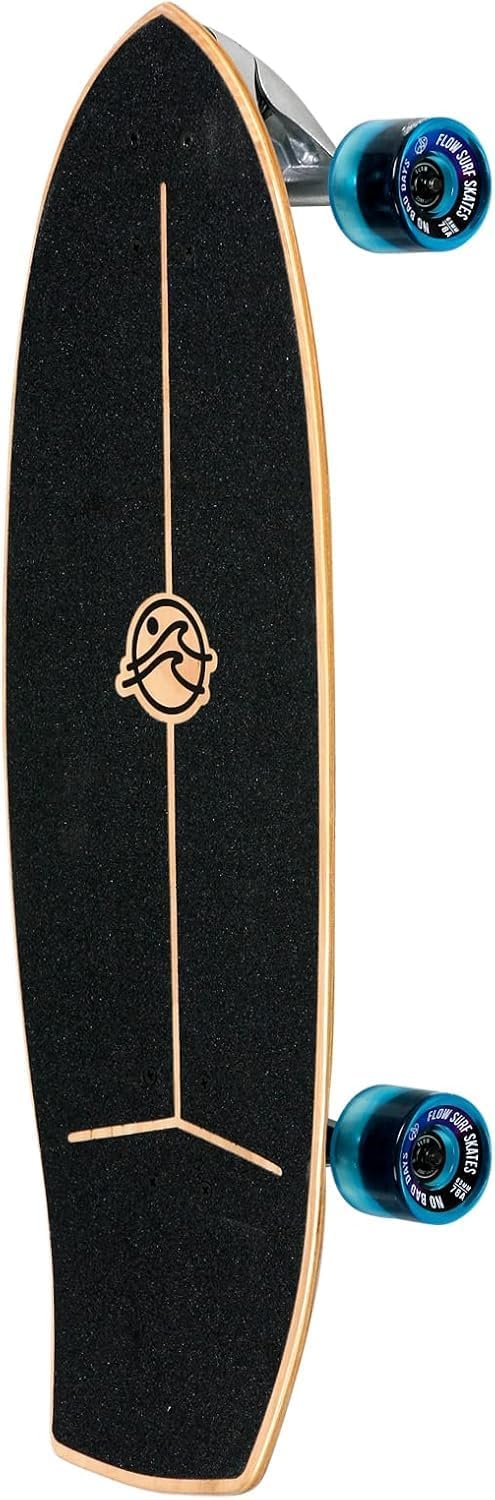
The good news is that surfing is not purely an ocean sport anymore. Surf skates — skateboards engineered with a specialized front truck (the front axle mechanism) that mimics the pivoting, weight-shifting movement of surfing — have become a serious training tool for everyone from weekend warriors to competitive juniors. Pair that with targeted dry-land drills and you have a real system for maintaining — and even building — surfing ability between sessions. This guide breaks down which surf skates are worth the money, how to structure a dry-land routine, and how to match both to your current level.
What Makes a Surf Skate Different from a Regular Skateboard
A standard skateboard turns by leaning into angled trucks. It works, but the pivot range is limited. You can carve, but you can’t really pump — you can’t generate speed from a standstill by shifting your weight the way you do when driving through a bottom turn.
Surf skates solve that with a front truck that rotates independently, often on a spring-loaded or pivoting mechanism. That mechanical difference is everything. It means you can initiate turns with your hips and shoulders, generate forward momentum through a pumping motion, and practice the lateral weight transfer that makes surfing work.
The two most-referenced truck systems right now, according to Stab Magazine’s surf skate comparison, are:
- Carver CX trucks — a ball-and-socket pivot that most closely replicates the loose, flowing feel of longboard or mid-length surfing
- Smoothstar Thruster system — a spring-loaded truck that emphasizes tighter, snappier pivot range, closer to a high-performance shortboard feel
Neither is universally better. The choice maps directly to the surfing you’re trying to improve.
By the numbers:
- Carver CX trucks: ~30-degree pivot range, looser spring tension, suits carving and flow training
- Smoothstar Thruster: ~20-degree pivot, stiffer return, suits snap, snap-back, and rail-to-rail transitions
- Average surf skate deck length: 29–34 inches (shorter = more responsive; longer = more forgiving)
- Price range: $180–$380 complete, or $90–$160 for trucks-only if you already own a deck
Choosing the Right Surf Skate for Your Level
If You’re an Intermediate Surfer Working on Carving and Flow
You’ve got your pop-up dialed. You can ride down the line, make a few turns, and you’re working on linking those turns more smoothly — carving through a bottom turn and following it up with a top turn without losing speed.
Here the Carver CX system is the workhorse. Reviewers and surf coaches consistently cite it as the most intuitive truck for surfers who are learning to feel rail-to-rail pressure. The longer, looser arc it produces encourages you to stay low, compress into turns, and extend out of them — exactly the movement pattern that translates to trimming and carving on a mid-length or fish in the water.
Look at complete Carver setups in the $220–$280 range ($$). Owners report that the 32-inch deck length hits a useful middle ground — responsive enough to feel your mistakes, stable enough to build confidence on.
One honest caveat: Carver CX trucks are loose. If you’ve only ridden standard skateboards, the pivot will feel wild at first. Tighten the kingpin nut (the bolt at the center of the truck) slightly until you calibrate to the movement, then progressively loosen it as your balance improves.
If You’re Developing Snap and High-Performance Maneuvers
You’re comfortable on your shortboard, you’re working on generating speed off the bottom and hitting the lip with intention. You want something that forces you to be precise — punishing lazy technique the way a performance shortboard does.
The Smoothstar range is where coaches and competitive junior programs tend to land, based on patterns in long-run reviews and coaching program endorsements. The tighter pivot of the Thruster system requires you to actually drive the truck with body rotation, not just lean passively. That specificity is the point.
Smoothstar complete boards run $280–$360 ($$$). If you’re sourcing for a junior development squad or a surf school quiver, the per-unit cost is significant — but the durability reports from volume buyers are consistently positive, and the boards hold up to repeated use better than some cheaper alternatives.
Building a Dry-Land Routine Around Your Surf Skate
The surf skate is a tool. Without structure, it’s just fun skating. With structure, it’s a training session with measurable carryover to the water.
Here’s a framework that maps to how surf coaches typically periodize dry-land work, per Surfline’s dry-land training overview and Outside Online’s cross-training guide for surfers.
Session Structure (45–60 Minutes)
Warm-up: Pop-up pattern work (10 minutes)
Before you touch the board, do pop-up repetitions on flat ground. The pop-up is the explosive move from lying face-down to a standing surf stance — the motion that starts every wave. Coaches and conditioning specialists consistently emphasize that this movement degrades fastest when surfers are out of the water, because it requires hip flexor power, shoulder stability, and proprioception (your body’s sense of its own position in space) in combination.
10–15 slow-motion reps, then 10 fast, explosive reps. Focus on landing in a wide, low stance with bent knees and your arms extended for balance. Do not rush to stand fully upright — that’s the mistake that costs you the first section of every wave.
Main block: Surf skate carving (25–30 minutes)
Find a smooth, slight downhill — a parking lot with a gentle grade works perfectly. The Inertia’s training articles consistently note that a slight incline lets you focus on weight transfer rather than speed generation, which keeps early sessions more controlled.
Start with long, slow rail-to-rail carves. The goal is not to go fast; it’s to feel the compression-and-extension cycle in every turn. Compress into the bottom of each arc, feel your weight load onto the rail (edge of the board), then drive the board up and across by extending your legs and rotating your hips. That sequence — compress, load, extend, rotate — is exactly the bottom-turn-to-top-turn mechanics you’re reinforcing.
Progress to: pumping drills (generating speed through a flat section with no initial push), snap repetitions (quick pivots off an imaginary lip), and cutback repetitions (wide arc turns that simulate redirecting back toward the breaking section of a wave).
Cool-down: Paddling and shoulder mobility (10–15 minutes)
Shoulder fatigue is real for surfers, and it compounds fastest when dry-land training neglects the paddle pattern. A resistance band (a stretchable elastic band used for strength training) attached to a fixed point simulates the catch-and-pull motion of paddling. Wavelength Surf Magazine’s fitness content consistently points to band-based paddle training as one of the highest-carryover dry-land exercises available.
10–15 minutes of banded paddle sets, then finish with thoracic spine (mid-back) rotation stretches and hip flexor holds. These are the two mobility limiters that degrade most noticeably after time out of the water.
Matching Dry-Land Work to Surf Conditions
This is where intermediate surfers often leave progress on the table. They train generically. But if you surf primarily beach break — fast, steep waves that close out quickly — your training needs are different from someone surfing a long point break.
| Surf context | Surf skate emphasis | Dry-land drill focus |
|---|---|---|
| Fast beach break | Quick pivot, snap timing | Explosive pop-up, band sprints |
| Long point break | Carving flow, speed generation | Pump drills, long carve arcs |
| Reef / hollower waves | Low stance, tube instinct | Crouching balance holds |
| Cold-water sessions (wetsuit) | Restricted movement simulation | Train in a light jacket to simulate neoprene |
The last row in that table matters more than it looks. Surf coaching resources from Surfline and The Inertia both note that surfers often under-account for how much a 4/3mm wetsuit (a wetsuit with 4mm of neoprene in the body and 3mm in the arms and legs, standard for Atlantic waters in the 50–60°F range) restricts shoulder rotation and hip mobility. Training in even a hoodie helps your nervous system calibrate to that constraint before you’re in the water.
The Decision Frame: Is Surf Skate Training Worth the Investment?
Let’s be direct. A quality surf skate is $220–$360. That’s real money. Is it justified?
If X, then Y:
- If you surf fewer than 2 sessions per week due to schedule or flat spells, a surf skate will measurably slow the skill erosion between sessions. The return on investment is clear.
- If you’re actively working on a specific maneuver — a cutback, a snap, a roundhouse — the skate gives you unlimited repetitions in a controlled environment. That rep volume doesn’t exist in the ocean, where conditions and set intervals govern everything.
- If you run a surf school or junior program, a quiver of 4–6 Smoothstar or Carver boards is a legitimate coaching infrastructure investment, not just a nice-to-have. Volume pricing is available from most distributors.
- If you’re a social skater who’ll use it twice and leave it in the garage, save the money and invest in a yoga or mobility program instead. The tool only works if the routine is real.
The surf skate won’t replace the water. Nothing does. But as a gap-closer between sessions — and as a deliberate training tool when you’re building toward a specific goal — it’s one of the more honest investments in the intermediate surfer’s toolkit.
Start with one session per week, on a Tuesday when the parking lot is empty and the excuse not to surf is maximum. Build from there. Your first session back in the water after a consistent month of dry-land work will tell you everything you need to know.
Sources referenced: The Inertia, “Why Surf Skates Are the Best Off-Season Training Tool”; Surfline, “Dry-Land Training for Surfers: What Actually Works”; Stab Magazine, “Carver vs. Smoothstar: The Surf Skate Showdown”; Wavelength Surf Magazine, “Surf Fitness: The Case for Skate Training”; Outside Online, “Cross-Training for Surfers: Build Surf-Specific Fitness on Land.”