You paddle out, get caught inside by a cleanup set, and your board rips away from you. A second later the leash — the cord that connects your ankle to your board — snaps taut and hauls the board back. That’s the whole job. A leash is a simple piece of kit: a velcro cuff that wraps around your ankle or calf, connected by a coiled or straight polyurethane cord to a small plug molded into the tail of your board. But simple doesn’t mean interchangeable. The wrong length and the wrong cord thickness can drag against every wave you ride, snap at exactly the wrong moment, or turn a wipeout into a safety issue. This guide breaks down how to match leash specs to your board, your surf conditions, and your skill level — so you’re spending money on the right piece, not replacing a snapped cord mid-trip.
Length First: Why “Board Length Plus a Few Inches” Is the Real Rule
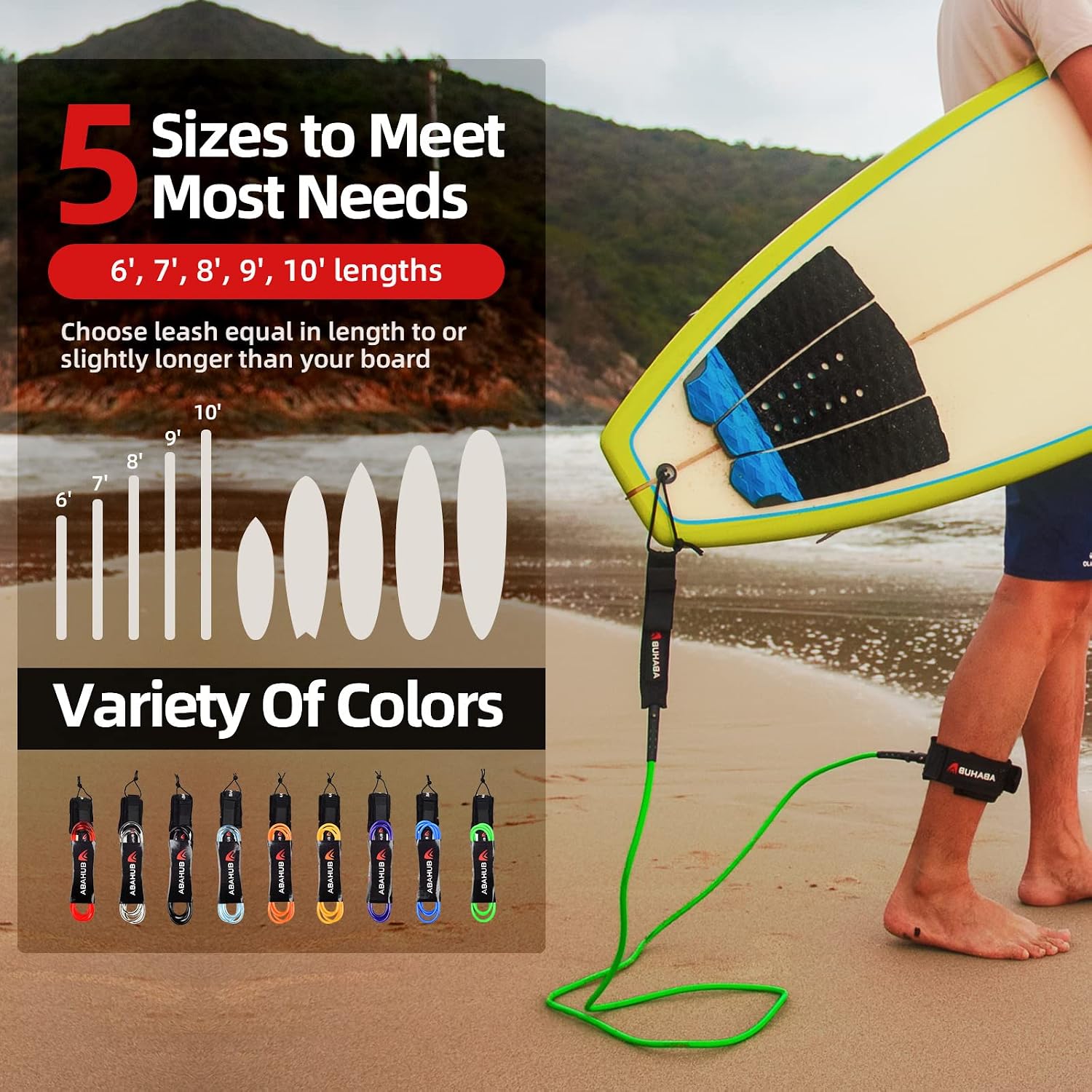
The most repeated rule in leash sizing is straightforward: your leash should be approximately the same length as your board, or slightly longer. Surfline’s equipment guide puts the working standard at matching leash length to board length within six inches. That guideline exists for a specific reason — drag and rebound distance.
A leash that’s too short creates rebound snap, meaning when you fall, the board can whip back toward your head faster and with less warning. Surfer Magazine’s gear coverage has repeatedly flagged this as the primary safety argument for sizing up rather than down. A leash that’s too long adds unnecessary drag in the water, creates more slack to tangle around your legs in critical moments, and slows your paddle-back after a wipeout.
Here’s how the sizing maps across board types:
Shortboards (5’6”–6’6”): Ride a 6’ leash. This is the performance window. Owners report that dropping to a 5’ leash on a shortboard starts producing noticeable rebound risk in overhead surf.
Mid-length and funboard shapes (6’6”–8’0”): Move to a 7’–8’ leash. These boards have more volume — meaning more mass pulling against you when the cord goes taut.
Longboards (9’0”+): 9’–10’ leash minimum. A common mistake is running a 7’ leash on a 9’6” log. The math doesn’t work: the board outruns the leash’s stretch capacity and you either snap cord or get a violent rebound.
Big wave / gun shapes: Specialty leashes of 10’–12’ with reinforced swivels. These are a different category discussed below.
One condition nuance worth flagging: crowded lineups. When the peak is packed, a shorter-than-board-length leash keeps your loose board in tighter proximity to you — reducing danger to other surfers. Cleanline Surf’s buying guide notes this as the one situation where experienced surfers deliberately size down by six inches to a foot.
Cord Thickness: The Durability and Drag Trade-off
Leash cord is measured in millimeters of diameter. This single number controls two things in tension with each other: strength and water drag.
Thicker cord is stronger and more resistant to snap — but it catches more water, creating drag on every paddle stroke and adding weight in the water. Thinner cord reduces drag meaningfully but has a lower breaking threshold. Boardcave’s leash overview puts the practical range for most surfers between 6mm and 8mm, with a clear decision fork:
By the Numbers
| Cord Thickness | Best For | Breaking Load (approx.) |
|---|---|---|
| 5–5.5mm | Competition shortboard, small clean surf | Lower threshold — not for heavy conditions |
| 6–6.5mm | Everyday shortboard performance | Standard; solid for 2–8 ft surf |
| 7mm | Mid-length, funboard, intermediate surfers | Good all-around durability |
| 7.5–8mm | Longboard, heavier surfers, punchy beach break | High strength, accepts more cord stress |
| 9mm+ | Big wave, reef, XXL surf | Purpose-built; significant drag trade-off |
Breaking load figures vary by brand and manufacturing batch. Always check manufacturer ratings before surf travel or heavy conditions.
Wavelength Surf Magazine’s gear reviews consistently note that surfers transitioning from a 6mm to a 5mm competition leash are often surprised by how quickly drag decreases — but that trade-off shows up immediately if you wipe out in powerful surf and put real load on the cord.
The Inertia’s safety coverage has flagged cord abrasion as an underappreciated failure point: a leash that looks intact can have micro-fractures in the polyurethane from repeated stretching. Most experienced surfers replace leashes every 6–12 months of regular use, regardless of visible wear.
Straight vs. Coiled: A Condition-Specific Call
You’ll see two cord configurations on the market: straight cords and coiled cords.
Straight cords are the default for shortboard and performance surfing. They lie flat in the water, create less tangling around the legs mid-maneuver, and are the correct choice for beach break, point break, and reef conditions where you’re actively surfing the face of the wave.
Coiled cords are the correct choice for stand-up paddleboarding (SUP) and some longboard applications. The coil keeps excess cord out of the water when you’re standing upright and paddling on flat water between sets. In a standard shortboard session, a coiled leash is actively counterproductive — the coil catches water and drags unpredictably.
If a shop recommends a coiled leash for your shortboard, that’s a mismatch. Stick with straight cord for wave riding.
Swivels, Cuffs, and the Details That Actually Matter
Two components on a leash get ignored until they fail: the swivel and the cuff.
Swivels prevent the cord from twisting and wrapping around your legs. A quality leash has swivels at both ends — at the cuff and at the rail saver (the flat section that attaches to your board’s leash plug). Single-swivel designs are a cost cut that shows up as cord twist within a few sessions. Owners across aggregated reviews report that double-swivel leashes — standard on brands like FCS, Creatures of Leisure, and Dakine — maintain cleaner cord behavior across a full session.
Cuffs should be wide enough to distribute pressure comfortably but not so loose that they slide down toward your foot under load. Neoprene-lined cuffs are the spec to look for in colder water conditions; they reduce abrasion against wetsuits and bare skin over long sessions.
Rail savers — the wide flat section near the board end — protect your board’s tail rail from the cord digging in during a wipeout. A narrow rail saver on a powerful wave is a recipe for a dinged rail within a season.
Matching Leash to Wave Type and Water Temp
Condition-specific leash decisions are where intermediate surfers make the most expensive mistakes — specifically, buying a single leash and using it everywhere.
Beach break: 6–7mm cord, board-length leash, straight cord. Beach break is punchy and unpredictable. You want durability over drag savings here. The extra millimeter of cord thickness is worth it when you’re getting pitched on a closeout.
Point break: 6mm performance cord is appropriate in smaller, cleaner surf at a well-shaped point. The longer ride means your leash is in the water for extended periods — drag reduction matters more here than at beach break.
Reef break: Size up in thickness, always. Owners surfing reef consistently report higher cord failure rates because shallow-water wipeouts put maximum sudden load on the leash — the board catches water and stops while your body keeps moving. A 7–7.5mm cord at a reef is a reasonable baseline. FCS leash spec sheets note their Comp series (5.5mm) is explicitly not rated for heavy reef conditions.
Cold water and wetsuit use: A thicker cuff is more important here. In water below 55°F, where you’re wearing 4/3mm or 5/4mm wetsuits, a standard cuff creates friction points at the wetsuit cuff seam. Wider neoprene-padded cuffs from brands like Dakine and Creatures of Leisure address this directly — reviewers in cold-water markets (Pacific Northwest, Atlantic northeast) consistently rate cuff padding as a deciding factor.
Budget Brackets and What You’re Actually Paying For
Leashes sit in a relatively narrow price band, but the tiers are real.
$ ($20–$35): Entry-level construction, often single swivel, minimal cuff padding. Fine for learning and small surf. Not the right tool for overhead-plus conditions or regular reef sessions.
$$ ($35–$60): The performance standard. Double swivel, quality polyurethane cord, reinforced rail saver, neoprene cuff lining. This is where brands like FCS, Creatures of Leisure, and Dakine compete. Most surfers should live here.
$$$ ($60–$90+): Comp-grade ultra-thin leashes and big wave specialist leashes. The comp leash sacrifices durability for drag reduction. The big wave leash adds cord diameter, reinforced swivels, and calf attachment options. Neither is the right default purchase.
The Decision Rule
If you leave with one framework, make it this:
- Match leash length to board length — within six inches, erring longer rather than shorter.
- Match cord thickness to conditions: 6mm for everyday performance shortboard surf, 7–8mm for mid-lengths, longboards, and reef, 5–5.5mm only if you’re competing in small clean surf and accept the durability trade-off.
- Choose straight cord for all wave-riding; coiled cord only for flatwater paddle applications.
- Prioritize double swivels and a wide rail saver regardless of price tier — these are failure points that matter.
- Replace on a schedule, not just when the cord looks worn. Wavelength Surf Magazine’s gear notes and Cleanline Surf’s recommendations both converge on 12 months of regular surf as a reasonable replacement interval for polyurethane cord exposed to UV, salt, and repeated load cycles.
Get those variables dialed, and the leash disappears from your session — which is exactly what it should do.