You’re standing in the surf shop — or more likely, staring at a product page at midnight — trying to decide between a 7-foot foam board and a 6-foot foam board for a kid, a spouse, or yourself just stepping into the sport. Foam boards, often called “foamies” or “soft-tops,” are surfboards with a soft foam deck and a lightweight foam core. They’re more forgiving than fiberglass, cheaper to replace, and far safer when a wave knocks the board into your shins. For anyone in their first year of surfing, a foamie isn’t a compromise — it’s the right tool. The question isn’t whether to buy one. It’s which one, and whether a 7-foot shape will carry you further than a 6-foot shape before you outgrow it.
This article puts three boards head-to-head: the Wavestorm 7ft, the Thurso Surf 7ft, and the Rock-It 6ft Albert. Each one targets a slightly different surfer at a slightly different stage. By the end, you’ll have a clear decision rule — not a vague “it depends.”
| EDITOR'S PICKRock-It 6' Albert Performance F… | Mid-tierThurso Surf 7/8 ft Soft Top Foa… | Budget pickWavestorm - Classic Soft Top Fo… | |
|---|---|---|---|
| Length | 6 ft | 7/8 ft (selectable) | 7 ft |
| Leash included | — | — | ✓ |
| Fins included | — | — | ✓ |
| Board type | Performance fish | Beginner longboard | Classic soft top |
| Construction | — | — | Heat laminated |
| Skill level | — | All levels | Beginner and all levels |
| Price | $299.98 | $289.00 | $279.99 |
| See on Amazon → | See on Amazon → | See on Amazon → |
The Boards at a Glance
Before diving into the tradeoffs, here’s the core spec comparison. Volume is measured in liters — more liters means more float, which makes it easier to paddle and pop up (stand up) on a wave.
By the numbers:
| Board | Length | Width | Volume (approx.) | Tail Shape | Budget Tier |
|---|---|---|---|---|---|
| Wavestorm 7ft | 7’0” | 22” | ~65–70L | Rounded pin | Wavestorm AZ22-WSSF700-PIN — $279.99 |
| Thurso Surf 7ft | 7’0” | 22.5” | ~68–72L | Rounded squash | Thurso — $289.00 |
| Rock-It 6ft Albert | 6’0” | 21.5” | ~42–46L | Swallow/fish | Thurso — $289.00 |
The Wavestorm and Thurso are in the same physical ballpark. The Rock-It is a different category of board — shorter, lower volume, performance-oriented — which is exactly the point of including it here.
Head-to-Head Board Breakdown
Wavestorm 7ft: The Proven Teaching Machine
The Wavestorm 7ft is the default first board for a reason. It’s the board that surf schools stock in multiples, that parents recognize by name, and that reviewers keep citing as “the board that actually got me standing.”
Aggregated buyer feedback from beachbreak markets — particularly shore-break towns with punchy, consistent near-shore waves — documents surfers weighing 116 lbs and 135 lbs, both complete beginners, progressing from lying flat to standing consistently across five sessions. That’s not a miracle — that’s what sufficient volume and a stable outline do when conditions cooperate. Reviewers in those accounts specifically credit the board’s 22-inch width and rounded tail for keeping the board stable underfoot during the pop-up transition.
Surfer Magazine’s guide to choosing a first surfboard establishes that the key metric for beginner boards is volume relative to body weight — a rule of thumb is roughly 1 liter of volume per kilogram of body weight, though beginners often benefit from more. The Wavestorm 7ft’s estimated 65–70 liters makes it suitable for surfers up to roughly 70–80 kg (154–176 lbs) who are learning to pop up.
Wavestorm strengths:
- Widely available and priced at the low end of the market
- Stable, forgiving outline for true beginners
- Documented zero-to-standing performance across multiple buyer accounts
- Replacement fins and parts are comparatively easy to source
Wavestorm caution: Aggregated reviews of smaller Wavestorm fish and swallow-tail shapes — models shorter than 7ft — include accounts of nose damage on delivery and build quality rated notably worse than the original longer Wavestorm formats. That feedback applies to smaller sibling models, not the 7ft itself, but it’s worth knowing that Wavestorm’s quality consistency varies across its product line. For teaching situations, stick to the 7ft and 8ft formats.
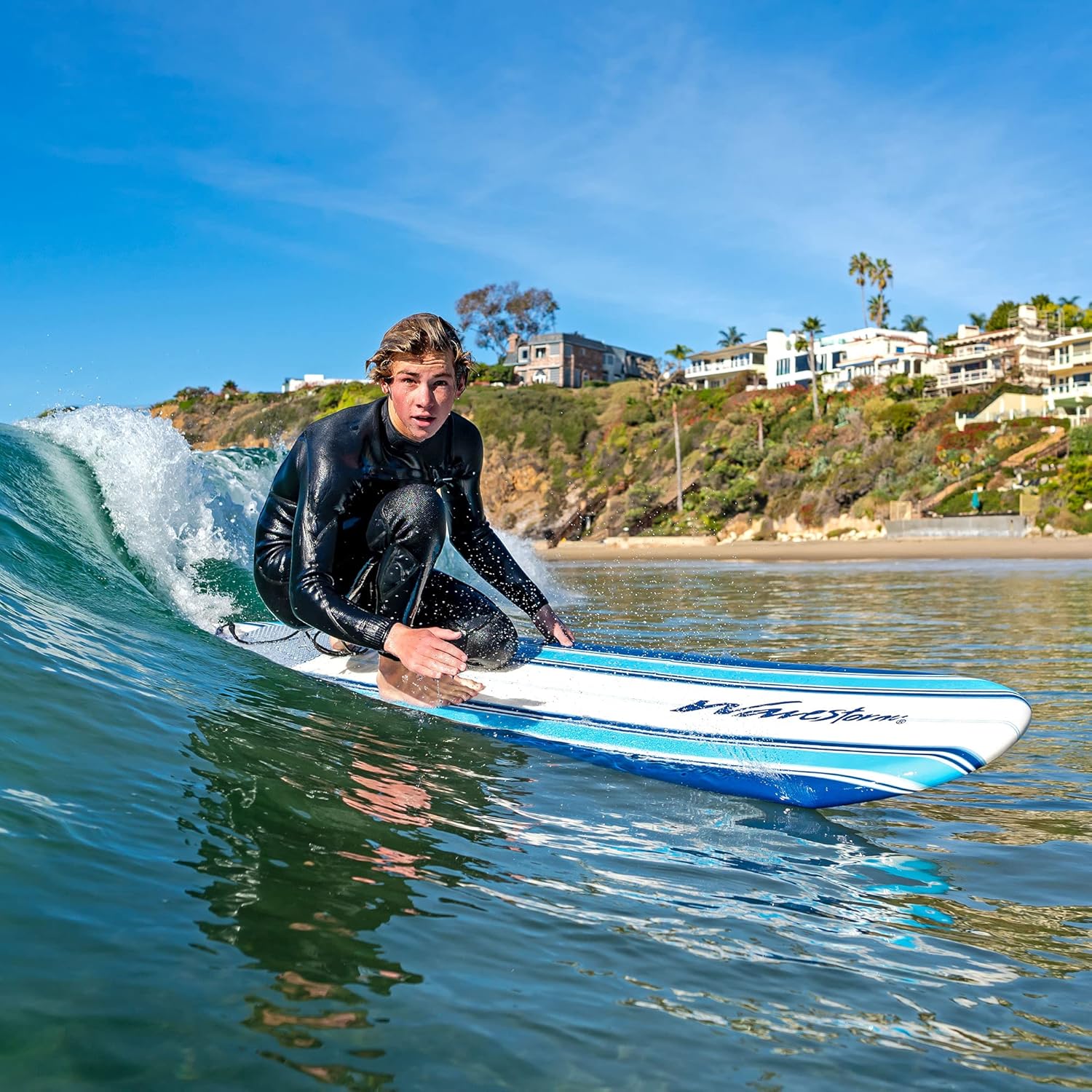
Wavestorm AZ22-WSSF700-PIN
$279.99
In stock on Amazon
Check price on AmazonThurso Surf 7ft: The Better-Packaged Rival
Thurso Surf has carved out a loyal buyer base not by outclassing Wavestorm on raw performance, but by arriving in better shape. That matters more than it sounds.
Across aggregated reviews, buyers who switched to Thurso after receiving damaged boards from other brands specifically call out Thurso’s packaging — reinforced corners, denser foam wrap — as a meaningful differentiator. In a category where a delivery ding can mean an unusable board and a multi-week return process, that’s a real competitive edge.
The Thurso 7ft’s slightly wider nose (22.5 inches versus the Wavestorm’s 22 inches) adds a small amount of forward stability — useful when a young surfer is still figuring out weight distribution. Owners also flag the Thurso as a particularly strong performer in shore-break scenarios, praising it specifically for teaching children in fast, dumpy waves that form close to the beach. The Inertia’s coverage of foam board design notes that shorter, wider foam boards handle shore-break better than longer, narrower shapes because there’s less board to manage when a wave pitches quickly — the Thurso 7ft’s outline sits in a practical middle ground.
Where Thurso earns its spot: If you’re ordering online and have had a bad experience with boards arriving damaged, Thurso’s packaging track record is worth the slight price premium over Wavestorm. For surf school operators ordering multiple units, that reliability compounds — one damaged board in a quiver of eight can disrupt a morning session.
Thurso weaknesses: Less retail ubiquity than Wavestorm. Replacement parts and fin compatibility are slightly less straightforward — always confirm fin box type before ordering replacements, and ask the manufacturer directly whether your fin box is FCS II (a two-tab fin system requiring FCS II-compatible fins) or a proprietary format before purchasing aftermarket fins.
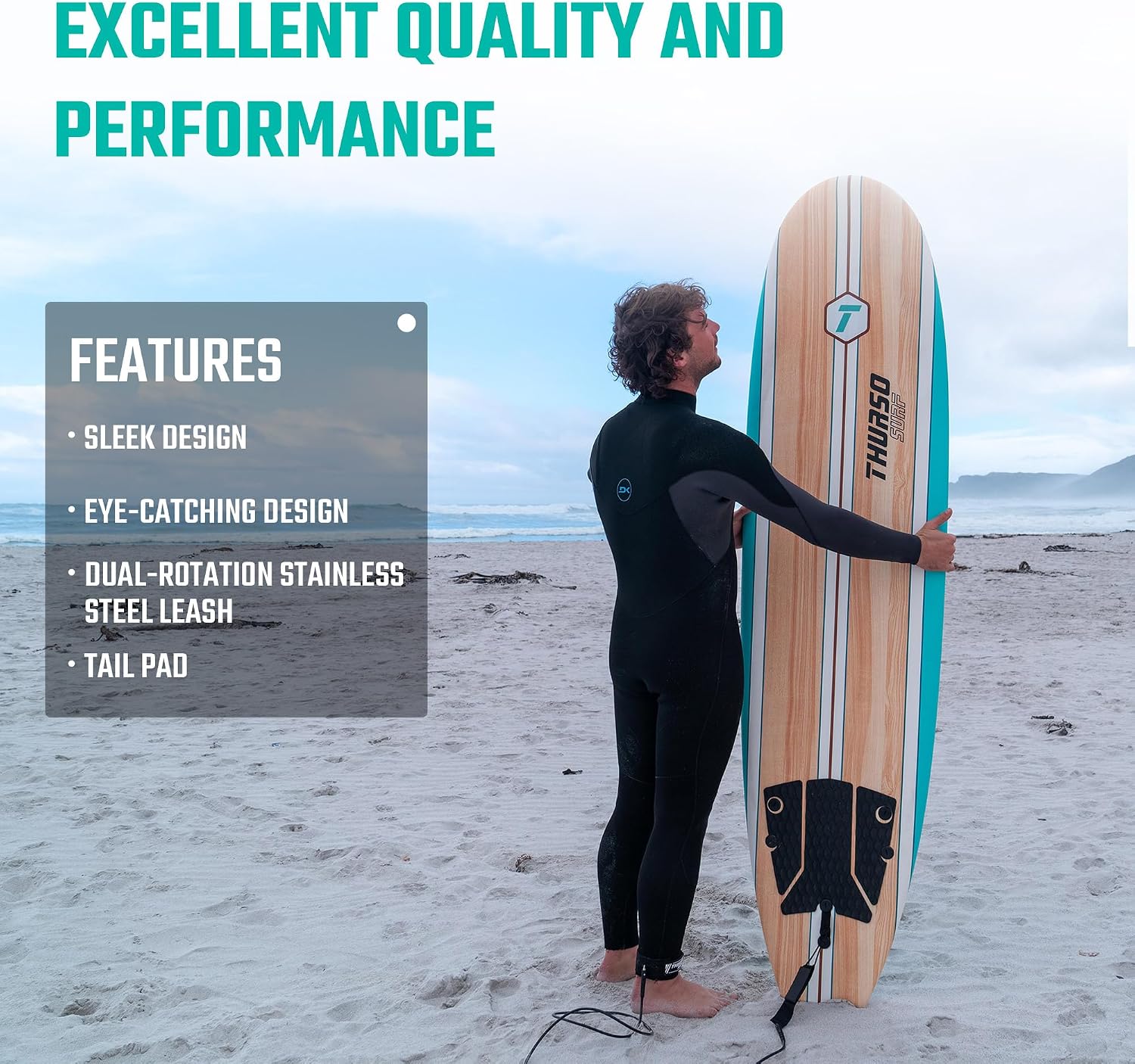
Thurso
$289.00
In stock on Amazon
Check price on AmazonRock-It 6ft Albert: The Bridge Board, Not the Beginner Board
Here’s where the comparison gets interesting — and where buyers most often misjudge the category.
The Rock-It 6ft Albert is not a beginner board. It’s a bridge board: designed for someone who can already stand up reliably on a 7ft foamie and wants to start practicing turns and trim (riding along the wave face at an angle, rather than just going straight to shore). At an estimated 42–46 liters, it has dramatically less float than either 7ft option. A 150 lb surfer who still struggles on a 7ft will find the 6ft humbling — less paddle power, faster to tip, and less margin for a sloppy pop-up.
What the Rock-It 6ft does well: its swallow tail — a fish-shaped tail with two small points that increases drive and speed in small, mushy waves — makes it lively in knee-to-waist-high beachbreak. Boardcave’s surfboard volume and sizing guides note that fish tail shapes generate more speed through flat sections than a rounded pin, which is a direct advantage in the kind of soft, rolling waves beginners practice in as they develop.
A real quality-control issue to know about: One documented buyer account of the Rock-It 6ft Albert flags that a fin arrived missing from the box and the buyer initially could not locate a replacement. This is a genuine usability concern. Rock-It’s customer service was specifically praised in that same account as responsive and effective — but the experience raises a flag for anyone ordering for a child’s trip or a surf camp where same-day setup is non-negotiable.
Fin compatibility note: The Rock-It 6ft Albert uses a proprietary fin setup, not FCS II or Futures (another common single-tab fin system used in performance boards). If you need replacement fins, contact Rock-It Surf directly before searching third-party surf shops — most do not stock proprietary soft-top fins, and online listings can be inconsistent. Do not attempt to force FCS II fins into a proprietary box; the geometry differs and you risk damaging the fin box permanently.
Who this board is actually for: A surfer who can stand up on 80% of their caught waves on a 7ft foamie, weighs under 160 lbs, and wants to start feeling what a shorter shape demands. Not a first board. A second board.
Thurso
$289.00
In stock on Amazon
Check price on AmazonDecision Rules: If X, Then Y
This is the frame that matters. Use it before you click buy.
If you’re buying for a child aged 10–15 who is a true beginner: Start with the Wavestorm 7ft or Thurso 7ft. The volume keeps the learning window open. The Thurso earns the edge if you’re ordering online and have budget for the slight premium — its packaging track record is better. The Wavestorm earns the edge if you can pick it up locally or have a convenient store return option.
If you’re a parent who wants to step a child down from a longer board: A 7ft is the right step-down from an 8ft for most children, but hold at the 7ft until pop-up consistency is well established. Don’t jump to the 6ft Rock-It Albert until standing on caught waves is reliable and repeatable.
If you’re a surf school operator ordering a quiver: The Thurso 7ft’s packaging reliability matters at volume. Budget accordingly.
If you’re an adult recreational surfer who can already stand up and wants to progress: The Rock-It 6ft Albert is worth considering — but only if your pop-up is consistent and your wave reading is developing. The lower volume will expose every technical weakness. That’s the point, and it’s why the board earns a place in this comparison even though it isn’t a beginner tool.
If you need a board today and a missing fin would ruin the trip: Don’t risk the Rock-It 6ft unless you’ve confirmed your fins are in the box and you have a backup plan. The Wavestorm’s parts ecosystem is more forgiving in a pinch.
Frequently Asked Questions
What is the right foamie length for a 10-year-old who is 5ft tall? A 7ft foamie is the right call. A 10-year-old at 5ft will struggle to maneuver a longer 8ft or 9ft board in shore-break, and a 6ft fish like the Rock-It Albert carries too little volume for a beginner at that weight. The 7ft hits the sweet spot — manageable length, enough float to catch small waves easily, and not so long that wiping out becomes dangerous to nearby surfers. Per Cleanline Surf’s foam board buying guidance, volume-to-weight ratio matters more than length alone, but for a child under 100 lbs, both the Wavestorm 7ft and Thurso 7ft carry more than enough float to support the learning process.
Will a 7ft foamie fit in a sedan or do I need a roof rack? Most sedans cannot fit a 7ft board inside the cabin — it exceeds the diagonal measurement of even large back seats. A roof rack or a truck bed is the practical solution. Some hatchbacks and station wagons can fit a 7ft if the front passenger seat is moved forward, but this is car-specific. Foam boards are lighter than fiberglass, so a basic soft roof rack (foam pads with straps) works fine for occasional trips. For regular use, invest in a proper rack system rated for your vehicle’s roof.
How does the Thurso 7ft handle shore-break compared to the Wavestorm 7ft? Aggregated owner reviews give Thurso a slight edge in shore-break specifically. The slightly wider nose adds forward stability in fast, dumpy waves, and buyers purchasing for children in shore-break conditions — where waves pitch quickly and there is little time to adjust position — consistently rate the Thurso as easier to manage. That said, the difference is marginal. Both boards are substantially safer and easier to handle in shore-break than a 10ft longboard, which becomes difficult to control when a wave breaks close to the sand.
When should a beginner move from a 7ft foamie to the Rock-It 6ft fish shape? The milestone to watch is pop-up consistency — specifically, whether the surfer is standing up on roughly 8 out of 10 caught waves, not just occasionally. A second indicator is whether they’re starting to trim: riding across the wave face rather than going straight to shore. If both are happening, the 6ft fish will feel exciting rather than frustrating. If pop-up consistency isn’t there yet, the lower volume of the Rock-It 6ft will feel punishing, not progressive. Boardcave’s volume progression guides recommend dropping to a shorter shape only when a surfer is comfortably riding a board at or near their minimum recommended volume for their weight and skill level.
What replacement fins fit the Rock-It 6ft Albert if the originals go missing? The Rock-It 6ft Albert uses a proprietary fin system that is not compatible with FCS II fins (the most common two-tab fin standard found in performance shortboards) or Futures fins (a single-tab alternative used by many performance brands). If your fins are missing or damaged, contact Rock-It Surf’s customer service directly — buyer accounts in review documentation report that the support team is responsive and can source replacement fins. Do not attempt to force a different fin standard into the proprietary box; the geometry differs and you risk damaging the box permanently.
The right foamie for a progressing beginner isn’t the cheapest or the shortest — it’s the one that holds its value as a teaching tool long enough to matter. A 7ft shape, whether Wavestorm or Thurso, gives a new surfer room to build the fundamentals without fighting the equipment. The Rock-It 6ft Albert is the reward for doing that work. Know where your surfer actually is, not where you hope they are, and the decision becomes straightforward.