You drove an hour to the beach. Waves are two feet and crumbly — the kind that forgive everything. You pull out your board and the deck is dented like a golf ball, the tail is delaminating, and the fins are held on with hardware-store screws that have started to rust. Somewhere around session forty, a foam surfboard — a board made from a soft, closed-cell foam core instead of fiberglass and resin, safer, more buoyant, and much more forgiving for learning — stopped being a value and started being a liability.
This guide is for the surfer who’s past that mistake, or trying to avoid it entirely. We’re comparing the Wavestorm 8ft, the most purchased foam board in American surf history and available at Costco for around $150, against the serious foamie alternatives in the $180–$350 range. We’ll look at construction differences, real-world durability patterns, volume and dimensions, and the scenarios where each board earns its price tag. By the end, you’ll have a clear decision rule, not just a ranked list.
| EDITOR'S PICK[Thurso Surf 7/8 ft Soft Top Foa](https://www.amazon.com/dp/B07H13Q5P6?tag=greenflower20-20)… | Mid-tier[Wavestorm 8ft Surfboard](https://www.amazon.com/dp/B01DQ0D606?tag=greenflower20-20) // Foam… | Budget pickWavestorm -Soft Top Foam 5'6" S… | |
|---|---|---|---|
| Length | 7-8 ft | 8 ft | 5'6" |
| Tail shape | — | — | Swallow |
| Included fins | — | — | Multiple fins |
| Leash included | — | — | ✓ |
| Skill level | Beginner | All Levels | Beginner |
| Price | $289.00 | $256.38 | $183.99 |
| See on Amazon → | See on Amazon → | See on Amazon → |
Why the Wavestorm Is Both a Legend and a Trap
Let’s give credit where it’s due. The Wavestorm 8ft democratized surfing. The Inertia has noted in its editorial coverage of the soft-top market that no single product has put more people on waves than the Costco foamie, and that’s not hyperbole. At roughly $150 in 2026, with a tri-fin setup and a leash included, the barrier to entry effectively disappeared.
Published specs on the Wavestorm 8ft:
- Length: 8’0”
- Width: approximately 22.5”
- Thickness: approximately 3”
- Volume: estimated 80–85 liters (the manufacturer does not publish an official figure)
- Fins: proprietary 3-fin box system, not FCS II or Futures compatible
- Construction: EPS foam core, HDPE slick bottom, soft EVA foam deck
That volume number matters. Volume — measured in liters — tells you how much flotation a board provides. More liters means more buoyancy, which means easier paddling and wave-catching. For most adult beginners, 75–90 liters is the target zone. The Wavestorm hits it.
Here’s where the trap opens. The construction prioritizes cost, not longevity. Owners across aggregated reviews on Cleanline Surf and elsewhere consistently report the same sequence: the EVA foam deck starts compressing and denting within 20–40 sessions under regular use. The HDPE bottom can crack at the tail after impacts. The fin boxes — a proprietary system incompatible with the industry-standard FCS II or Futures fin systems — strip easily and cannot be upgraded. By session 60 to 80, many owners report visible delamination, meaning separation between the foam core and outer skin layers, along the rails.
Stab Magazine’s ranking of soft-top surfboards described the Wavestorm as the board that wins on price and loses on longevity, which is an accurate editorial summary of the pattern that emerges across years of owner reports.
The verdict on the Wavestorm is not that it’s a bad board. It’s that it’s a 40-to-60 session board priced like one. If you surf twice a month, that’s two to three years of useful life. If you surf twice a week, you’re shopping again by next spring.
How the Top Foamie Competitors Stack Up
### Catch Surf Odysea Log: The Mid-Tier Standard-Setter
The Catch Surf Odysea Log, priced at $229–$280 depending on size and retailer, is the board that redefined what a foamie should feel like. It’s where the comparison gets interesting for anyone planning to actually stick with surfing.
Published specs on the Catch Surf Odysea Log 8’0”:
- Length: 8’0”
- Width: 22.5”
- Thickness: 3.25”
- Volume: approximately 85–90 liters (Catch Surf publishes approximate figures by model)
- Fins: FCS II compatible on most models — the industry’s most widely used fin system, allowing you to swap fins from dozens of manufacturers — though some entry variants ship with a fixed-fin setup; confirm compatibility before purchasing
- Construction: multi-layer soft-top with a hardened epoxy stringerless core and higher-density deck skin
The difference in construction is meaningful. Boardcave’s Soft-Top Surfboard Buyer’s Guide specifically highlights deck skin density as the primary predictor of long-term durability in foam boards, and the Odysea’s deck skin is measurably firmer underfoot than the Wavestorm’s. Owners consistently describe the Wavestorm’s deck as spongier and more prone to denting by comparison.
Across aggregated owner reviews compiled by Cleanline Surf, Odysea owners report significantly cleaner deck conditions past the 80-session mark. The FCS II fin compatibility upgrade is real money in your pocket over time: FCS II fins are available from around $30 for basic glass-flex sets up to $180 or more for carbon performance sets, and the ability to tune your board’s drive and pivot as your surfing evolves is something the Wavestorm’s proprietary system simply cannot offer.
The honest trade-off: the Odysea costs $80–$130 more upfront. That’s the entire decision math for most buyers.
Wavestorm
$256.38
In stock on Amazon
Check price on AmazonSoftech Handler: The Intermediate Surfer’s Foamie
The Softech Handler runs $260–$310 and comes from an Australian brand with deeper roots in the surf industry than its soft-top lineup might suggest. The Handler’s construction uses a higher-density core and a more durable slick bottom than either the Wavestorm or the base Odysea models.
Wavelength Surf Magazine’s Best Beginner Surfboards of 2025 cited the Handler as the top pick for intermediate surfers who want a foamie for small-wave days in their quiver — meaning surfers who already own performance boards but want something fun and forgiving on two-foot beach break. Fin system: FCS II compatible. Volume on the 8’0”: approximately 82 liters.
Owner reports across surf retail review aggregates describe the Handler’s rails holding up through repeated beach-break impacts better than either the Wavestorm or the standard Odysea, a pattern consistent with the thicker co-molded rail construction Boardcave’s buyer’s guide identifies as the key variable in impact durability.
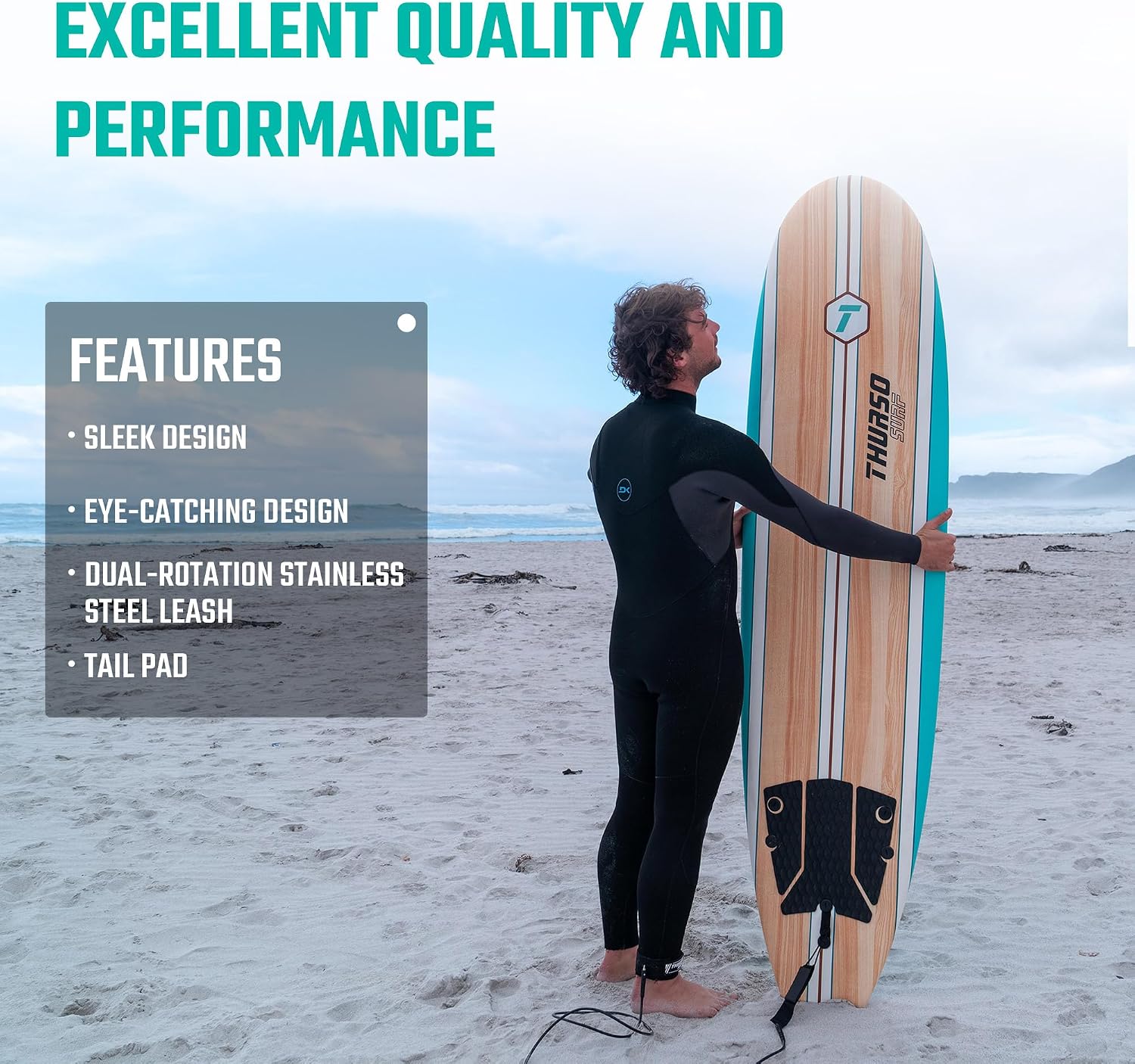
Thurso
$289.00
In stock on Amazon
Check price on AmazonSouth Bay Board Co. Heritage: The Value Fleet Option
The South Bay Board Co. Heritage runs $220–$280, and owners consistently report solid construction for the price. South Bay’s customer service reputation is strong across surf retail channels, and the brand publishes volume figures clearly on its product pages — a transparency the Wavestorm noticeably lacks.
Fin system varies by model; verify FCS II or Futures compatibility before purchasing if upgradeability matters to you. For surf school operators buying in volume, South Bay’s pricing and durability profile makes it a legitimate fleet consideration. The brand’s willingness to publish specs openly is also a signal of category seriousness that entry-level brands often skip.
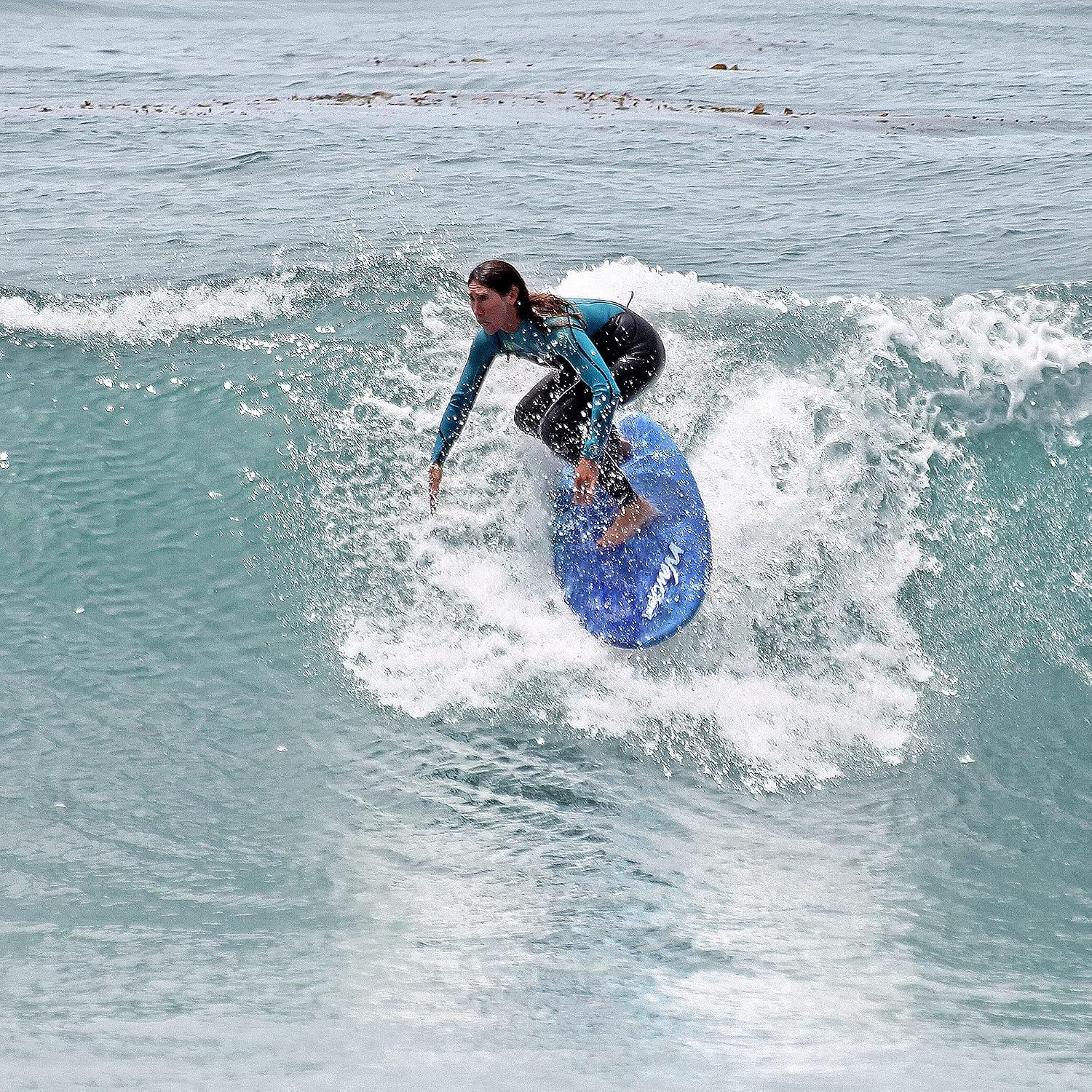
Wavestorm AZ21-WSSF560-BLU-1PK
$183.99
In stock on Amazon
Check price on AmazonWhat Actually Breaks, and When
Durability in foam boards fails at four points, and the boards above rank differently at each one.
1. Deck compression. This is the golf-ball denting you see in high-traffic knee and foot zones. It’s cosmetic at first, then structural. The Wavestorm’s lower-density EVA skin compresses faster than the Odysea or Softech equivalents. Boardcave’s Soft-Top Surfboard Buyer’s Guide notes that deck skin density above 60 kg/m³ significantly extends compression resistance — a spec the Wavestorm does not meet based on available construction data.
2. Delamination at the rails. Where the top skin meets the slick bottom along the board’s edges — the “rails” — is the most common failure point after impacts. All foamies are vulnerable here, but thicker, co-molded rail construction present in the Softech Handler and higher-end Odysea builds holds notably longer in owner reports aggregated by Cleanline Surf.
3. Fin box failure. The proprietary fin boxes on the Wavestorm use a simple screw-in system that strips with regular fin removal and reinstallation. FCS II’s click-in mechanism on the Odysea and Softech eliminates this failure mode almost entirely. If you’re running a surf school and removing fins for storage between sessions, this is not a minor point — it’s a fleet management issue that compounds across dozens of sessions per board.
4. Slick bottom cracking. The HDPE slick bottom on the Wavestorm is thinner than competitors’ versions and prone to stress cracking at the tail. Owners who surf beach break with shore-dump — waves that break directly on the sand in shallow water — report tail damage more frequently than those surfing gentler, deeper-water breaks.
The Decision Rule
Here’s the if/then framework this comparison leads to.
If you’re buying for a single beginner who may or may not continue surfing: The Wavestorm at $150 is the rational choice. The cost-per-session math works if there’s genuine uncertainty about commitment. Accept the durability ceiling. Don’t spend $260 on someone who might surf six times.
If you’re buying for yourself and plan to surf more than 30 sessions per year: The Catch Surf Odysea at $260 is the top pick. The $110 price gap closes within the first season when you’re not replacing a board that’s delaminated. FCS II compatibility means the board grows with your ability, letting you experiment with different fin configurations as your surfing evolves.
If you’re a surf coach or school operator buying five or more boards: Skip the Wavestorm entirely. The total cost of ownership — accounting for replacement cycles, fin box repairs, and the reputational issue of putting students on visibly deteriorating equipment — flips the math against it by unit three or four. South Bay Board Co.’s volume pricing and Softech’s durability profile both warrant direct outreach for fleet quotes.
If you’re an intermediate surfer wanting a small-wave quiver addition: Neither the Wavestorm nor the standard Odysea Log is your board. Look at shorter-template foamies designed for surfers who already know what they’re doing — boards in the 5’6”–6’2” range built for performance on small surf rather than as paddling platforms for beginners.
Quick-Reference Comparison
| Board | Price (2026) | Volume (approx.) | Fin System | Deck Durability |
|---|---|---|---|---|
| Wavestorm 8ft | ~$150 | 80–85L | Proprietary only | Denting common by session 40 |
| Catch Surf Odysea 8ft | ~$260 | 85–90L | FCS II compatible | Holds up past session 80 |
| Softech Handler 8ft | ~$290 | ~82L | FCS II compatible | Strong; top-rated for durability |
| South Bay Heritage 8ft | ~$240 | Published by brand | Varies by model | Positive reports; good value |
The foamie category has earned its place in serious quivers. The Wavestorm built the market — cheaply, accessibly, and at genuine scale. The boards above are what the market built once surfers started asking for something that lasted. Know your session count, know your budget, and buy accordingly.