Picture this: you paddle out at a New Jersey beach break in October, water temperature sitting around 62°F, and by the time you’ve taken your third wave you notice something is off. Your pop-up — the move where you go from lying flat on the board to standing in one fluid motion — feels sticky. Your shoulders are pulling. Your lower back is working twice as hard as it should be. You chalk it up to fatigue, or a cold water day, or just being rusty. But here’s the thing: it might not be any of that. It might be your wetsuit.
A wetsuit is a close-fitting suit made from neoprene — a synthetic rubber that traps a thin layer of water against your skin and lets your body heat warm it, keeping you insulated in cold water. Women’s bodies have different proportions than men’s: longer torsos relative to leg length, wider hips, narrower shoulders, and more curve through the chest and waist. When women surf in men’s or unisex suits — which are cut for a straighter, narrower torso — the neoprene pulls across the shoulders and bunches at the waist, restricting exactly the range of motion you need for paddling and popping up. This guide will show you what to look for, which specs actually matter for Atlantic conditions, and how to match the right suit to your budget and the water temperature where you actually surf.
Why the Cut Matters More Than the Brand Name
Let’s get specific about what “fit” means in a wetsuit context, because it’s not the same as fit in a regular piece of clothing.
In a wetsuit, fit is about pre-stretch positioning. Neoprene stretches, but it has a return force — it wants to snap back. If the seams and panels aren’t positioned for your body’s geometry, that return force works against your movement rather than with it. For women surfing Atlantic breaks from Nova Scotia to South Florida, this shows up in two specific places:
The shoulder and paddle zone. A men’s-cut suit is built for narrower shoulders and a flatter chest. On a woman’s body, the chest panel sits too high, which shortens the sleeve and creates tension across the back every time you reach forward to paddle. Across aggregated reviews on Cleanline Surf’s women’s wetsuit category, the single most consistent complaint about men’s-fit suits is restricted shoulder rotation during paddling.
The torso length and waist. Women’s torsos are proportionally longer. A men’s suit that fits in the chest will often be too short through the midsection, creating a “pull-up” effect that drags the suit out of position. That gap at the lower back is also a flushing point — cold Atlantic water shoveling in around the lumbar every time you duck dive. On a 58°F day in late October off Cape Hatteras, that is not a theoretical problem.
Women’s-specific suits address both by repositioning the chest panel lower, widening the hip block, narrowing the shoulder, and adding length through the torso. Manufacturers like Rip Curl, O’Neill, Patagonia, and Matuse all publish distinct women’s pattern templates that diverge meaningfully from their men’s blocks. Per Wavelength Surf Magazine’s review of women’s-specific construction, the torso differential on Rip Curl’s women’s Flashbomb versus the equivalent men’s cut is approximately 1.5 to 2 inches through the mid-panel — enough to change the suit’s behavior entirely.
Atlantic Water Temperatures: Matching Thickness to Your Region
Thickness is measured in millimeters (mm) and written as two or three numbers separated by slashes — for example, 4/3 or 3/2. The first number is the thickness across the torso (where you need maximum insulation), and the second number is the thickness through the arms and legs (where you need maximum flex). A third number, when present (e.g., 5/4/3), applies to the lower leg. Thicker = warmer. Thinner = more flexible.
Here’s a rough temperature-to-thickness map for the Atlantic coast, drawn from Boardcave’s wetsuit temperature guide and Surfline’s regional water temperature data:
By the numbers:
| Region / Season | Avg. Water Temp | Recommended Thickness |
|---|---|---|
| Maine / Nova Scotia, May–Oct | 48–62°F | 4/3 to 5/4/3 + boots/gloves |
| New England, Jun–Sep | 60–70°F | 3/2 to 4/3 |
| Mid-Atlantic (NJ/VA), Apr–Nov | 52–72°F | 3/2 (summer) / 4/3 (shoulder) |
| Outer Banks / SC, Oct–Mar | 50–60°F | 4/3 |
| Florida / Caribbean, year-round | 72–82°F | 2mm shorty or 1mm top |
The Mid-Atlantic is the decision-heavy zone. A 3/2 (3mm torso, 2mm limbs) is the Atlantic workhorse suit. It handles water temps from roughly 58°F to 68°F with comfort. Drop below 58°F — which happens every spring and fall in New Jersey, Delaware, and the Outer Banks — and you want a 4/3 with sealed seams. Per The Inertia’s rundown on seasonal wetsuit strategy, the surfers who get the most water time on the East Coast are the ones who don’t try to stretch a 3/2 into November.
Seam construction is where warmth is actually won or lost. There are three seam types you’ll encounter:
- Flatlock — stitching passes all the way through the neoprene. Comfortable, cheap, but lets water in. Fine for water above 65°F.
- Blindstitched (also called glued and blindstitched, or GBS) — panels are glued and stitched without puncturing the outer face. Water-resistant. Standard in any quality 3/2 or 4/3.
- Sealed or taped seams — blindstitched seams with an additional internal tape layer. Essentially waterproof at the seam. Mandatory for anything under 58°F or for cold-water-sensitive surfers.
The Eco-Material Shift and What It Means for Women’s Fit
In 2026, the shift away from petroleum-derived neoprene is no longer niche. Patagonia’s Yulex suits — made from natural rubber certified by the Forest Stewardship Council — and Matuse’s Geoprene suits are now fully mainstream at the premium tier. Surfer Magazine’s women’s wetsuit coverage consistently notes that Yulex and Geoprene run slightly softer out of the box than traditional neoprene, which matters for fit: the suit conforms to your body geometry faster.
The practical tradeoff is price. Eco-material suits land in the $$$ bracket:
- Patagonia R2 Yulex Women’s 3/2 — Chest zip entry (a zipper across the chest rather than down the back — easier to put on alone, better lower-back seal). Manufacturer-rated to 58–68°F. Owners consistently report excellent shoulder mobility and a torso length that works for taller women. MSRP around $549–$599.
- Matuse Haokah Women’s 3/2 — Back zip. Geoprene construction. Reviewers across specialty retailers note a snugger initial fit that loosens with water exposure. MSRP around $495–$549.
For surfers who aren’t ready to commit at the $$$ level, the mid-tier options are genuinely good:
- Rip Curl Flashbomb Women’s 4/3 ($$) — Zip-free entry (no traditional zipper — the neck opens and the suit pulls on). Rip Curl’s proprietary E6 neoprene is among the stretchiest petroleum-based options on the market. Per aggregated reviews at specialty retailers, the Flashbomb women’s cut is one of the benchmark fits for hip-to-shoulder ratio. MSRP around $379–$429.
- O’Neill Psycho Tech Women’s 4/3 ($$) — Back zip. TechnoButter 3x neoprene. Wavelength Surf Magazine has noted this suit as a reliable cold-water value for intermediate surfers who surf the Mid-Atlantic shoulder season. MSRP around $349–$399.
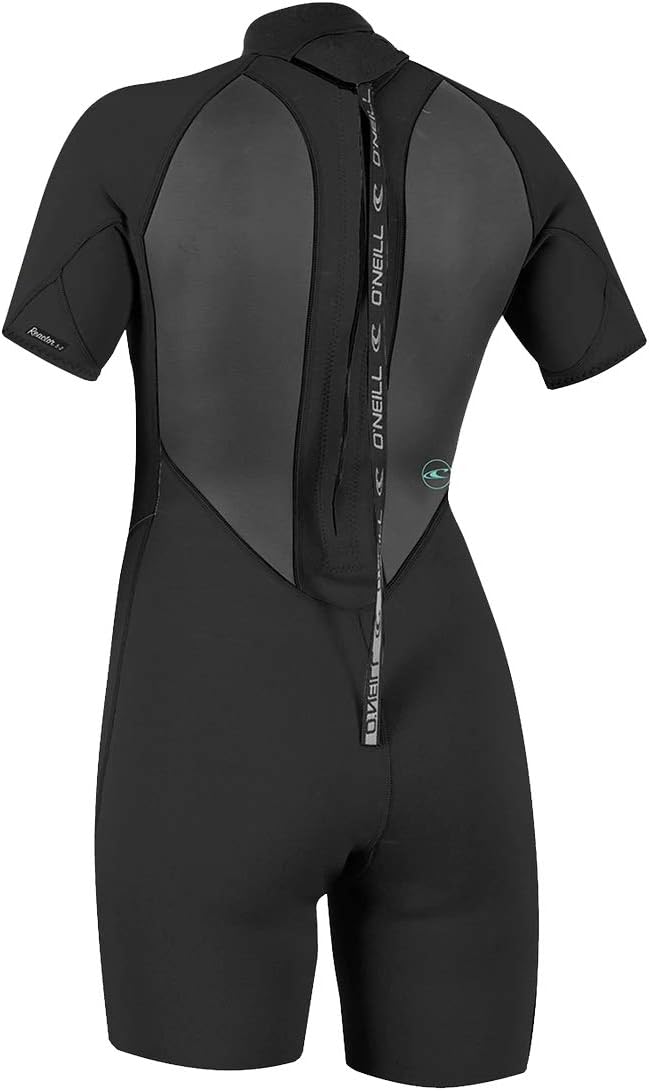
Budget entry point ($): The O’Neill Reactor II Women’s 3/2 (around $109–$139) uses flatlock seams, so it’s genuinely a summer-only suit above 65°F, but the women’s panel cut is honest and the sizing runs accurately. It’s a defensible choice for Florida surfers or as a warm-month back-up suit.
Zip Type: The Decision Nobody Explains Clearly
You’ll see three zip configurations. Each has a real tradeoff.
Back zip — The zipper runs vertically up the back, from the lower lumbar to the neck. Easy to get in and out of alone. The zipper creates a structural seam across the back, which can restrict shoulder rotation slightly and is the most common flushing point (water entry) in cold conditions. Dominant at the entry and mid-tier price points.
Chest zip — The zipper sits across the chest horizontally. Better lower-back seal, dramatically less flushing. Slightly harder to get into alone — you need to work your shoulders through a narrower neck opening. Standard in premium suits. If you surf in water below 60°F with any regularity, the chest zip is worth the extra step.
Zip-free / zipperless — No zipper. The suit stretches enough to pull over your body. The best seal of all three. Requires the most stretchy, premium neoprene to work properly. Only makes sense at the $$$ tier where the material quality supports it. Rip Curl’s Flashbomb series uses this system well.
The If-X-Then-Y Decision Matrix
You’re buying a wetsuit for Atlantic surf. Here’s how to route yourself:
If you surf primarily in Florida or the Southeast Atlantic in spring through fall (water above 68°F): A women’s-specific 2mm shorty or a 3/2 flatlock with honest women’s panel geometry is all you need. Don’t overspend on sealed seams you’ll never use. Budget: $. Look at the O’Neill Reactor II women’s line.
If you surf the Mid-Atlantic (NJ to Outer Banks) and want a single do-everything suit: A women’s-specific 4/3 with blindstitched or taped seams and a chest zip is the correct answer. It covers you from April through November. Budget: $$. The Rip Curl Flashbomb Women’s 4/3 is the benchmark recommendation in this bracket based on owner-reported fit and mobility.
If you surf New England or Maritime Canada with any consistency, or if cold water affects your performance noticeably: A women’s-specific 4/3 with fully taped seams, chest or zip-free entry, and eco-material construction. This is a multi-season investment and the per-session economics justify the spend. Budget: $$$. The Patagonia R2 Yulex Women’s 3/2 covers warmer months; pair it with the R3 4/3 for the shoulder season.
If you run a surf school or junior development program and are buying in volume: Prioritize consistent women’s sizing across the quiver over premium neoprene. O’Neill’s women’s Reactor and Bahia lines offer predictable sizing charts, durable construction, and volume pricing through specialty dealers. Cleanline Surf and similar specialty retailers have historically worked with programs on volume orders — call before you click.
One last thing: if you’ve been surfing in a men’s suit and your pop-up has always felt like a fight, try a properly fitted women’s-specific suit before you blame your technique. The difference, per owners making that switch across reviews collected by Surfer Magazine, is often described as immediate and significant. The suit should feel like it disappears. If it doesn’t, the suit is wrong — not you.